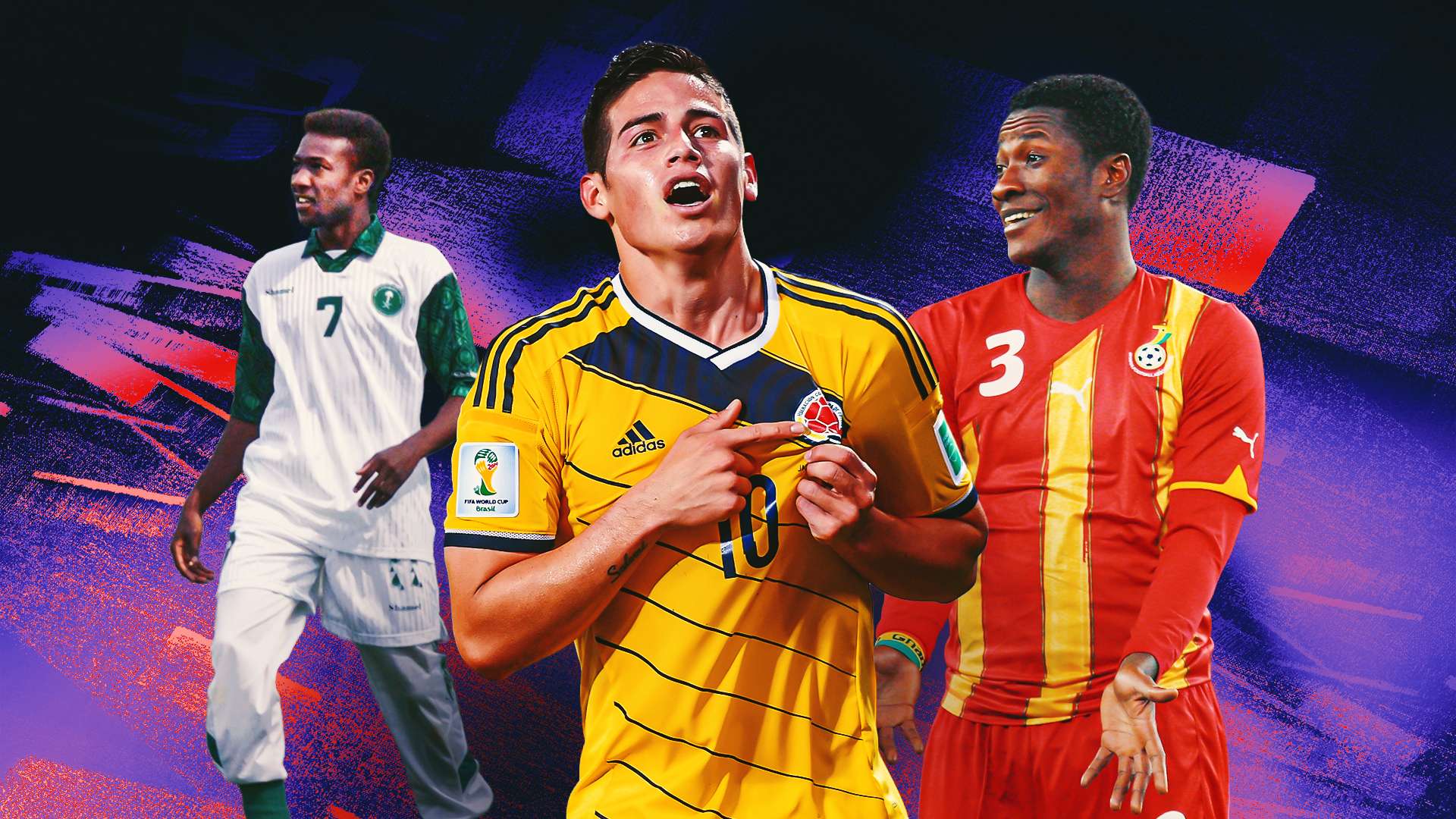
The FIFA World Cup has long served as the grandest stage for footballers to dazzle the world — sometimes only for a brief, shining moment. Here’s a look back at some of the tournament’s most iconic one-hit wonders.
There’s a popular meme that goes something like this: “Men just love sitting around naming athletes.” As humorous as it sounds, there’s an element of truth to it. Every sports enthusiast has found themselves in a friendly debate, trying to recall the most obscure player names, hoping to earn nods of recognition from fellow fans.
Names like Papiss Cissé or Julio Olarticoechea often come up — reminders of players who once captured the world’s imagination. The World Cup has a way of producing such fleeting heroes — players who burn bright and fade fast. And it’s these stories that give the tournament its unique allure. Let’s revisit some of those unforgettable figures who shone once and never quite reached those heights again.
Asamoah Gyan, Ghana
In the 2010 World Cup, Ghana scored four goals — and Asamoah Gyan netted three of them. The Black Stars were the surprise package of the tournament: disciplined, attacking with flair, and instantly likable. Gyan, then playing for Rennes in Ligue 1, was known but not yet a household name.
That changed in South Africa. His extra-time winner against the United States in the Round of 16 became a defining moment. Yet, his story ended in heartbreak — with a missed penalty against Uruguay in the quarterfinals that denied Ghana a historic semifinal berth. Despite that, Gyan remains one of the enduring figures of the 2010 World Cup.
James Rodríguez, Colombia
Few moments in modern World Cup history are as vividly remembered as James Rodríguez’s volley for Colombia in 2014. It was a goal of breathtaking skill — a chest control, a quick setup, and a stunning strike from the edge of the box. In slow motion, his awareness, balance, and technique appear almost otherworldly.
Rodríguez wasn’t just about that one goal. He finished the tournament as the top scorer with six goals, earning the Golden Boot. His performances led Real Madrid to sign him for a hefty fee. However, his magic faded at the Santiago Bernabéu, where a team already boasting Cristiano Ronaldo, Gareth Bale, and Karim Benzema had little room for a free-spirited No.10. After stints at various clubs, Rodríguez has struggled to find the same spark that lit up Brazil 2014.
Sofyan Amrabat, Morocco
One moment summed up Sofyan Amrabat’s 2022 World Cup — a lung-busting chase and a perfectly timed slide tackle on Kylian Mbappé in the semifinal against France. The Moroccan midfielder, virtually unknown before the tournament, became a symbol of his nation’s resilience and tactical tenacity.
Amrabat’s tireless performances helped Morocco become the first African side to reach a World Cup semifinal. But post-tournament, his star dimmed quickly. His move to Manchester United never fully clicked, and his time at Real Betis saw him reduced to a rotation player. Nevertheless, his 2022 campaign remains one of the standout breakthrough stories in recent memory.
Siphiwe Tshabalala, South Africa
When Siphiwe Tshabalala opened the scoring for South Africa against Mexico at the 2010 World Cup, the entire nation erupted in joy. His electrifying run and thunderous top-corner finish were accompanied by a jubilant celebration that became the symbol of that tournament’s spirit.
Although South Africa couldn’t progress beyond the group stage, Tshabalala’s goal — later nominated for the Puskás Award — remains one of the most iconic moments in World Cup history. He went on to enjoy a respectable club career in South Africa and Turkey, but that unforgettable strike defined his international legacy.
El Hadji Diouf, Senegal
When Liverpool signed El Hadji Diouf before the 2002 World Cup, they believed they were securing one of Africa’s brightest attacking talents. At just 21, Diouf’s blistering pace and flair lit up the tournament in South Korea and Japan. His performances earned him a place in the World Cup’s Best XI as Senegal reached the quarterfinals in their debut appearance.
However, Diouf’s career trajectory soon declined. He struggled to adapt at Liverpool and bounced around several clubs afterward. His best scoring season came in 2004 with Bolton Wanderers, where he netted nine goals — a far cry from the promise he once showed on the global stage.
Saeed Al-Owairan, Saudi Arabia
Few goals in World Cup history have been as dazzling as Saeed Al-Owairan’s solo effort for Saudi Arabia. He dribbled past defenders from his own half before finishing with clinical precision — a goal that remains etched in football folklore.
Despite that moment of genius, Al-Owairan’s career stayed largely confined to the domestic league, representing Al Shabab in the Saudi Pro League. At the time, Saudi regulations prevented players from moving abroad. He scored 14 goals in official matches for his national team, with that World Cup wonder being his 13th. While regarded as one of Asia’s finest footballers, the world only caught a glimpse of his brilliance — on that one unforgettable day.