As the next World Cup draws near, memories resurface of the last time the tournament was held in the United States. For German football fans, those recollections are far from pleasant.
Throughout the years, the German national team's training bases have often mirrored their fortunes in major tournaments. The legendary "Spirit of Spiez" inspired the DFB squad to their first triumph in 1954, while the relaxed atmosphere of Campo Bahia in 2014 helped them secure a fourth star on Brazilian soil. In stark contrast, the remote Soviet-era sanatorium in Watutinki, Russia (2018), and the secluded Zulal Wellness Resort in Qatar (2022) seemed to have the opposite impact.
This time, the DFB contingent has chosen The Graylyn Estate in Winston-Salem, North Carolina, as their base—a location roughly halfway between New York and Miami, or, as some would joke, in the middle of nowhere. Visually, however, the property impresses; its design resembles that of a medieval castle.
Television presenter Laura Wontorra visited the estate ahead of time for a documentary and came away unimpressed. “I’d put a question mark behind that. It’s an interesting choice of accommodation,” she commented later at a Magenta media event. “I think you can train well and stay focused there, but there’s absolutely nothing happening around it.”
During the 1994 World Cup, the German delegation was stationed just outside Chicago.
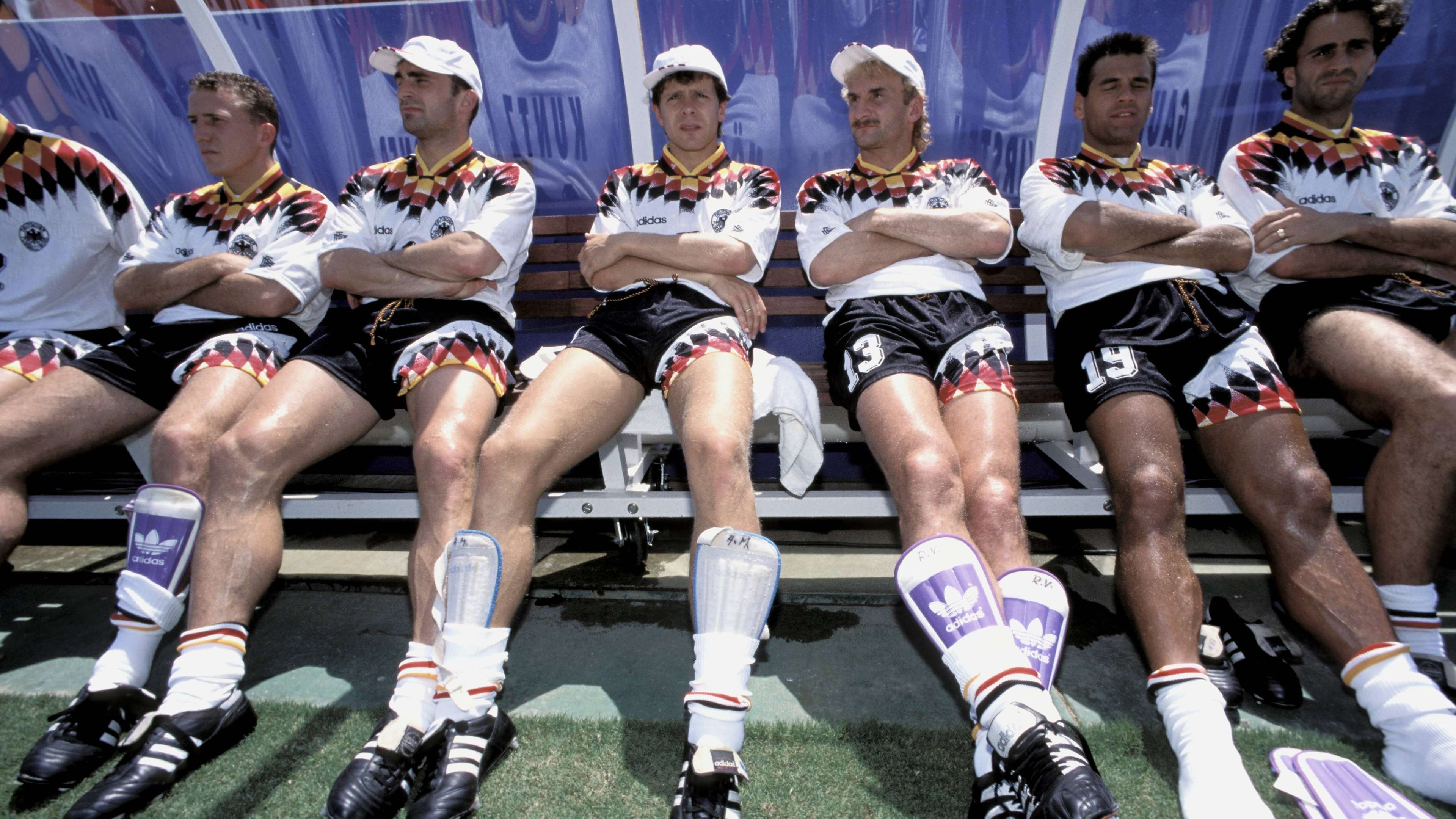
This year’s base differs drastically from the DFB’s setup during the 1994 World Cup in the United States—the only edition hosted there so far—a tournament remembered as one of the lowest points in German football. That campaign was overshadowed by Stefan Effenberg’s infamous gesture and a shocking quarter-final defeat to Bulgaria. The team’s headquarters at the time was the Golfhotel Oak Brook near Chicago.
National coach Berti Vogts was already under tremendous scrutiny before the competition began, largely due to expectations set by his predecessor, Franz Beckenbauer. After leading Germany to the 1990 World Cup title and successfully integrating players from East Germany, Beckenbauer boldly proclaimed that the team would be “unbeatable for years to come.” The disappointment of Euro 1992, where Germany lost the final to Denmark—a team that had only qualified at the last moment—only intensified the pressure to defend the world title.
Germany kicked off their 1994 campaign at Soldier Field in Chicago, just a short distance from their hotel. Although no matches will be played there during the upcoming World Cup, Chicago remains on Germany’s itinerary—perhaps for sentimental reasons. The current squad recently flew to Chicago for a training camp and will face hosts USA in a final friendly at Soldier Field on Saturday. In 1994, Germany started with a 1–0 victory over Bolivia at the same venue.
Lothar Matthäus: “I don’t care what a player’s wife says.”
Aside from the opening win, there was little joy at the Oak Brook Golf Hotel. The oppressive heat and internal friction among players created a tense atmosphere as Vogts struggled to maintain discipline. Central to the discord were the players’ wives and their perceived privileges.
In a later column for Die Zeit titled “It was always about the players’ wives,” Andreas Möller recalled, “There were many conflicts within the team. The atmosphere was bad. Nothing like the 1990 World Cup, where everything just fell into place.” He explained that in 1994, “some players wanted their wives to be involved in everything. We were wasting time on trivial matters back then.”
The tension began even before the tournament. Stefan Effenberg wanted his family to attend the welcome reception, a suggestion that other players opposed. Soon after, Bodo Illgner’s wife, Bianca, publicly demanded free accommodation and meals at the team hotel, prompting Thomas Helmer to retort, “Bodo is number one, not his wife. She needs to accept that once and for all.” Team captain Lothar Matthäus was equally blunt: “I don’t care what a player’s wife says.”
Eventually, the players’ families were accommodated separately at the nearby Drake Hotel, though Lolita Matthäus—Lothar’s wife—occasionally ignored the rule. Today, the issue of players’ partners staying with the team is no longer contentious. However, national coach Julian Nagelsmann plans to allow family visits on the days following matches at the upcoming World Cup.
Effenberg’s exit was followed by a golf tournament controversy.
In 1994, Germany’s second group-stage match against Spain ended in a 1–1 draw, and a subsequent 3–2 victory over South Korea ensured they topped the group. The Dallas match, played in nearly 40-degree heat, was remembered as frustrating for reasons beyond the weather—it was marred by Stefan Effenberg’s infamous moment of indiscipline.
After a subpar performance, Vogts substituted Effenberg midway through the second half. As he left the pitch, sections of the German crowd jeered him, and, according to witnesses, he responded with a middle-finger gesture. No photographic or video proof ever surfaced, but the damage was done. Despite support from senior teammates such as Rudi Völler, Jürgen Klinsmann, Lothar Matthäus, and Bodo Illgner, Vogts and DFB President Egidius Braun decided to expel Effenberg from the squad.
Effenberg remained in the United States with his family following his dismissal. Meanwhile, the atmosphere at the Oak Brook hotel remained unsettled. On the eve of Germany’s round-of-16 clash with Belgium, a massive golf tournament involving about a thousand participants took place on the same premises, each with their own entourage. Despite the disruption, Germany managed to overcome Belgium but were unexpectedly knocked out by Bulgaria in the quarter-finals, bringing a chaotic campaign to an abrupt end.