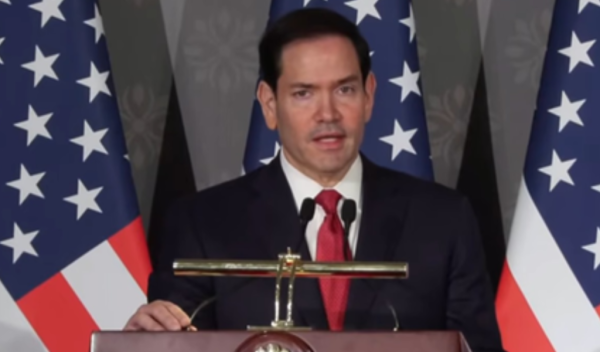
U.S. Secretary of State Marco Rubio told the Senate Foreign Relations Committee that Iran has agreed to negotiate aspects of its nuclear programme previously off-limits, following recent U.S. military action. He said the U.S. blockade on Iranian shipping is costing Tehran hundreds of millions daily.
Published Date – 2 June 2026, 11:55 PM
Washington: U.S. Secretary of State Marco Rubio said Tuesday that Iran has agreed to discuss parts of its nuclear programme that it had previously refused to negotiate, raising the prospect of new talks after recent U.S. military action against Tehran.
Testifying before the Senate Foreign Relations Committee, Rubio said Iran’s military capabilities had been significantly weakened and that Tehran was now willing to engage on issues it had long kept off the table.
“There is the prospect before us, which could happen today, it could happen tomorrow, it could happen next week, that, for the first time certainly in my memory, they have agreed to negotiate aspects of their nuclear programme that just a month ago, just a year ago, they were refusing to even mention, much less enter into discussions about,” Rubio said.
Rubio appeared before lawmakers to defend President Donald Trump’s proposed State Department budget. Much of the hearing focused on Iran, the Strait of Hormuz, and the administration’s broader foreign policy agenda.
The secretary defended recent U.S. military operations against Iran, saying they had sharply reduced Tehran’s ability to shield its nuclear programme behind conventional military power.
“Iran’s desire to build a nuclear weapon was going to be effectuated behind a conventional shield,” Rubio said.
He said “Operation Epic Fury” had achieved its objectives by damaging Iran’s missile production capabilities and military infrastructure.
“Operation Epic Fury … was highly successful in achieving its military objectives,” Rubio said.
Rubio argued that Iran had sought to build a vast arsenal of missiles, drones, and naval assets that would deter any outside action against its nuclear programme.
“The president chose to act to deny them that point of immunity,” he said.
The secretary delivered one of the administration’s strongest assessments yet of the damage inflicted on Iran’s military.
“Today, there is no Iranian navy. There is no such thing,” Rubio said. “There is no Iranian navy. It lies at the bottom of the ocean.”
Committee Chairman Jim Risch praised the administration’s approach towards Iran and thanked Rubio for his role in the operation.
Rubio said a ceasefire had been reached after the military campaign but accused Tehran of failing to fulfil a commitment to reopen the Strait of Hormuz.
“They would reopen the straits. They did not,” he said.
The United States responded by imposing, as Rubio described, an effective blockade on Iranian shipping.
“The cost to Iran every single day in lost revenue is in the hundreds of millions of dollars,” he said.
The Opposition Democratic Senators challenged the administration’s handling of the crisis. Senator Jeanne Shaheen said the State Department has failed to adequately consult Congress on decisions involving Iran and questioned the broader impact of the conflict.
Rubio acknowledged that negotiations with Tehran remained difficult and often relied on intermediaries.
“That is not a guarantee that ultimately it will lead to a deal that’s acceptable to the Senate or acceptable to the American people,” Rubio said. “But we will be able to engage them in a process to truly test the proposition of how far they’re willing to go.”