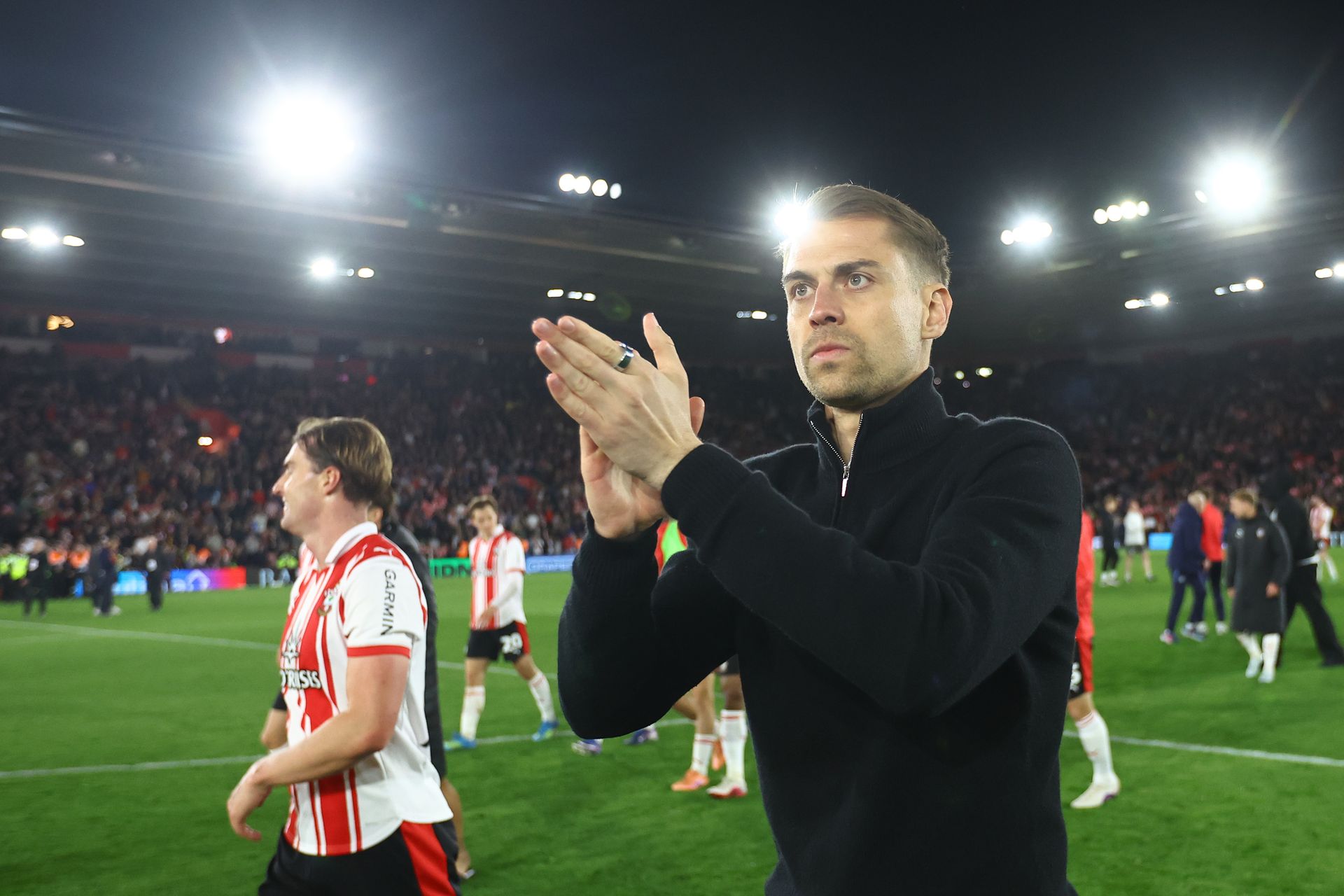
On Tuesday, Southampton shared a video across their social media platforms featuring head coach Tonda Eckert apologising for the recent Spygate controversy.
Despite remaining unbeaten throughout the 2025/26 play-offs, Southampton will play Championship football again next season.
The primary responsibility for this situation lies with first-team head coach Tonda Eckert. To his credit, he has faced the criticism directed at him in recent weeks head-on.
The Saints were removed from the Championship play-off final against Hull City and replaced by Middlesbrough—who had lost in the semi-final—after an independent commission ruled that Southampton were guilty of spying on Boro’s training sessions in the 72 hours before their first-leg clash.
Since 2018, English Football League (EFL) clubs have been prohibited from observing opponents’ training in the three days prior to a match.
Even before the original 2018 Spygate incident involving Leeds United and Derby County, which led to changes in EFL regulations, it was already expected that clubs would act in good faith towards one another—this principle is clearly stated in EFL rules.
Since taking charge at Southampton, Eckert is reported to have overseen a series of spying operations on upcoming opponents, with the club admitting to being involved in at least two other instances of similar conduct.
This week, Eckert released an eight-minute video message, directed primarily at the club’s supporters but evidently intended for a wider audience, apologising for the actions that saw Southampton handed an unprecedented play-off disqualification.
Maintaining direct eye contact with the camera, almost as if analysing a Middlesbrough training session recorded on a phone, Eckert took responsibility for the scandal that cost Southampton their shot at promotion back to the Premier League.
At first glance, the video appeared to be a typical celebrity apology. Familiar phrases rolled out—“I’ve let you down,” “I take full responsibility,” and so on. Yet, midway through, the tone shifted noticeably.
Suddenly, Eckert began explaining his actions. The tone became defensive rather than remorseful, leaving many neutral observers unconvinced about the authenticity of his apology.
Usually, a genuine apology involves accepting fault, offering restitution, and avoiding explanations that sound like justifications. Eckert’s approach, however, leaned towards clarification rather than contrition.
“When I worked in Italy for over four years, our starting lineups would always leak before matches,” Eckert said. “That’s because our training sessions, especially the ones before games, were often observed by media and opposing teams.”
He continued, “Pep Guardiola has also mentioned that during his time at Bayern Munich, it was common practice in Germany for teams to observe each other’s training sessions. I’m not saying this to excuse what we did, but to give context about the football culture I grew up in.”
“There are different rules in England, different regulations from the EFL, and I should have known them,” he admitted. “The bitter irony is that none of what happened had any impact on sporting performance. I don’t want to use that as an excuse. I made a mistake, and I take full responsibility.”
Though Eckert accepted the punishment, his tone suggested a lingering sense of justification. He had broken the rules and was sanctioned for it. Some might argue Southampton’s punishment was harsh, but as the club’s representative, Eckert bears accountability for the actions carried out under his leadership.
However, Eckert appears to have escaped further consequences. The German coach remains in charge and seems to have fostered a siege mentality at St. Mary’s Stadium—judging by the support he continues to receive from fans online.
Many supporters feel they were the ones most unfairly affected, not Eckert, not Taylor Harwood-Bellis—whose “spying” celebration in the semi-final second leg added unwanted attention—and not the club executives in the director’s box.
Nevertheless, Eckert retains the backing of fans. He guided Southampton to a strong run of form that secured their play-off place in the first place. In football, winning often overshadows controversy. While it’s unclear how much the spying actually helped, even marginal gains can matter in such a tight, low-scoring sport.
Still, the question remains—has Eckert truly taken responsibility? Was his apology sincere, or simply strategic?
Football clubs stand as pillars of their communities, ideally led by ethical figures who uphold the rules. While this doesn’t mean Eckert lacks integrity, in this instance, he was clearly in the wrong.
By referencing his experiences in Italy and Germany, invoking Guardiola’s name, and lamenting the “bitter irony” of the situation, Eckert’s apology began to sound more like justification than remorse. Genuine apologies don’t need context—they simply need sincerity.
If spying supposedly offered no advantage, why do it? If the EFL rules were unclear, why not verify them? And if Southampton truly didn’t know they were wrong, why did the analyst flee when caught—complete with a change of clothes? Perhaps because Rockliffe doubles as a golf course, and he came prepared for a different kind of round.
When an apology requires lengthy explanation, it ceases to be an apology—it becomes an excuse. And when such explanations come from positions of authority, they rarely serve the interests of those most affected.
Moreover, there has been no public apology to intern Will Salt, who was allegedly instructed to carry out the spying and whose face ended up on the front pages of national newspapers. Leaked messages suggest that interns and junior analysts felt pressured into involvement.
“I didn’t really have an option and wasn’t given a chance to say no. I was an intern and was just following orders,” one junior analyst reportedly told colleagues.
There remains much about this saga that doesn’t sit right—and perhaps never will.