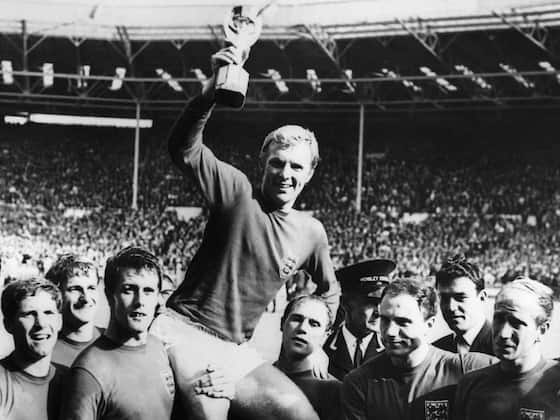
On the day Thomas Tuchel unveiled his World Cup squad at Wembley, a curious moment occurred as he passed by a photograph of Bobby Moore proudly holding the Jules Rimet Trophy. Although the England manager was discussing his ambitions for winning the tournament, there was no particular mention or nod to the historic image beside him.
That, perhaps, is unsurprising. At Wembley, reminders of 1966 are everywhere—woven into the very fabric of the stadium. The achievement remains omnipresent, always hovering in the background, though it is no longer referenced as frequently as before.
The iconic images of Geoff Hurst driving home England’s fourth goal or Nobby Stiles dancing with joy are no longer as dominant in the national football consciousness. Even television intros have moved away from the once-familiar phrase, ‘They Think It’s All Over.’
England captain Bobby Moore lifting the Jules Rimet Trophy after the 4-2 victory over West Germany in 1966 remains one of the most celebrated moments in English sport. Yet, when Tuchel was asked about what 1966 meant to him upon taking the job, the question seemed even more pertinent for the nation he now represents.
England’s only World Cup triumph has cast a long shadow over every tournament since. This summer, as the 60th anniversary approaches, the sense of resonance feels even stronger. If ever there was a time to replicate that achievement, it is now. But one wonders—does 1966 still hold the same relevance?
The 4-2 win over West Germany is now chronologically closer to the Titanic’s sinking than to the 2026 World Cup. The wait for another victory seems heavier than the weight of that long-lost trophy itself. In many ways, the passage of time has only added to its mythic aura.
It’s not just the number of years that have passed, or how they’ve been immortalised in song. We now stand thirty years removed from the release of ‘Three Lions,’ which first commemorated “thirty years of hurt.”
The year 1966 also carried symbolic weight—it marked exactly nine centuries after the Norman Conquest of 1066, one of the most famous dates in English history. Its significance as a historical landmark is reinforced by its uniqueness. That World Cup remains England’s sole major trophy in men’s football, the only great triumph for the men’s team to look back upon.
Indeed, England are the only men’s World Cup winners never to have secured another major title. No other nation that has won a World Cup or European Championship has endured such a prolonged drought, apart from the now-defunct USSR.
As a result, the 1966 World Cup occupies a complex place in the English psyche—it is at once a dream, a burden, a source of pride, and a haunting memory. It represents both a distant past and an ever-present ideal.
Like the Second World War, the memory of 1966 is fading as those who experienced it firsthand become fewer. Geoff Hurst, immortalised by his final hat-trick, is the only surviving member of that starting eleven. The passage of time has also brought tragedy, as many players from that squad later suffered from dementia—now increasingly recognised as a consequence of repeated head impacts, and a reminder of how football once failed its heroes.
As with many historic events that you grow up simply “knowing,” it’s easy to imagine it was always destined to happen. But speaking with someone who was there, like 79-year-old Arthur Devereux, reveals the wonder of that day. “It was an absolutely magical feeling,” he recalls. “We weren’t sure how it would go, but it was thrilling just to see England in a World Cup final.”
Duncan Hamilton’s acclaimed book ‘Answered Prayers’ provides essential context. Post-war Britain was still clearing rubble in some cities, and the war’s presence lingered across culture—on television, in cinemas, and in literature. As Hamilton notes, the war was “ever-present, shadowing nearly everything, even when no one spoke about it.”
Devereux admits he was too young to think about that, and manager Alf Ramsey never invoked wartime sentiments in his pre-match talk against West Germany. The world was simpler then. Devereux recalls receiving a full set of tickets for all matches as a gift from his brother—something almost unimaginable today.
Reading Hamilton’s work alongside Michael Calvin’s ‘1966: A Moment in Time’ underscores how distant that era feels. Gordon Banks once said the tournament reflected “the simplicity of how football used to be.” Indeed, it was a different world—both on and off the pitch.
Bobby Charlton’s tactical advice included not placing his shots too precisely: “If you don’t know where it’s going, how can the goalkeeper?” The players were budding stars, yet still lived like ordinary men. Their earnings from victory were lower than what some street vendors made outside Wembley. Franz Beckenbauer dined with a local English family, and Pele was often spotted playing casually in local parks in Cheshire.
England’s players were even allowed a pint when manager Ramsey approved. The culture of watching football in pubs began in that very year, as landlords realised they needed televisions to keep patrons from staying home during matches.
Celebrations were modest—no open-top buses or extravagant parades. The contrasts with today are stark. The players’ wives and partners were excluded from the victory banquet, and the entire squad was white, reflecting the racial tensions of 1960s Britain.
There are faint echoes of the present, even if they are emotional rather than direct. Ramsey’s handling of Jimmy Greaves, for instance, parallels modern selection debates—he once described trying to “accommodate” Greaves, much as some discuss Jordan Henderson today. Bobby Charlton, once viewed as an “individualist,” matured into a complete player just before the tournament, while Jimmy Armfield was valued for his “knowledge and nous.”
Devereux recalls that the atmosphere walking to Wembley was one of excitement rather than expectation. England had only begun competing in the World Cup in 1950, and there was no weight of history yet. That would change after 1966. The triumph set a standard to aspire to and altered the national team’s psychology forever.
At first, even the players didn’t grasp the magnitude of becoming world champions. It wasn’t the same outward confidence that Iker Casillas displayed after Spain’s 2010 win. Many of Ramsey’s men described feeling “numb” in the moment of victory—perhaps explaining the enduring debate over whether Hurst’s second goal actually crossed the line.
Although some players later benefited commercially from their fame, Hamilton noted that by the mid-1970s, “England’s triumph already seemed a little dated.” Bobby Moore, the symbol of that victory, never again enjoyed such glory. Devereux believes things might have been different had England followed up with another win in 1970. A repeat might have turned 1966 from an isolated memory into the start of a legacy like those of Brazil or Germany.
Thomas Concannon of the Football Supporters Association reflects: “I see it as a remarkable moment. We’ve all watched the highlights, and I wish I could have witnessed it live. It feels so long ago—the game, the trophy, everything has changed so much that it’s hard to feel directly connected.”
Its endurance now lies in faded photographs, like those used to commemorate the Queen’s Platinum Jubilee. Yet it remains—a feeling waiting to be rekindled, an image ready to be relived.
Devereux remembers staying in his seat to watch the Queen present the trophy to Moore, though he wasn’t among those who rushed the pitch after Hurst’s famous fourth goal. And, echoing Kenneth Wolstenholme’s immortal commentary, the nation will perhaps never be entirely “over it.”
What England needs now is not to move on—but to find a new moment that can stand proudly beside it.