Japan’s emotions ran high after their heartbreaking exit from the 2022 World Cup in Qatar, where the Samurai Blue fell short of a historic quarter-final appearance after losing to Croatia in a penalty shootout.
At that tournament, forward Takefusa Kubo was the youngest player in Hajime Moriyasu’s squad, just 21 years old at the time.
Four years later, Kubo is no longer the youngest in the team. That title now belongs to 21-year-old Kento Shiogai, who joins the squad for the 2026 World Cup.
Over those four years, Japan has undergone a remarkable transformation, improving both individually and collectively, with players gaining valuable international experience.
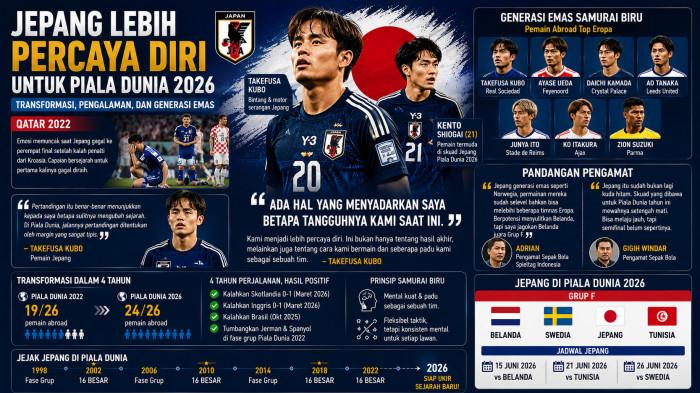
Since their first World Cup appearance in 1998, Japan has consistently shown progress in each edition, with their best results being appearances in the Round of 16.
Heading into the 2026 World Cup, the team feels more confident than ever, drawing on their journey and experience to aim for a new chapter in their football history.
“There was a moment when I realized how strong we have become,” Kubo told FIFA in an interview on Friday (5 June 2026).
“It was around our fourth or fifth match in the Asian qualifiers. We were ahead by six points, and that made me realize just how resilient we are as a team.”
“I feel that we’ve become more confident. It’s not only about the results but also about how we play and how cohesive we’ve become as a unit,” he added.
In the World Cup, every detail matters. Teams that lose focus, even for a moment, can be punished by their opponents.
Kubo experienced that firsthand when Japan was defeated by Croatia — a team that went on to finish third in Qatar.
That loss extended Japan’s streak of Round of 16 exits, repeating the pattern from 2002, 2010, 2018, and 2022.
“That match really showed me how difficult it is to change history,” Kubo admitted.
“Whether it was our intensity during the game or the small details we failed to execute properly, we realized there was something missing.”
“At the World Cup, matches are decided by the finest of margins. I think it’s crucial to handle every aspect of the game with extreme care,” he emphasized.
In recent years, Japanese players have developed rapidly, a fact reflected in the number of overseas-based players in the 26-man squad for this World Cup.
In 2022, 19 of the 26 players were based abroad. For 2026, only three players come from the domestic league, meaning 24 players are currently playing overseas, mainly across Europe.
This, combined with a series of positive results over the past four years, has given Kubo and his teammates even greater confidence.
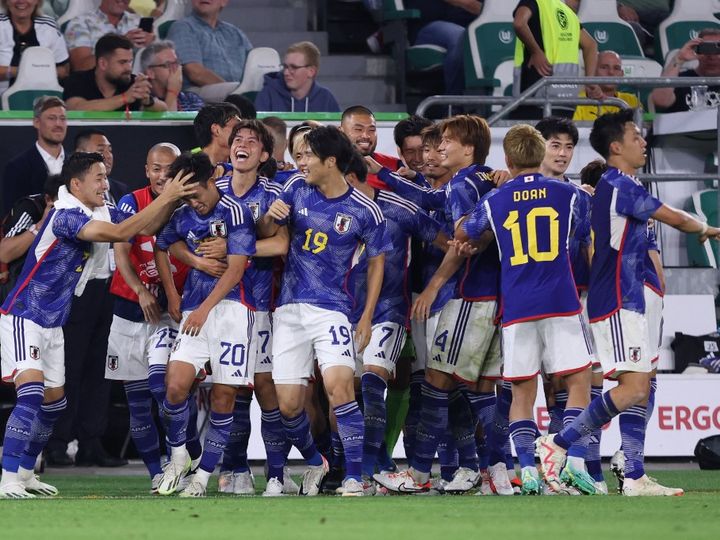
Most recently, during the March FIFA Matchday, Japan earned hard-fought away victories over Scotland and England, both by identical 0-1 scorelines.
“We adapt our tactical approach depending on our opponents, but mentally we approach every match the same way,” Kubo explained.
“Of course, we respect our opponents, but we truly believe we have what it takes to win,” he asserted.
Football analyst Adrian from Spieltag Indonesia, during a podcast with Tribunnews on Sunday (31 May), compared Japan’s current squad to Norway’s golden generation.
He described Japan as a team blessed with a generation of exceptionally talented players.
Besides Kubo, the squad features Ayase Ueda (Feyenoord), the top scorer in the Dutch League, Daichi Kamada (Crystal Palace), Ao Tanaka (Leeds), Junya Ito (Stade de Reims), Ko Itakura (Ajax), and Zion Suzuki (Parma).
According to Adrian, Japan is one of the teams capable of springing surprises at this tournament.
Drawn into Group F alongside the Netherlands, Sweden, and Tunisia, Adrian still predicts the Netherlands will likely top the group.
“Japan has been impressive in the last two World Cups. This generation, like Norway’s, is a golden one, and with Hajime Moriyasu’s leadership and experience in major tournaments, their style of play is already on par with, or perhaps even better than, some European national teams,” he said.
“This group is stacked — the Netherlands as the traditional powerhouse, Japan and Sweden as dark horses. It’s going to be a tough group, but I still think the Netherlands will top Group F,” Adrian concluded.
Meanwhile, football analyst Gigih Windar from Semarang holds a different view, arguing that Japan should no longer be considered a dark horse.
He pointed out that Japan defeated Brazil in October 2025 and previously overcame both Germany and Spain to top their group at the 2022 World Cup — a result that eliminated Germany from the group stage for the second consecutive time after their 2018 exit to South Korea.
“Japan is no longer a dark horse. Calling them that is outdated,” Gigih told Tribunnews on Wednesday (4 May 2026).
“If you look at the squad they’re bringing to this World Cup, it’s incredibly strong,” he added, before detailing the list of Japanese players currently playing in Europe.
According to Gigih, Japan has the potential to go further than ever before, though reaching the semi-finals might still be a challenge given the competition’s intensity.
“Japan can be considered a strong contender, but reaching the semi-finals might still be a bit too soon. The quarter-finals seem more realistic,” he said.
In the 2026 World Cup, Japan will begin their Group F campaign against the Netherlands on 15 June, followed by Tunisia on 21 June, and will conclude the group stage with a decisive match against Sweden on 26 June.
(Tribunnews.com/Sina)