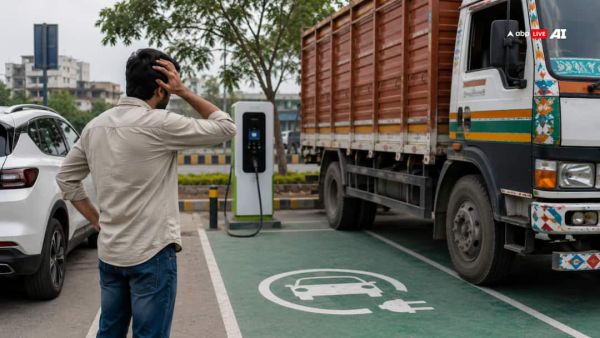
Scroll through Instagram reels, and you will almost certainly come across comments lamenting the lack of civic sense in India. That same problem is visible in the way many people treat EV charging stations. Charging stations are often occupied by vehicles that have no intention of charging.
Charging spots remain poorly maintained, hidden away in corners of highway plazas, and treated as an afterthought even in residential projects where apartments cost upwards of Rs 2 crore.
If India wants electric vehicles to become mainstream, building chargers alone will not be enough. EV adoption also depends on confidence. Drivers need to know that charging will be convenient, accessible and reliable. That requires a change in everyday habits and attitudes.
Unless your vehicle can actually use a charging point, that charging spot is not meant for you. Parking a petrol or diesel vehicle in an EV charging space is known as "ICE-ing", short for Internal Combustion Engine. It is one of the most common frustrations faced by EV owners worldwide.
In countries with high EV adoption, such as Norway, Germany and the Netherlands, charging bays are often treated similarly to disabled parking spaces. Blocking them can prevent EV drivers from completing their journeys. As a result, authorities impose hefty fines and, in some cases, even tow away offending vehicles.
India does not yet have a uniform nationwide law that penalises petrol or diesel vehicles for occupying EV charging points. Enforcement largely depends on residential societies, municipal authorities and local parking regulations.
Maharashtra has taken one of the strongest steps in this direction. The state prohibits non-EVs from parking in designated EV charging areas within housing societies, malls and similar facilities. Violators can be penalised under applicable parking rules enforced by the property or local authority. As EV adoption rises, more states may need to consider similar measures.
Charging etiquette is not only about non-EV drivers. EV owners themselves play a major role in ensuring charging infrastructure remains accessible.
In many residential complexes, it is common for owners to leave their vehicles plugged in overnight. While convenient, this can prevent others from accessing the charger during early morning hours. A charging station should not become a reserved parking space.
Similarly, not every charging session needs to end at 100%. In many situations, 80% is sufficient. The final portion of charging typically takes longer and can unnecessarily occupy a charger that another driver may urgently need.
Drivers should also handle charging equipment carefully. Leaving charging connectors on the ground after unplugging increases the risk of damage. Charging plugs and sockets are delicate components, and replacing them can be costly.
Where multiple chargers are available, choose one that matches your vehicle's charging capability. If your car can accept 100 kW and both 100 kW and 250 kW chargers are available, use the lower-capacity charger and leave the faster unit available for vehicles that can fully utilise it.
One of the most important rules of charging etiquette is simple: never unplug someone else's vehicle without permission.
Most charging connectors remain locked until the charging session is complete. Attempting to forcibly remove a connector can damage both the vehicle and the charging station.
If a charger is occupied, wait for the owner to return or intervene only if the owner has explicitly permitted it.
Good behaviour alone cannot solve every problem. Many charging locations still lack basic support services such as clean washrooms, food options, weather protection, windshield cleaning facilities and waste disposal points.
Another common complaint among EV owners is arriving at a charger that appears available on an app but is blocked by a parked vehicle or is otherwise unusable.
Improving the charging experience requires both better infrastructure and better behaviour.
EV charging is still relatively new in India, and everyone is learning as the ecosystem evolves.
Disputes over charging access can quickly escalate, especially in high-demand locations. Patience and courtesy go a long way. Whether it is helping another driver understand a charging process or simply vacating a charger once your session is complete, small actions can make a meaningful difference.
The future of electric mobility will not depend only on batteries, charging speeds or government incentives. It will also depend on whether Indians treat charging infrastructure as a shared public resource rather than personal property.