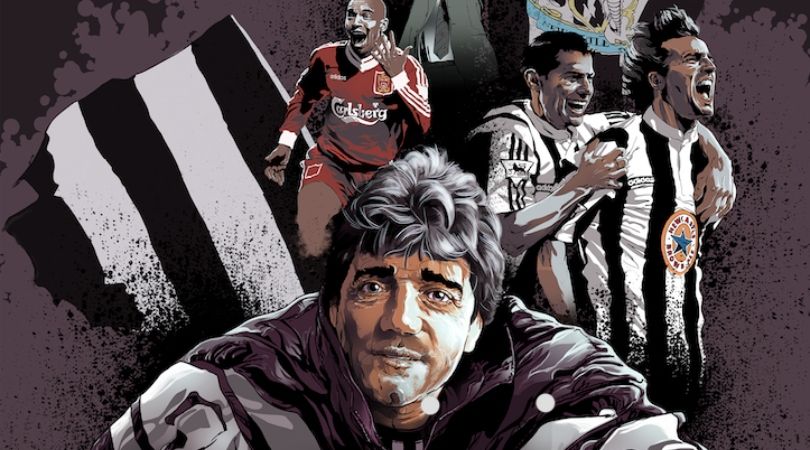
Three decades after Kevin Keegan’s unforgettable “love it” outburst, the former Newcastle United manager revisits how his side let a Premier League title that seemed destined for them slip from their grasp.
On the final day of the 1995/96 Premier League season, the trophy was at St James’ Park, though fans never saw it. The league had brought a replica in case Newcastle United defeated Tottenham Hotspur and Manchester United lost at Middlesbrough.
Instead, Newcastle were held to a draw, while Manchester United comfortably secured a 3-0 victory and lifted the real trophy at the Riverside Stadium. The replica remained stashed away in the depths of St James’ Park, unseen by the players. For much of that season, Newcastle had looked certain champions — 12 points clear of Manchester United at one stage — yet fell agonisingly short in the end.
“When I look back now, there’s pride, but I still have nightmares about how we threw it away,” Keegan admits.
In 1992, Newcastle were in dire straits — bottom of the old Second Division with just six wins in 30 matches under Ossie Ardiles and the worst defence in the league. There were genuine fears the club might collapse altogether.
Keegan, who had just returned to England after several years in Spain following his retirement in 1984, had all but drifted away from football. Living in Marbella, he barely watched matches and devoted much of his time to golf — so much so that his daughters thought he was a professional golfer.
“We only came back to England for our daughters’ education,” he recalls. “There was no plan to get back into football.” But early in 1992, a surprise phone call from Newcastle chairman Sir John Hall changed everything. “He said, ‘The two people who can save Newcastle are talking right now — you’ve got the passion, I’ve got the money.’”
Keegan’s wife, Jean, instantly knew he would accept. “Maybe if it was any other club, I’d have said no,” he says. “But this was Newcastle. My dad was a Geordie who talked about Hughie Gallacher and Jackie Milburn. I’d played there before. I knew what the fans expected.”
Yet the club’s condition shocked him. The training ground was dilapidated — assistant Terry McDermott called it a “sh*t hole.” The facilities were filthy, with players even taking their kits home to wash due to the lack of a washing machine. Keegan personally spent £6,000 refurbishing it, determined to restore pride.
“After we cleaned it up, the players started training and playing with pride again,” he says. That season, Newcastle narrowly avoided relegation, finishing four points above the drop zone after a decisive final-day win at Leicester City.
Keegan refused to settle for survival. Before the next campaign, he boldly declared Newcastle would reach the Premier League — and they did. With key additions like Rob Lee, John Beresford, Scott Sellars, and Andy Cole, the team won their first 11 league matches and finished eight points clear as champions.
Upon entering the Premier League in 1993, Keegan immediately issued a challenge to Sir Alex Ferguson’s Manchester United: “Watch out, Alex, we’ll be after your title,” he wrote in the match programme. “You can’t say that now,” he reflects. “Back then, you could really go for it.”
Newcastle’s ambition grew. Deputy chairman Douglas Hall even flew to Turin in a bid to sign Roberto Baggio from Juventus. “He said, ‘We’re going to sign Baggio.’ I told him, ‘You’re just going to knock on the door?’ Unsurprisingly, he didn’t get anywhere,” Keegan laughs.
Still, Newcastle thrived without Baggio. The partnership between Andy Cole and Peter Beardsley delivered 55 league goals as they finished third. “We were a juggernaut,” Keegan recalls. “Once we got going, we were unstoppable.”
In 1994/95, they dipped slightly to sixth, and Keegan made the tough call to sell Cole to Manchester United. “It was a shock,” he admits. “But I felt we’d seen the best of him, and he wanted to move.”
By the summer of 1995, Keegan was ready to mount a full title assault. He signed Les Ferdinand from QPR, Belgian defender Philippe Albert from Anderlecht, and French winger David Ginola, who soon dazzled fans with his flair. “It was like a kaleidoscope — everything clicked,” he recalls. Newcastle won nine of their first ten matches and led the league for eight months.
“I never argue when people say I wasn’t into tactics — it’s true,” Keegan says. “I built the team I wanted to watch. I could never play for a 0-0.” His approach was simple — attack, entertain, and let players express themselves. Even when centre-back Darren Peacock asked if he could sign another defender, Keegan refused to change his style.
By January, Newcastle were 12 points clear. But defeats at Manchester City and West Ham cut the gap, setting up a pivotal clash with Manchester United at St James’ Park on 4 March 1996. Despite dominating the first half, they couldn’t beat Peter Schmeichel, and Eric Cantona’s goal gave United a decisive 1-0 win. “We played better in that game than when we beat them 5-0 later,” Keegan insists. “But we couldn’t score. That hurt.”
Newcastle lost further ground after a heartbreaking 4-3 defeat at Liverpool in one of the Premier League’s most iconic matches. “We should have won that game twice,” Keegan says. “But Stan Collymore scored at the end. Pavel Srnicek should have saved it. I never had a truly great goalkeeper at Newcastle — if we had Schmeichel, we’d have won the league.”
As pressure mounted, Newcastle faltered. “We played under incredible tension,” Keegan admits. “People say we should’ve gone defensive, but that wasn’t us. I couldn’t suddenly drop Ginola and add defenders.”
In February, he signed Faustino Asprilla from Parma for £6.7 million — a move some blamed for disrupting the team. “That’s unfair,” Keegan says. “He also won us games.”
By late March, Manchester United overtook Newcastle. Ferguson’s comments about Leeds United’s effort angered Keegan, who believed the Scot was manipulating opponents. After beating Leeds 1-0 on 29 April, Keegan erupted in a live TV interview — the famous “I will love it if we beat them” rant. “I don’t regret it,” he insists. “It was pure emotion. People think it cost us the title, but by then it was already gone.”
Manchester United sealed the championship with victory at Middlesbrough, while Newcastle drew with Tottenham, finishing four points behind. “The mood was flat,” Keegan recalls. “I hated doing the lap of honour. We had nothing to show for it.”
Despite the heartbreak, Keegan remains proud. “They say no one remembers who finishes second, but people remember us,” he says. “We were everyone’s second-favourite team. They’ll always remember the way we played.”