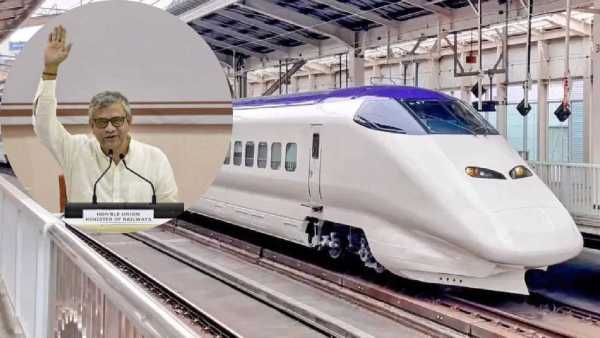
Union Railway Minister Ashwini Vaishnav made a big announcement for West Bengal on Saturday (June 6). He said that Bengal will get its first bullet train, which will run between Siliguri and Delhi. This train will reach Siliguri from Delhi via Lucknow, Varanasi and Patna. This will make the journey of the passengers easier and the journey will be completed in just 6 hours.
Minister Ashwini Vaishnav made this announcement after a meeting of senior railway and state government officials in Nabanna on Saturday. This will be the second bullet train of Desh Bullet, which will be prepared after the Mumbai-Ahmedabad high speed train corridor.
The Delhi to Bengal Bullet Train Project, passing through Uttar Pradesh and Bihar, will be prepared by connecting two different corridors. Its first part will be Delhi-Varanasi corridor and the second will be Varanasi-Patna-Siliguri corridor. Work on this project is likely to start from 2028.
The bullet train running between Delhi and Bengal will connect many big cities. Many new stations will be built on this corridor, starting from New Delhi to Jewar Airport in Noida, Mathura, Agra, Etawah, Lucknow, Prayagraj, Varanasi, Ghazipur, Patna and then to New Jalpaiguri near Siliguri. In future, this route can also be expanded to Guwahati in Assam.
Currently, the train journey from Delhi to Siliguri takes 18 to 20 hours by trains like Rajdhani Express or Duronto Express. But after the Bullet Train Corridor, the 1500 kilometer journey from Delhi to Siliguri will be covered in just 6 hours. The bullet train will run at a speed of 250 to 300 kilometers per hour. With the introduction of this bullet train, it will take only three and a half hours to reach Varanasi from Delhi. At the same time, the journey from Varanasi to Siliguri will be less than three hours.
The Delhi Siliguri High Speed Corridor will connect North India with the gateway to North-East India. Most of the Delhi Howrah route will also be covered. Railway Minister says that more than Rs 1 lakh crore is being invested in Bullet Train and other railway projects in Bengal.
Siliguri is called Chicken Neck Corridor by entering the North-East. It connects North-East India to the rest of the country. With this bullet train, along with tourism, movement of army and logistics will also be very easy. The high-speed network will increase both trade and tourism of North Bengal and North-Eastern states. Railway Minister Ashwini Vaishnav and Bengal officials have assured to expedite the land acquisition for this project. Land acquisition related work will start soon in Delhi and Varanasi also.
Vaishnav said, when former Chief Minister Mamata Banerjee was the Railway Minister, Bengal used to get only Rs 4 thousand crore from the Railways. Now the NDA government led by PM Modi has received Rs 14205 crore for 2026-27. He said that many projects remained stuck due to lack of permission. He said that in many cases like Kolkata Metro, the TMC government even went to court. 60 next generation trains will be started for Kolkata Metro. More than 100 stuck railway projects in West Bengal will be given new impetus.
He said that since BJP came to power in 2014, the Center has been working in a planned manner for the development of Bengal. He said that from 1972 to 2014, there was only 28 km metro in Bengal. Got 45 km metro after 2014. Despite approval from Delhi, many projects could not be completed due to non-cooperation of the previous government. Bengal Chief Minister Subhendu Adhikari assured the Railway Minister of all kinds of cooperation including early approval of all railway projects.
Railways will have to overcome many difficult challenges in building the Bullet Train Rail Corridor. The biggest task will be to acquire land on a large scale in the densely populated states of North India. Apart from this, laying a high-speed track in the sensitive Chicken Neck area of Siliguri and near the International Border can also be technically challenging.
Officials say that making the track from the chicken neck section will be the biggest challenge. Designing a track in densely populated areas and near international borders will not be easy. Fragile land and heavy rains are also a big hindrance. Roads get washed away during rains, hence building a sensitive rail network will be challenging.