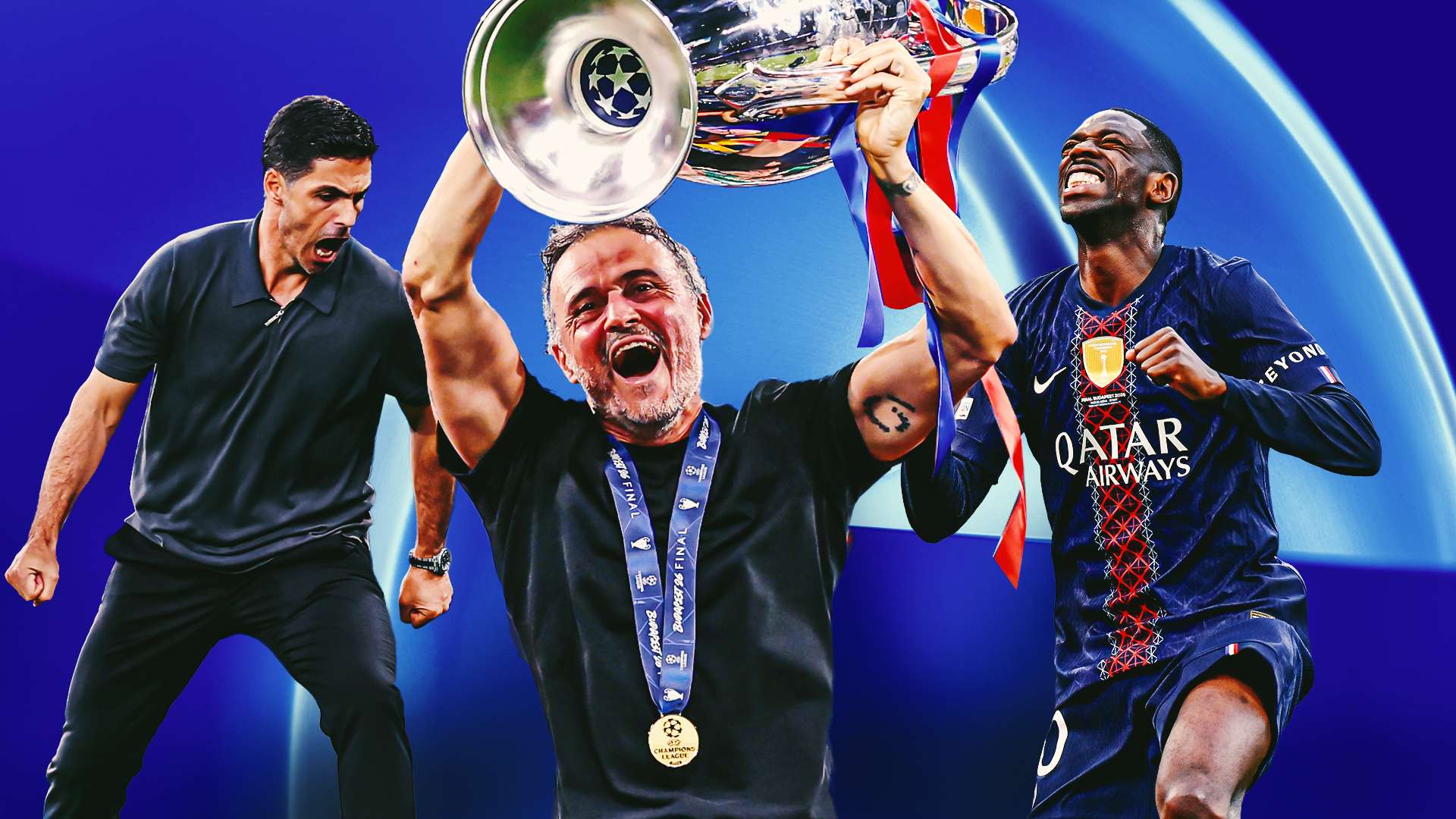
Paris Saint-Germain have done it once again! The club that was once mocked for choking in the Champions League proved their resilience by defeating Arsenal 4-3 on penalties after a 1-1 stalemate in Budapest, retaining their European crown on Saturday night. Unlike last year’s comprehensive win over Inter, PSG had to dig deep to overcome the Gunners, who took an early lead through Kai Havertz after a fortunate deflection.
For a large portion of the game, Luis Enrique’s side struggled to break down Arsenal’s superb defensive unit, with Gabriel Magalhaes and his teammates doing a stellar job of neutralising one of the most potent attacking setups in Europe.
However, Khvicha Kvaratskhelia came alive after the interval, and when the Georgian was brought down clumsily by Cristhian Mosquera in the 65th minute, Ousmane Dembele calmly converted the subsequent penalty to level the scores.
PSG could—and perhaps should—have sealed the victory in regular time. Kvaratskhelia’s fierce shot was deflected onto the post by Myles Lewis-Skelly, while Bradley Barcola squandered a golden chance in stoppage time, slicing wide after a poor first touch when clean through on goal.
Even after losing key players during extra time, PSG displayed remarkable mental fortitude alongside their technical brilliance to prevail in the shootout.
Here’s a breakdown of the major winners and losers from a tense showdown at the Puskas Arena.
WINNER: Luis Enrique
During post-match coverage on TNT Sports, former Liverpool captain Steven Gerrard confessed he was running out of words to describe Luis Enrique’s excellence—and it’s easy to understand why. The ex-Barcelona manager remains one of football’s most endearing figures: humble, passionate, and articulate, inspiring both players and fans alike whenever he speaks about the game and life in general.
It’s no surprise then that his players work tirelessly for him. Still, it’s an extraordinary accomplishment at a club previously criticised for being all flair and no substance. After lifting his third European Cup—only Carlo Ancelotti has more—Luis Enrique dismissed talk of joining the ranks of footballing “legends”, but few would argue against that description.
LOSER: Gabriel Magalhaes
When Gabriel blasted his penalty over the crossbar to hand PSG the title, all of the Parisian players rushed to celebrate with goalkeeper Matvey Safonov in front of their supporters—except one. Marquinhos made a direct run toward his compatriot Gabriel, embracing him in consolation. The Brazilian defender fully deserved the sympathy; he had been outstanding for 120 minutes, repeatedly thwarting PSG’s attacks.
Had Arsenal triumphed in the shootout, Gabriel would likely have been named Player of the Match. Unfortunately, this will serve as his personal ‘John Terry’ moment—one that will take time to overcome. Yet as Marquinhos knows well from past heartbreaks, true champions bounce back, and Gabriel certainly has the character to do so.
WINNER: PSG’s dynasty
When PSG dismantled Inter in last year’s final, many suspected that their next title would not take long. That prediction has come true. This young, dynamic team continues to mature and evolve, showing they can win in multiple ways. Even though their attack wasn’t at its sharpest in Budapest, they still found a way—true champion behaviour.
PSG’s place in footballing history is now undeniable. They are the first club since Real Madrid nearly a decade ago to retain the Champions League, and only the third ever to clinch both their domestic championship and the European Cup in consecutive seasons.
And the journey may just be beginning. With an average age of 24, this PSG side ranks among the youngest winners in the competition’s history. Moreover, despite speculation linking Luis Enrique to the Premier League, he’s already discussing squad reinforcements for next season—a worrying sign for their rivals.
The Parisians have joined the elite circle of European football gods—and they may soon dominate it entirely.
LOSER: Arsenal’s midfield
While penalties ultimately decided the final, Arsenal’s midfield struggles played a key role in their downfall. After taking an early lead, they consistently failed to retain possession and control the tempo.
Declan Rice, Myles Lewis-Skelly, and Martin Odegaard gave maximum effort—Rice tirelessly chased down opponents, and Lewis-Skelly made a vital block to deny Kvaratskhelia. Yet, both struggled in possession: Lewis-Skelly completed only 12 passes in 90 minutes, while Rice lost the ball 15 times—second only to goalkeeper David Raya, who misplaced 28 passes.
Odegaard once again faded in a big game, effectively leaving Arsenal outnumbered in midfield. Martin Zubimendi, brought in for control, looked fatigued and was restricted to a substitute role, leaving Mikel Arteta with important summer decisions ahead.
Despite Arsenal’s impressive depth—which helped them navigate the Premier League marathon—their meagre 24.7% possession in Budapest, the lowest ever in a Champions League final, shows they need more creativity and composure in central areas to conquer Europe.
WINNER: Harry Kane
The Champions League usually shapes the Ballon d’Or race—but perhaps not this time. Declan Rice’s performance did not help his cause, while Kvaratskhelia, though brilliant throughout the tournament and responsible for winning PSG’s equalising penalty, wasn’t at his best in the final, possibly due to a leg injury. Dembele’s successful penalty also masked his limited sharpness following a recent hamstring issue.
Vitinha’s Player of the Match award may boost his own Ballon d’Or chances, but the picture remains wide open heading into the World Cup. That’s unfortunate for Kvaratskhelia, whose Georgia won’t participate, but good news for Dembele, Vitinha, Rice, and others like Lamine Yamal, Luis Diaz, Michael Olise, and current frontrunner Harry Kane.
LOSER: Arteta’s defensive tactics
For neutral fans, Arsenal’s early goal was the worst outcome—it turned the final into a defensive drill rather than a spectacle. Predictably, PSG spent most of the match patiently probing against Europe’s most organised defence.
As Declan Rice admitted, Arsenal had no intention of playing open football against Luis Enrique’s side, saying, “If we’d played that way, that’s exactly what they wanted—that’s how they score five or six.”
Still, Arsenal’s pragmatism bordered on negativity. They have become difficult to enjoy, their matches more endured than watched. Their time-wasting tactics, including Raya’s late “injury” before his miraculous recovery, drew frustration from spectators.
Such an approach is hard to justify for a team built at a cost exceeding £1 billion. Arsenal ended with less possession than in their 2006 final—when they played with ten men—and managed just one shot on target, their goal. From the sixth minute onwards, they resembled a lower-league side hoping for a giant-killing. To be blunt, it would have been unjust had it worked.
The defining moment of their night came when they squandered a chance to double their lead before half-time, instead wasting time over a corner. While many will sympathise with Arsenal for losing on penalties after an unbeaten campaign, purists will feel relieved that the trophy went to the team that wanted to play football rather than stifle it.