Munish Sood
Mandi
The Himachal Pradesh government is actively working to bolster the rural economy through various initiatives aimed at increasing income and fostering self-employment opportunities. A key program in this effort is the sericulture initiative led by the Industries Department’s Sericulture Wing, which plays a crucial role in empowering women economically and promoting sustainable income sources.
In the Sarkaghat area of Mandi district, women are increasingly turning to silkworm rearing as a viable income source, which is enhancing their household financial stability and promoting self-sufficiency.
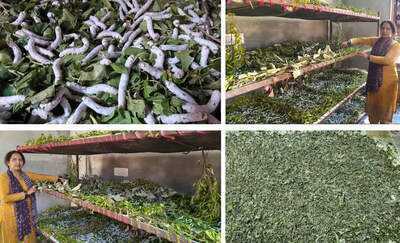
One notable success story is that of Madhu, a resident of Sinharn village in Sarkaghat tehsil. She learned about sericulture through an awareness campaign organized by the department, which provided her with the necessary technical support and guidance to start her own production at home.
Thanks to structured government assistance, Madhu has successfully engaged in silk production from her home, significantly improving her financial situation. The cocoons she produces are sold for approximately ₹1,000 to ₹1,200 per kilogram, allowing her to earn around ₹12,000 per production cycle, with two cycles each year, leading to an annual income of ₹24,000 to ₹25,000.
She also highlighted that the state government has facilitated this initiative by providing essential infrastructure, such as rearing stands, plastic trays, nets, and a dedicated rearing shed for organized production. Additionally, mulberry saplings and financial aid for plantation activities are supplied, along with biannual silkworm seed distribution. Field staff regularly monitor the operations and offer technical advice to ensure high-quality production.
Madhu emphasized that this initiative has greatly enhanced rural livelihoods and increased women's involvement in income-generating activities. She expressed gratitude for the government’s support, noting that the program has enabled families to secure a dependable income source right in their communities.
Her success has inspired many other women in the region to pursue sericulture as a livelihood. Currently, around 40 to 50 women are engaged in silkworm rearing, indicating a steady growth of the initiative and its positive impact on rural economic participation.
The sericulture program is fully funded by the state government for mulberry plantation costs. Beneficiaries receive essential rearing infrastructure, including stands, trays, and nets through various schemes. For larger-scale operations, a 20×20 feet rearing shed is constructed with complete financial backing.
This scheme operates on a shared funding model, with contributions from both central and state governments, where beneficiaries typically cover about 10% of the total costs. The silkworm rearing cycle lasts between 15 to 18 days, allowing beneficiaries to generate income quickly.
According to Arun Kumar, Sericulture Inspector at the Government Sericulture Centre in Mouhi, the operational area includes Sajao-Piplu, Baldwara, and Samahela under the Sericulture Division Sandhol. This year, around 250 beneficiaries have received silkworm seeds, and 50 to 55 new rearing sheds are being constructed to benefit an equal number of families.
He further noted that with two production cycles each year (in March and August), individual beneficiaries could earn between ₹35,000 and ₹50,000 annually, making sericulture a promising supplementary livelihood option in the region.