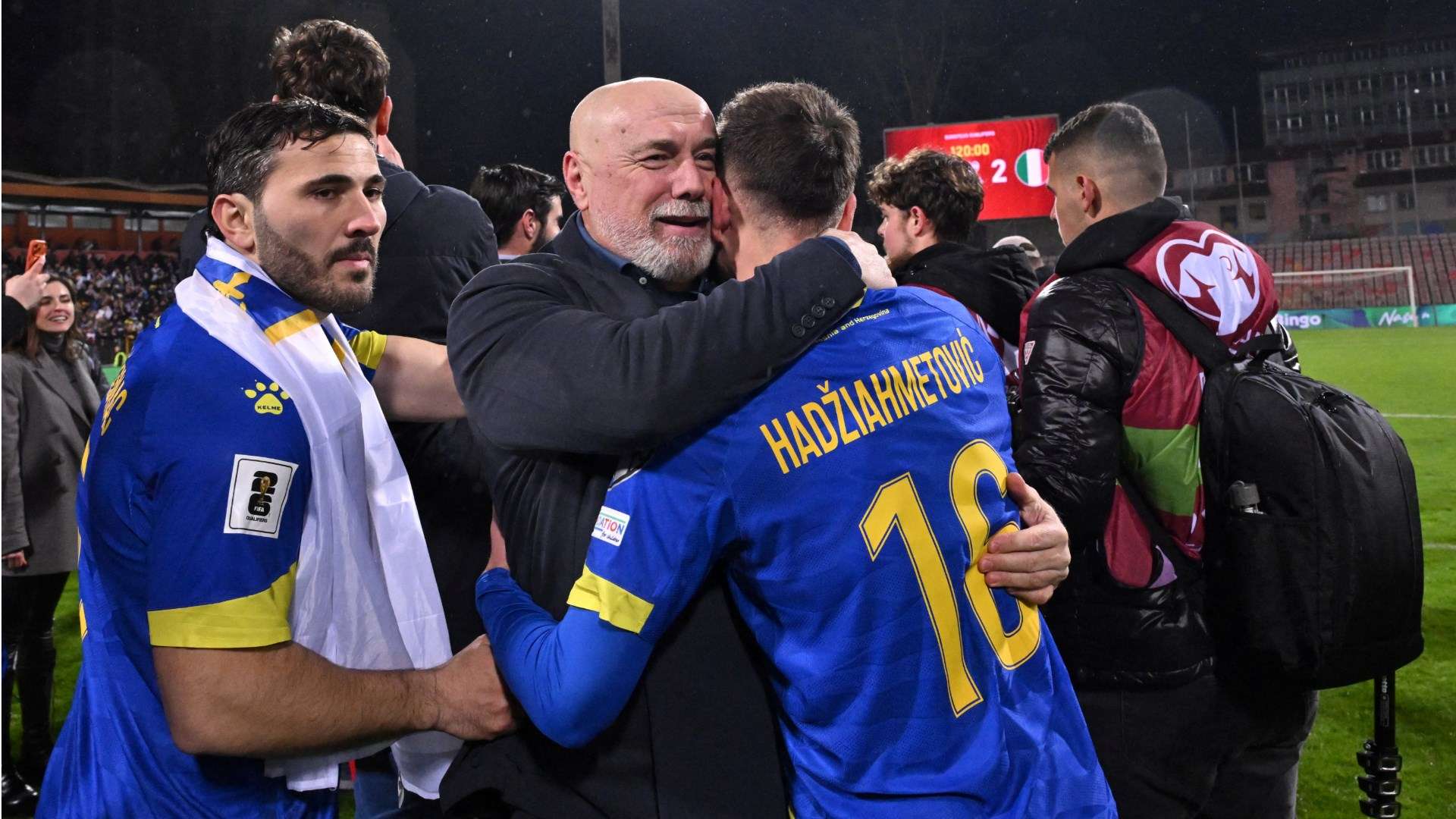
Despite the gloomy state of Bosnian football at the time, Sergej Barbarez boldly stepped up to become the national team manager—his first-ever coaching job. That leap of faith has paid off handsomely and may yet culminate in a World Cup fairy tale.
“That first match, when the national anthem plays – that will be my moment. Those three seconds will be mine,” Bosnia and Herzegovina coach Sergej Barbarez told Sky in a recent chat, as he looked ahead to this summer’s World Cup.
In a stunning and deeply emotional twist, Barbarez’s team sealed their World Cup qualification in March by defeating powerhouse Italy in the play-off final, sending the Azzurri crashing out in heartbreak. The unforgettable sight of young playmaker Esmir Bajraktarevic lifting his shirt in front of the roaring Zenica crowd after netting the decisive penalty will forever remain part of Bosnia’s football folklore.
The triumph echoed the achievements of the nation’s golden generation—Miralem Pjanic, Zvjezdan Misimovic, Edin Dzeko, and Vedad Ibisevic—who took Bosnia, a country of just over three million, to its maiden World Cup appearance in Brazil in 2014. Now, Bajraktarevic and his teammates are following in their footsteps—and remarkably, the evergreen Dzeko, now 40, is still leading from the front.
To truly understand the magnitude of Bosnia’s 2026 World Cup journey—both emotionally and in sporting terms—we must revisit the pre-Barbarez era. “Over the past decade, things went from bad to worse. To be honest, a normal person wouldn’t have accepted this job,” said the former Bundesliga forward (330 appearances for Rostock, Borussia Dortmund, Hamburg SV, and Bayer Leverkusen) in an interview with kicker in October 2024.
After the high of 2014, Bosnia and Herzegovina slowly slipped away from major competition contention. The low point came during the Euro 2024 qualifiers, which saw three managers dismissed in barely 15 months.
Following a disastrous 2022 World Cup qualifying campaign, Faruk Hadzibegic took charge in early 2023 but lasted only four games, losing three, including a 2-0 home defeat to Luxembourg. His 170-day stint ended abruptly. Meho Kodro succeeded him but survived a mere 49 days and two matches—scraping past Liechtenstein 2-1 before falling 0-1 to Iceland.
By then, Euro 2024 qualification hopes were already dead. Yet Savo Milosevic, who took charge in September 2023, remained optimistic: “I truly believe this team can reach the Euros. It has the quality to be there.” The ex-Yugoslavia international and Euro 2000 joint top-scorer alongside Patrick Kluivert was expected to steady the ship—but things went south again.
His only win came in his debut, a 2-0 victory over Liechtenstein. Heavy defeats followed—a 0-5 drubbing by Portugal, a 1-4 loss to Luxembourg, and a 1-2 setback against Slovakia—leaving Bosnia with nine points from ten matches. A 2-0 win against Liechtenstein briefly kept him afloat, but a 1-2 loss to Ukraine in the play-off semi-final ended his tenure by spring 2024.
After a year without a single win, the Bosnian Football Association showed rare patience by standing by Sergej Barbarez.
When Barbarez signed in mid-April 2024, Bosnian football was in disarray. Appointing the former striker seemed logical, given his status as one of Bosnia’s greatest forwards. A key member of the 2000s teams that narrowly missed major tournaments, he helped build the foundations for Bosnia’s 2014 World Cup run.
Still, his hiring was a shock: the then 52-year-old had never coached before. “I’ve been waiting for this chance for so long,” Barbarez told kicker. After retiring in 2008, he briefly served on Hamburg SV’s supervisory board (January 2009–May 2010) and occasionally appeared as a television analyst. Having twice held talks for the national job, he turned to professional poker when neither materialised. Then, seemingly out of nowhere, he became national coach, tasked with halting years of decline. With six coaches in five years, the FA committed long-term, offering Barbarez a four-year deal until 2028, with Euro 2028 qualification as the primary goal. “The 2026 World Cup is also a dream,” Barbarez said, “but we’re being realistic. We’re following a long-term plan.”
True to their word, Bosnia’s administrators gave Barbarez time. “We’ve brought in new lads, tried many things, taken big risks. I don’t think there’s another case like ours,” he told Transfermarkt. “A guy who’s never coached before suddenly takes charge. My first five games—four were away. And one of them was against Germany. Brutal.”
Early results were poor: friendlies against England and Italy ended in predictable defeats, while the Nations League brought heavy losses to the Netherlands (2-5) and Germany (0-7). Still, there were glimpses of progress—a spirited 1-2 loss to Germany and a 1-1 draw with the Dutch.
Finally, in March 2025, Barbarez celebrated his first win—a shock 1-0 victory in Romania to kick off World Cup qualifying, raising hopes of finishing second behind Austria.
They nearly topped the group. On the final day, Bosnia led Austria 1-0 until the 77th minute, before Michael Gregoritsch’s equaliser cost them first place.
Barbarez’s revival rests on three pillars: identity, mentality, and emotion. “At the start, we had to clear the slate,” he told Transfermarkt, explaining why passion matters more to him than tactics. “I always ask my players if they know why I succeeded in my career. Because I loved that bloody ball—and I still do. When you love something, the right path finds you.”
He built a staff of former internationals who share his philosophy. “Seven of the eleven have played together at the top level,” said the ex-HSV star. Assistants include Zlatan Bajramovic and Mirko Hrgovic, with Kenan Hasagic as goalkeeping coach and Emir Spahic as technical director.
“It’s about the little details—how to act in specific moments. Our international experience counts because football evolves, but emotions don’t change: you always give everything for your country.”
Barbarez’s World Cup squad is divided into three groups.
The first is practically one man: Edin Dzeko. With nearly 150 caps, he remains Bosnia’s talisman. “It’s special for an 18-year-old to meet Dzeko—his idol—and now share a dressing room,” Barbarez told Transfermarkt. “Sometimes just a few words from him change everything. The lads listen. That’s important.”
Fresh off helping Schalke 04 earn Bundesliga promotion, Dzeko is vital—fitness permitting. A shoulder injury kept him out of the run-in. “If he’s 100 per cent, there’s no reason to ease him in,” said Barbarez. “We play every six days, so recovery time is good. Modern science helps too.” Barbarez even lets Dzeko decide his own workload.
Dzeko remains prolific—five goals in seven qualifiers. His late equaliser against Wales and assist versus Italy proved decisive. Even at 40, he’s indispensable.
“It’s like Germany winning the World Cup,” one observer quipped about Bosnia’s qualification.
The second group consists of experienced leaders in their 30s—like Sead Kolasinac (32, Atalanta), goalkeeper Nikola Vasilj (30, FC St. Pauli), and Ivan Sunjic (29, Pafos FC), a former Croatia international who switched allegiance. Stuttgart striker Ermedin Demirovic, 28, another key player, said, “It’s as if Germany won the World Cup. People thank you for bringing happiness to the country.” Born in Hamburg, Demirovic chose Bosnia early in his career. “I did it for my grandad,” he said. “He was so proud. He’s gone now, but I’m happy to go to the World Cup for him and my family.”
He added, “People suffered terribly in the war. Many still have very little. We’ve given them something to celebrate. That makes it even more special.”
Barbarez’s own life was shaped by history. “I was basically forced to flee,” he told 11Freunde, recalling 1991–92. Sent by his father from Mostar to Hanover just before the Bosnian War, he ended up staying and later built his career in Germany. After shining for Hannover 96 and Union Berlin, he joined Hansa Rostock, catching the eye of Germany coach Berti Vogts, who suggested naturalisation. “If I’d accepted, maybe I’d have several World Cups and Euros by now. But I never considered it—I always wanted to play for my homeland,” Barbarez said.
Kerim Alajbegovic shares that patriotism. The Cologne-born forward, who came through 1. FC Köln and Bayer Leverkusen’s youth systems, made his senior debut under Barbarez last September. Now captain of Bosnia’s youngest World Cup generation, he leads a group “aged 19, 20, 21,” Barbarez noted proudly. “We’re almost the youngest team here.” At just 18, Alajbegovic impressed for RB Salzburg, attracting major European clubs. His flair and confidence in qualifying matches were vital, especially his second-half cameo in the 3-1 win over Romania and his assist for Dzeko’s goal against Wales.
“He’s unbelievable,” said Barbarez. “To have that belief at 18 is amazing. Sometimes I worry it’s all a sham—but they really live it.” With Bayer Leverkusen activating his buy-back clause, Alajbegovic returns to Germany as a potential breakout star. “I told him: pick a club where you’ll play. That’s key for him and for us,” Barbarez added.
Another young gem is Esmir Bajraktarevic, the 21-year-old PSV winger who scored the winning penalty against Italy. Born in the USA, he switched allegiance from the United States to Bosnia after Barbarez convinced him. Centre-back Tarik Muharemovic (23, Sassuolo) is another rising star, now a defensive mainstay and reportedly on Inter Milan’s radar.
Can Bosnia go further this time? In 2014, they fell short in a group with Argentina, Nigeria, and Iran—winning only against the latter. Now, drawn with Switzerland, Canada, and Qatar, Barbarez’s men fancy their chances. “It’s hard to predict results,” Barbarez said. “But we can talk about emotions. I told the nation: let’s have a wonderful summer. We’ll carry your voice to America. I want to make people proud and put smiles on their faces.”
Bosnia and Herzegovina’s 2026 World Cup Squad
Goalkeepers: Nikola Vasilj (FC St. Pauli), Martin Zlomislic (HNK Rijeka), Mladen Jurkas (FK Borac Banja Luka)
Defenders: Tarik Muharemovic (US Sassuolo), Nidal Celik (RC Lens), Sead Kolasinac (Atalanta Bergamo), Stjepan Radeljic (HNK Rijeka), Nikola Katic (FC Schalke 04), Nihad Mujakic (Gaziantep FK), Dennis Hadzikadunic (Sampdoria Genoa), Amar Dedic (Benfica Lisbon)
Midfielders: Amir Hadziahmetovic (Hull City), Benjamin Tahirovic (Brøndby Copenhagen), Ivan Sunjic (Pafos FC), Dzenis Burnic (Karlsruher SC), Armin Gigovic (Young Boys Bern), Ivan Basic (FC Astana), Amar Memic (Viktoria Plzeň), Ermin Mahmic (Slovan Liberec)
Forwards: Kerim Alajbegovic (RB Salzburg), Esmir Bajraktarevic (PSV Eindhoven), Ermedin Demirovic (VfB Stuttgart), Haris Tabakovic (Borussia Mönchengladbach), Jovo Lukic (Universitatea Cluj), Samed Bazdar (Jagiellonia Bialystok), Edin Dzeko (FC Schalke 04)