For much of the past year, India and Bangladesh have been attempting to repair a relationship shaken by one of the most consequential political upheavals in South Asia in recent decades.
Following the collapse of Sheikh Hasina's autocratic government in August 2024 and the subsequent rise of a new political order in Dhaka, both countries have gradually moved from mutual suspicion toward cautious engagement.
Diplomatic contacts have resumed. Official rhetoric has softened. After months of uncertainty, New Delhi and Dhaka appeared to recognize an inescapable reality: geography leaves them little choice but to cooperate.
Yet while diplomats work to rebuild trust, events along the 4,100-km border are increasingly pulling the relationship in the opposite direction.
A growing dispute over alleged 'push-ins' — attempts to force individuals across the border into Bangladesh outside established repatriation procedures — has emerged as the most immediate challenge to the fragile thaw. The issue now threatens to overshadow efforts by both governments to stabilise ties after nearly two years of diplomatic strain.
The controversy intensified this week after West Bengal's new BJP chief minister Suvendu Adhikari claimed that around 4,800 people had already been sent from India to Bangladesh and that another 836 individuals were being held in detention centres near the border awaiting deportation.
Speaking at a BJP programme, Adhikari said Indian authorities had begun removing alleged illegal immigrants who did not qualify under the Citizenship Amendment Act (CAA)."We have started the work of deporting infiltrators who do not fall under the purview of CAA," he was quoted as saying by Indian media.
He further claimed that holding facilities had been established in border districts and indicated that additional deportations would take place in the coming days.The remarks immediately drew attention in Bangladesh, where officials have repeatedly objected to what they describe as unilateral attempts to send people across the frontier without prior verification or diplomatic coordination.
View this post on Instagram
Bangladesh's response was swift but revealing. "There has been zero push-in," Border Guard Bangladesh (BGB) spokesperson Lt-Col Abu Hasanat Mohammad Mahmud Azam said on Monday, 8 June. The statement did not deny that attempts had occurred. Rather, it reflected the BGB's position that none had succeeded.
According to Azam, Bangladeshi border guards had foiled approximately 30 push-in attempts within the previous 72 hours alone. While he could not provide an exact number of individuals involved, his comments underscored the scale of the recent activity along the border.
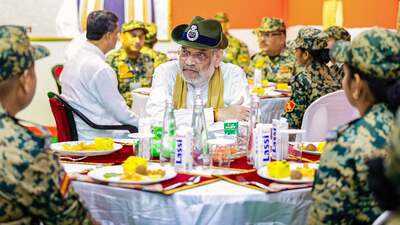
The issue is now expected to dominate discussions at the 57th director general-level conference between the BGB and India's Border Security Force (BSF), which opened in New Delhi on Monday.
Bangladesh's delegation is being led by BGB director-general Maj-Gen Mohammad Ashrafuzzaman Siddiqui, while BSF director-general Praveen Kumar heads the Indian side.
On the eve of the meeting, Bangladesh's home adviser Salahuddin Ahmed signalled that the issue would be raised directly with Indian authorities. "We will, Inshallah, resist all attempts of border push-ins. However, these issues should primarily be resolved through diplomatic discussions," he told reporters in Dhaka.
The dispute goes beyond competing numbers. At its core lies a disagreement over how undocumented migration should be managed between two countries that share one of the world's longest land borders.
Bangladesh has consistently maintained that it does not oppose the repatriation of its citizens if their nationality is properly established. What it rejects is the practice of returning individuals without verification through established bilateral mechanisms.
Dhaka's position is straightforward: if India believes someone is a Bangladeshi national residing illegally in India, that claim should be processed through existing verification channels before any repatriation takes place.
Officials argue that anything else risks creating legal uncertainty, humanitarian complications and disputes over nationality. The issue has become increasingly contentious because of conflicting claims about who is actually being sent toward the border.
Bangladesh has previously alleged that many individuals pushed toward its territory were later identified as Indian citizens. According to Bangladeshi officials, approximately 2,479 people were pushed toward the border between mid-2025 and early 2026, with a significant number subsequently determined not to be Bangladeshi nationals.
Bangladesh alleges 10 border ‘push-in’ attempts by India in 24 hoursIndia, meanwhile, has emphasised that it continues to use formal mechanisms. Indian authorities have said approximately 2,680 suspected Bangladeshi nationals were referred to Dhaka for nationality verification through established channels.
The widening gap between official procedures and developments on the ground is increasingly becoming a diplomatic problem.
The dispute cannot be separated from domestic politics inside India. For years, concerns over undocumented migration from Bangladesh have been a central theme in the BJP's political messaging, particularly in states bordering Bangladesh. The issue has shaped electoral campaigns, informed policy debates and become intertwined with broader discussions about citizenship and national identity.
Initially, much of that politics revolved around Assam, where the National Register of Citizens became one of the defining political projects of the BJP era. More recently, however, the focus has shifted toward West Bengal, where immigration remains a potent political issue and where the BJP has made significant electoral gains.
That shift matters.
Political success creates political expectations. Having campaigned heavily on promises to address illegal immigration, the BJP faces growing pressure to demonstrate tangible results. For critics in Bangladesh, the recent increase in alleged push-in attempts appears less like routine immigration enforcement and more like an extension of domestic political messaging.
Whether that interpretation is accurate or not, perception increasingly matters. The problem for New Delhi is that border incidents are colliding with larger strategic objectives.
When Sheikh Hasina's government fell in 2024, India lost its closest and most dependable partner in South Asia. For more than a decade, New Delhi had built much of its Bangladesh policy around a single political relationship. The sudden transition left Indian policymakers navigating an unfamiliar and less predictable environment.
The months that followed were marked by diplomatic caution. Political trust declined. Trade slowed. Anti-India sentiment, never entirely absent from Bangladeshi politics, resurfaced with renewed intensity.
The recent improvement in relations emerged not from sentiment but necessity.
India depends on Bangladesh for connectivity to its northeastern states and for regional stability along a strategically sensitive frontier. Bangladesh, meanwhile, relies heavily on India for trade, energy cooperation and access to regional markets.
Neither country can afford prolonged estrangement. Yet every reported push-in incident complicates efforts to rebuild trust.
In Bangladesh, the issue resonates far beyond migration policy. It touches on questions of sovereignty, national dignity and the nature of the bilateral relationship itself. Reports of attempted push-ins reinforce a narrative held by many Bangladeshis that India continues to approach its smaller neighbour from a position of entitlement rather than partnership.
That perception carries consequences.
Bangladesh's political landscape has changed significantly since 2024. The country that emerged after the fall of the Hasina government is more politically pluralistic, more openly nationalistic and increasingly determined to diversify its international relationships.
The BNP-led administration has sought to pursue a more autonomous foreign policy while expanding engagement with China, the United States and other international partners. Although India remains indispensable, Dhaka is no longer willing to define its foreign policy primarily through its relationship with New Delhi.
That reality presents India with a strategic choice. If New Delhi seeks a stable relationship with post-Hasina Bangladesh, it will need to recognise that coercive border practices — whether real or perceived — carry costs that extend far beyond migration management. Every disputed push-in strengthens those within Bangladesh who advocate greater distance from India and reduces the political space available for cooperation.
The irony is that both countries ultimately want the same outcome: a secure border, orderly migration management and a stable bilateral relationship.
Achieving those goals requires more than diplomatic statements. It requires consistency between what governments say across negotiating tables and what happens along the frontier.
The current diplomatic thaw remains tentative and reversible. The border dispute has become its first major test.
If India and Bangladesh fail to resolve the issue through established legal and diplomatic mechanisms, the frontier may once again become the place where broader ambitions for cooperation come undone. For two neighbours bound by geography, economics and security interests, that would represent a setback neither side can afford.
Faisal Mahmud is a Dhaka-based journalist