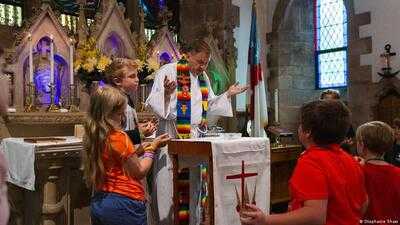
As the Trump administration undoes scores of environmental regulations and protections, some US Christian leaders are inviting their congregations to do as the Bible asks and be good stewards of the land.After years of decline, the number of Christians in the United States has stabilized. But, as they file into church on Sunday mornings, only a few will hear about the state of the planet that the Bible calls on them to steward. According to a 2025 study, although almost 90% of US faith leaders across all major Christian denominations believe in at least some degree of human-caused climate change, only about half have ever discussed it with their congregations. Styliano Syropoulos, one of the paper's researchers and an assistant professor at Arizona State University's School of Sustainability, said there were many factors that help create the disconnect. "Just because they care about it doesn't mean they feel obligated to talk about it," Syropoulos said, adding that pastors may feel ill-equipped to bring it up. "Or some might feel it's not their role. Climate change, at least in the US, is a heavily politicized issue." 'Second Coming capitalism' That is not lost on Reverend Bradley Mattson of the Hope Episcopal Church in Pennsylvania, who sees divided views on climate change in the United States as a reason to discuss the issue rather than stay quiet. "I would say that political forces in this country and in other countries around the world may work very hard to distance the human impact piece on our climate," he said. "They are working actively to say: 'There's nothing we can do about it. Let's slash, mow and spray and let's just go ahead and do whatever we want.'" Under the current administration, the United States is a case in point. From blocking renewables expansion to promoting the extraction and use of polluting fossil fuels, US president Donald Trump has undone literally dozens of regulations implemented to safeguard not just the nation, but the rest of the world from environmental destruction. "Any of us have the capacity to go too far with power, and we need to keep ourselves in check for that," Mattson said. "I think certain groups of people use power for unbridled consumption, and there's just no Jesus in that." Mattson said some people had a "Second Coming capitalism" way of looking at the world: the idea that we can consume at will "because eventually God will come back, destroy the Earth and make it new." He said this narrative stemmed from a misreading of Genesis, originally written in Hebrew, where the call to "fill the Earth and subdue it" is taken to mean exploitation — "just plow it down." The passage, he said, is in fact a call to be good stewards. Mattson takes that calling to stewardship seriously. He has involved his church in climate advocacy, reforestation and protection of the Great Chesapeake Bay Watershed, which stretches across six states, including New York. For the most part, his congregation is on board. But that's not the case for every pastor who wants to introduce care for the planet to their flock. Pushback against climate in church One state away, in Maryland, Brother Ken Taylor's efforts to weave environment and climate awareness into his sermons at Saint Nicholas Lutheran Church in Huntingtown, have met with a varied response. "There's a very loud minority of people, who, when we have dedicated a series of Sundays or a teaching series about climate, that say: 'Why are you bringing so much politics into the pulpit?'" Taylor said. Some have told Taylor outright that they are leaving his church because they found the approach too overtly environmentalist. And, though the pushback initially caught him off guard, it has not stopped him from encouraging climate action. Taylor's congregation plants native species to counter erosion, has set up water dispensers and bins for collecting things that are hard to recycle, and is getting involved in clean water protection. He said he understood that faith leaders can easily feel out of their depth when it comes to knowing enough about climate to talk about it. Or to face challenges from the pews — which is where the idea of having a congregation comes into its own. "We have to lean on the full community of people who care about this in order to move the needle at all," Taylor said. He added that he has often invited people from his flock to give talks to the congregation. Starting small with respect In Pennsylvania, Mattson said that, when he joined the Hope Episcopal Church six years ago, he began by integrating care for the planet in small ways that congregants could respect rather than imposing a whole climate agenda on them. One example was simply giving people freshly grown vegetables. "And then we did pollinators, and then we did herb gardens," Mattson said. "And then we started to talk to some granting organizations around environmental work and expanded into land stewardship, watershed protection." Mattson is grateful that his congregation has accepted him and his ways, which include an understanding that preaching is not the best approach when it comes to climate and the environment. "We tend to approach the life of faith from a position of running towards light, not away from darkness," he said. "I didn't tell you to not run your gasoline lawnmower, if that's all you have. I didn't tell you that you were evil because you had a gasoline lawnmower. What I said was: Think about pollinators. You know, Jesus said: Consider the lilies of the field. Consider them. Just think about it." Edited by: Jennifer Collins This article was adapted from a DW Living Planet podcast. To listen to the full episode, click here.