This compilation of the greatest Italian footballers of all time features some of the most gifted talents the sport has ever produced.
Creating a definitive list of the best Italian players is no easy feat.
Italy has consistently produced world-class footballers year after year – and the current national team continues that proud tradition. When one thinks of Italy, images of fine wine, sunny coastlines, delicious pizza, and of course, football immediately come to mind. The 'Bel Paese' is as famous for its love of the beautiful game as for its culture, and with good reason – countless legends have worn the Azzurri shirt.
Italian football expert Alasdair Mackenzie has selected his definitive top ten list of Italy’s all-time greats.
Legendary pre-war striker Silvio Piola remains the only Italian to have scored more goals than Alessandro Del Piero’s 346, while Del Piero holds Juventus' records for both goals (290) and appearances (705).
But the statistics alone don’t define him. Del Piero’s exquisite technical brilliance, his flair for spectacular strikes, and his mastery of free-kicks secured his place among Italy’s greatest ever forwards, far beyond mere numbers.
Del Piero was instrumental in Juventus’ Champions League triumph in 1996, scoring six goals during that campaign, and guided the club to six Serie A titles.
Perhaps the pinnacle of his career came in the 2006 World Cup, when he scored Italy’s second goal in the 2-0 semi-final victory over Germany before calmly converting a penalty in the shootout win over France in the final.
Like a fine wine, Dino Zoff only got better with age. The iconic goalkeeper lifted his first and only World Cup at the age of 40 in 1982 – the oldest player ever to do so – and was named the tournament’s best goalkeeper.
It was his second major international triumph following the 1968 European Championship, and his club career at Juventus was equally successful, earning six Scudetti, two Coppa Italia titles, and the UEFA Cup.
Widely regarded as one of the finest goalkeepers ever, Zoff ranked behind only Lev Yashin and Gordon Banks when the International Federation of Football History & Statistics listed their top goalkeepers of the 21st century. In 2004, UEFA honoured him as Italy’s greatest player of the previous 50 years.
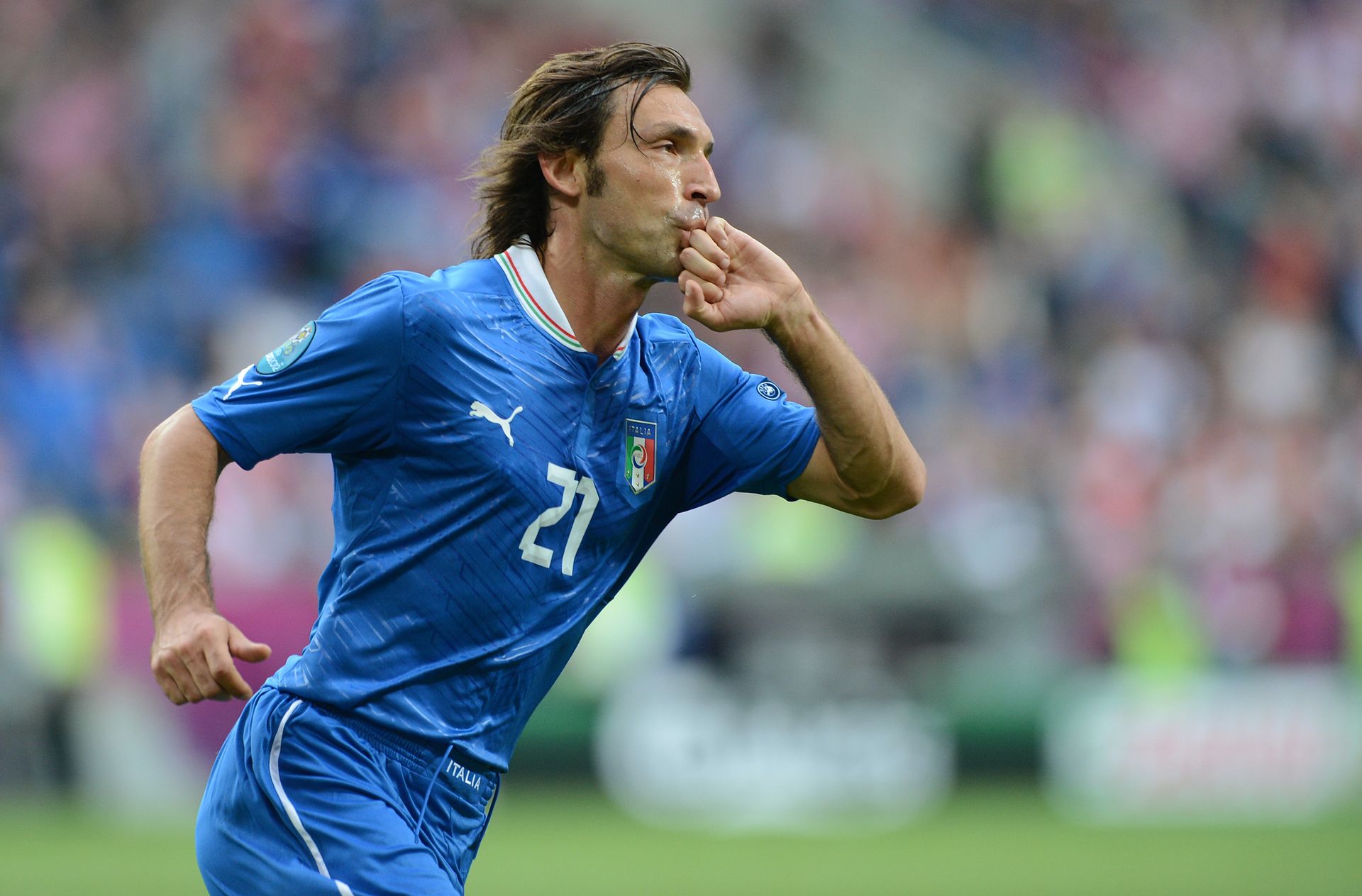
Andrea Pirlo remains one of the greatest deep-lying playmakers the game has ever seen. He exuded composure and elegance, combining vision, technique, and an effortless ability to dictate play or curl in perfect free-kicks.
Initially an attacking midfielder playing alongside Roberto Baggio at Brescia, Pirlo reached his peak after joining AC Milan, where he became one of Europe’s elite midfielders.
At San Siro, he collected two Champions League and two Serie A titles before adding four more league championships with Juventus, along with a 2006 World Cup winner’s medal.
As Juventus legend Zbigniew Boniek once said, “To pass the ball to Pirlo is like hiding it in a safe.”
Franco Baresi made his AC Milan debut at 17 and remained loyal to the club throughout his two-decade career, winning every major honour available.
He was a cornerstone of the legendary Milan sides managed by Arrigo Sacchi and Fabio Capello in the 1990s, forming an iconic defensive line with Paolo Maldini, Alessandro Costacurta, and Mauro Tassotti.
Baresi finished runner-up for the 1989 Ballon d’Or behind teammate Marco van Basten, after captaining Milan to consecutive European Cup victories. Between 1991 and 1994, he led the club to three straight Serie A titles, conceding just 15 goals in the 1993/94 season.
Though he never won an international trophy, coming closest in the 1994 World Cup final loss to Brazil where he missed a penalty in the shootout, Baresi is still revered as one of the greatest centre-backs ever, admired for his intelligence, leadership, and all-round defensive excellence.
Francesco Totti, the eternal symbol of AS Roma, may not have collected as many trophies as his talent warranted, but his loyalty to his boyhood club made him an icon in the capital.
Totti’s creativity and technical ability were unmatched in his prime, allowing him to both score and create goals with equal brilliance. He retired in 2017 as Serie A’s second-highest scorer with 250 goals.
He played a vital role in Italy’s 2006 World Cup triumph, featuring in every match despite fitness concerns, scoring a decisive penalty against Australia in the Round of 16, and finishing as joint-top assist provider with four assists.
Giuseppe Meazza was so exceptional that Italy’s most famous stadium bears his name. Commonly known as the San Siro, the arena’s official title honours the two-time World Cup winner who represented both AC Milan and Inter Milan.
Though he played for both, Meazza achieved more success with Inter. After being rejected by AC Milan as a youngster due to his small stature, he joined Inter and went on to become one of Serie A’s most prolific scorers, winning three league titles and three top-scorer awards.
His exploits for the national team cemented his legendary status. Meazza is one of only three players – alongside Giovanni Ferrari and Eraldo Monzeglio – to win two World Cups, claiming the Golden Ball in 1934 and captaining Italy to glory again in 1938.
Gianni Rivera, affectionately nicknamed the ‘Golden Boy’, burst onto the scene at a young age. He scored his first goal for AC Milan at just 17 in a thrilling 4-3 win over Juventus and quickly became one of football’s most iconic No.10s.
As Milan’s creative heartbeat, Rivera guided the Rossoneri to three Serie A titles and two European Cups, forming a close partnership with coach Nereo Rocco, who hailed him as a “genius.” He won the Ballon d’Or in 1969 after inspiring Milan to a 4-1 victory over Johan Cruyff’s Ajax in the European Cup final.
Rivera’s vision and passing ability became legendary, both for club and country. He made his Italy debut at 17, featuring in four World Cups, scoring the winner in the epic 1970 semi-final against Germany, and helping secure the 1968 European Championship, though injury kept him out of the final.
Gianluigi Buffon’s name is synonymous with goalkeeping greatness. Since bursting onto the scene as a teenager at Parma in 1995, his agility and reflexes made him a global sensation.
Juventus signed him for a world-record €52 million in 2001, a fee that proved to be money well spent. Buffon went on to win 12 Serie A Goalkeeper of the Year awards, 10 league titles, and set the record for most Serie A appearances.
He earned the Golden Glove after keeping five clean sheets during Italy’s 2006 World Cup triumph and has enjoyed incredible longevity, continuing to play into his 40s with Parma in Serie B. His evolution from an explosive shot-stopper to a master of positioning and anticipation kept him at the top for decades.
Paolo Maldini, one of football’s most elegant defenders, is inseparable from AC Milan’s golden era. Spending his entire 25-year career with the club, he epitomised loyalty and class.
Initially an adventurous left-back before transitioning into a composed centre-back, Maldini helped Milan win 25 trophies, including five European Cups/Champions Leagues and seven Serie A titles.
Despite never winning a major international title, he represented Italy in four World Cups, retiring before the 2006 triumph. His 647 Serie A appearances remain a record for an outfield player. Known for his impeccable reading of the game, Maldini famously remarked, “If I have to make a tackle, then I’ve already made a mistake.”
Roberto Baggio, one of the most gifted footballers ever, combined creativity, vision, and technical artistry to become the quintessential trequartista and one of Italy’s most beloved figures.
Nicknamed the ‘Divine Ponytail’, Baggio’s move from Fiorentina to Juventus in 1990 sparked riots in Florence, but he went on to win the Ballon d’Or, Serie A, Coppa Italia, and UEFA Cup titles in Turin.
Though his trophy cabinet may not fully reflect his brilliance, Baggio’s influence was immense. He finished his career with two Serie A titles and remains tied as Italy’s fourth-highest scorer. Despite the infamous missed penalty in the 1994 World Cup final, he was the reason Italy reached that stage in the first place.
In 2011, the Italian Football Federation recognised his iconic status by naming him the first-ever inductee into the Italian Football Hall of Fame.