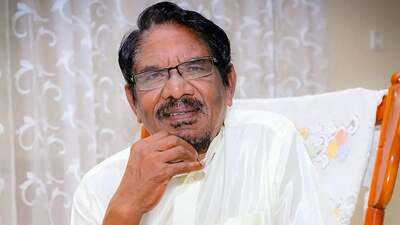
The death of veteran filmmaker, screenwriter, and actor P. Bharathiraja, 84, in Chennai on the morning of 10 June brings to an end an era of a towering titan who broke the shackles of studio-bound filmmaking to inject raw, rural realism into Tamil screenplays.
The national award-winning director had been battling prolonged age-related ailments and recurring respiratory complications for several months. Family associates noted that his physical decline was accelerated by severe emotional trauma following the sudden demise of his son, actor-director Manoj Bharathiraja, in March 2025. He is survived by wife, Chandraleela, and daughter, Janani.
Chief minister C Joseph Vijay was among the early visitors at the director's residence to pay tributes. In his condolence message he said, “A director who rose from a rural background and infused his films with vibrant life and realism, Mr Bharathiraja left a distinct mark on Tamil cinema with numerous successful films. For his work, he received many national and state honours, including the prestigious Padma Shri.”
The CM announced that in recognition of his contributions to cinema, state honours would be accorded to Bharathiraja.
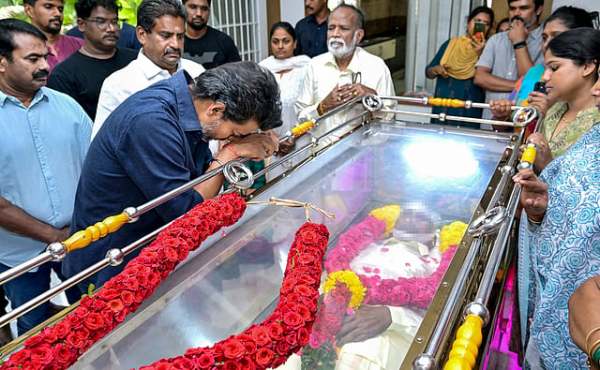 TN chief minister pays homage to Bharathiraja
The actor-director was known as a trendsetter for his choice of stories and their treatment. A multiple national award winner known for his predominantly rural content, Bharathiraja shot to fame with his debut directorial venture 16 Vayathinile in 1977. It also marked his maiden association with legendary musician Ilayaraja as the songs went on to become chartbusters.
Kamal Haasan and the late Sridevi were the lead pair, with superstar Rajinikanth playing the villain in a film that went on to rule the box office. 16 Vayathinile is rated one among the best Tamil films even today.
Rajinikanth and Kamal Haasan were also among those who visited Bharathiraja’s residence.
In an emotional tribute, Kamal Haasan said, “The gentleman has gone, but his art will continue to live on. I'm not counting the losses; I'm counting the gains. He was there, and he made films with me. I am very grateful."
Rajinikanth recalled how his ‘dear friend’ Bharathiraja was open-hearted. “He was like a child at heart. Whatever he felt, he would say it directly. He used to criticise me too. He would tell me, I like you as a person, but I don't like your acting. That was the kind of honesty he had.”
Born Chinnasamy on 17 July 1941, in Allinagaram, Theni district, Bharathiraja rose from humble beginnings to alter the trajectory of South Indian cinema permanently. Before his arrival in the late 1970s, Tamil cinema was heavily dominated by indoor studio sets, high-decibel theatrical melodramas and urban-centric narratives.
Bharathiraja shattered this status quo by taking his cameras out of the studio floors and onto the dusty, sun-drenched tracks of actual villages. He introduced mainstream audiences to an unglamorous, authentic rural landscape. 16 Vayathinile became a cultural phenomenon and established a new lexicon for commercial filmmaking.
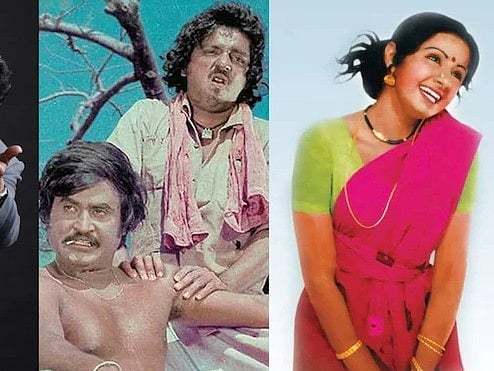 The iconic '16 Vayathinile'
His signature technique coupled folk aesthetics, localised dialects, and complex human vulnerabilities. For generations of viewers, the filmmaker's booming, emotive voiceovers introducing his works with the iconic phrase, ‘My dear Tamilians’ became synonymous with high-quality, rooted storytelling.
Over a prolific career spanning nearly five decades, Bharathiraja helmed more than 40 feature films across Tamil, Telugu and Hindi. He demonstrated a remarkable stylistic range, moving effortlessly from rural dramas to psychological thrillers.
His pathbreaking films in Tamil include Sigappu Rojakkal (1978), a sophisticated, gritty psychological thriller that broke his rural mould; Alaigal Oivathillai (1981), a poignant, critically acclaimed romance addressing caste and religious barriers; Mudhal Mariyathai (1985), a masterful, mature narrative on platonic love featuring Sivaji Ganesan; and Karuthamma (1994), a hard-hitting social commentary tackling the menace of female infanticide.
Beyond his technical prowess behind the lens, Bharathiraja was widely recognised as the industry’s ultimate star-maker. He possessed an uncanny eye for raw talent and systematically introduced a generation of performers who would go on to shape the future of Indian cinema.
In a characteristic and superstitious tradition, he frequently rechristened his lead actors with names beginning with the letter "R". Through this unique grooming school, he introduced iconic artistes such as Radikaa, Revathi, Radha, Rekha and Vijayashanti. He was also instrumental in launching the careers of male stars like Karthik and Pandian, alongside legendary technicians, comedians, and character actors.
Furthermore, the Bharathiraja School of Filmmaking served as a foundational training ground for several highly successful directors, including K Bhagyaraj, R Parthiban, and Pandiarajan, all of whom began their careers as his assistant directors.
In the latter half of his career, Bharathiraja seamlessly transitioned to the front of the camera, reinventing himself as a formidable character actor. His powerful screen presence and distinct dialogue delivery earned him widespread critical acclaim from younger generations of filmgoers.
As a director, his final creative output was a critically praised segment in the 2023 OTT anthology 'Modern Love Chennai'.
He was conferred the Padma Shri in 2004. His illustrious trophy cabinet also included six national film awards, four Filmfare awards south, and six Tamil Nadu state film Awards.