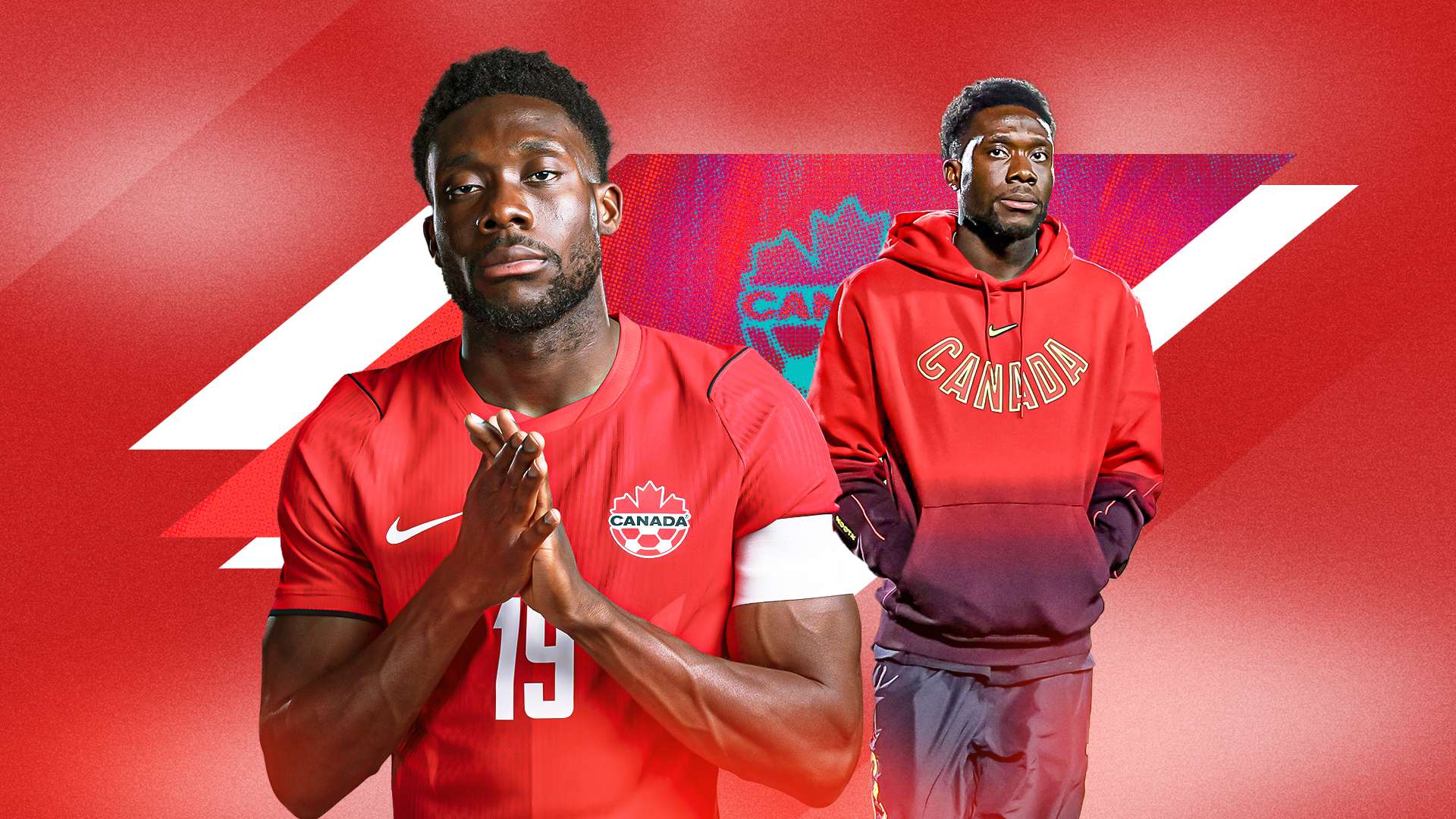
Alphonso Davies has long been hailed as Canada’s greatest-ever footballer, but as the 2026 FIFA World Cup approaches, the Bayern Munich speedster faces an uphill battle to be fit for what could be the defining tournament of his career.
Every Monday night, a large running group fills Toronto’s streets, their numbers swelling particularly during the summer months. On a recent evening, the runners passed Toronto Stadium, now decorated with FIFA World Cup branding and set to host six matches during the 2026 event.
Many in the group wore football jerseys, most notably Canada shirts bearing the name ‘Davies 19’. When one runner asked another if they were a football fan, the reply — though not enthusiastic — captured a truth: “I don’t love football, but I know Alphonso Davies.”
This Friday, just a short distance from where that photo was taken, Canada’s men’s national team will open the 2026 World Cup on home soil against Bosnia and Herzegovina — a historic first for the nation. However, Davies, the captain and star attraction, won’t be taking part fully, as injuries continue to limit his playing time.
Canada’s poster boy
Few athletes in Canada command the same recognition as Alphonso Davies. Regular followers of the sport may admire Jonathan David’s finishing or Tajon Buchanan’s pace, but Davies exists on another level. The Bayern Munich left-back stands as the lone household football name in the country, sharing celebrity status with icons like Christine Sinclair, Sidney Crosby, Drake, and Justin Bieber.
Yet, for Canada’s most significant home fixture ever, Davies will not be on the field. The 25-year-old’s absence, due to a right hamstring strain suffered in the UEFA Champions League semi-final against Paris Saint-Germain in May, has become an accepted reality after weeks of uncertainty.
‘Managing the group phase’
“No, he won’t play in the first game. But he’ll play in the tournament,” said Canada’s American head coach Jesse Marsch in an interview with CBC’s Adrienne Arsenault. Marsch, known for his optimism, is hopeful about reintroducing Davies later in the group stage, possibly for the matches against Qatar on June 18 and Switzerland on June 24.
“We’ll need to manage the group stage carefully and advance. I’m confident he’ll be ready once we progress. If we’re smart and cautious, he might even return in time for the third match,” Marsch added.
Finding a home in Canada
Canadian football’s rise owes a great deal to Davies. Without him, it’s unlikely Canada would be co-hosting the 2026 World Cup alongside the United States and Mexico.
Born in Ghana’s Buduburam refugee camp to Liberian parents fleeing civil war, Davies moved to Canada as a child with his family, settling in Edmonton. There, his football talent flourished, leading him to join the Vancouver Whitecaps MLS academy at just 14 years old.
Within a year, Davies made his professional debut. His proudest moment, however, came in June 2017 when, at age 16, he officially became a Canadian citizen and was immediately called up for the CONCACAF Gold Cup.
“It was the first time he saw his mother cry; he was learning his own story as the world did,” said Farhan Devji, author of ‘Alphonso Davies: A New Hope.’
Davies and his family epitomise the Canadian immigrant experience — embracing the culture, contributing to society, and fully integrating into their adopted home. Off the field, he’s known for his love of hockey, music, and gaming, and is often seen cheering for the Edmonton Oilers during the NHL off-season.
His story came full circle in 2018 in Moscow, where a 17-year-old Davies, braces still on, addressed the FIFA Congress to support North America’s bid to host the 2026 World Cup.
“My name is Alphonso Davies. My parents are from Liberia and fled the civil war,” he told delegates. “When I was five, a country called Canada welcomed us in. My dream is to play in the World Cup, and I know the people of North America will welcome the world.”
The injury nightmare
At the 2022 World Cup in Qatar, Davies achieved that dream, scoring Canada’s first-ever men’s World Cup goal against Croatia. Although Canada lost all their group games, his strike marked a historic milestone and a personal triumph.
However, the years since have been turbulent. Across the 2024–25 and 2025–26 seasons, Davies has endured repeated injuries. His last appearance for Canada came in March 2025, when he tore his ACL in the CONCACAF Nations League third-place match against the United States.
The injury sidelined him for 221 days, causing him to miss 39 matches for club and country. Bayern Munich even threatened legal action against Canada Soccer and Jesse Marsch over the incident, though the dispute subsided without escalation.
Davies returned in December, only to tear a muscle fibre in February. A brief comeback in a match against Atalanta in Bergamo ended after just 25 minutes due to another hamstring issue. Later, a recurrence of that same injury in the Champions League semi-final against PSG ended his season. In total, he has missed more than 370 days of action in less than 15 months.
‘Doubt in my head’
“There was doubt in my head; I was sad,” Davies admitted when speaking to reporters in Montreal last week about his struggle to recover in time for the World Cup. “From being a 17-year-old kid who helped bring the World Cup to our country, to not being able to play, it hit me hard. But I know how strong I am and how strong the people around me are — they’ll help me return safely.”
Making an impact off the pitch
Although he missed Canada’s pre-World Cup camp in Charlotte, North Carolina, Davies rejoined the squad in Edmonton in early June. He has since been training under a modified programme while continuing his rehabilitation.
Even in limited capacity, Davies’ presence is invaluable. As captain since the 2024 Copa America — where Canada reached the semifinals — his leadership and influence are irreplaceable. Healthy or not, he remains Canada’s most potent weapon, both as a player and as a symbol of national pride.
“I’ll give them the motivation they need,” Davies said, with midfielder Stephen Eustaquio expected to wear the armband in his absence. “Just being able to play in the World Cup, for our country and in front of our people, is motivation enough.”
Whether Davies ultimately takes the field or not, his influence on Canadian football — and his role in bringing the World Cup to home soil — is already cemented in history.