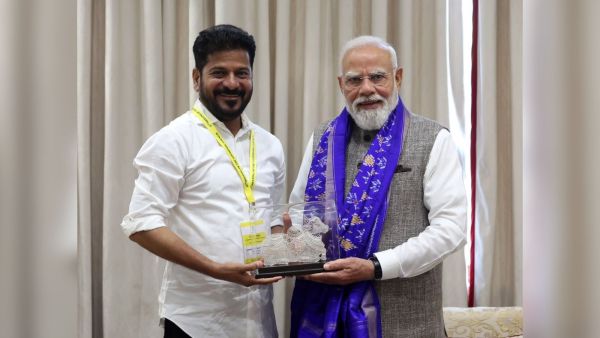
Hyderabad: Telangana Chief Minister A Revanth Reddy on Thursday, June 11, sought a task force for six metropolitan cities in the country, with an investment of Rs 1 lakh crore per city to develop them to global standards.
Addressing the 11th governing council of NITI Aayog in New Delhi, he stated that New Delhi, Mumbai, Kolkata, Chennai, Hyderabad and Bengaluru are true engines of the economy, yet they lag behind the world’s great cities.
While seeking an M6 Cities Task Force, he mentioned that these six cities house around 10 per cent of India’s people and generate nearly a quarter of its GDP.

“We urge a national task force, empowered to act with speed, to develop all six to global standards, not as expenditure, but as investment in the assets that generate the revenues, jobs and standing of a developed India,” he said.
The Chief Minister also sought the Centre’s support for developing the Regional Ring Road, the backbone of Hyderabad’s next phase of growth, opening new corridors for industry, logistics and planned housing.
He sought a 12-lane expressway to Bandar Port, connecting Bharat Future City to the Machilipatnam deep-water port in Andhra Pradesh and the global supply chain.
CM Revanth Reddy also requested approval for the Hyderabad Metro Rail Phase II to achieve clean air and sustainable, low-carbon mobility. He further sought the Centre’s assistance for Musi River Rejuvenation, aimed at restoring Hyderabad’s historic lifeline into a riverfront worthy of a world-class city.
He called for recognition and financing for the 30,000-acre net-zero, greenfield Bharat Future City. He also requested approval for the S Jaipal Reddy Palamuru-Rangareddy Lift Irrigation project, integrating the electronics ecosystem with an APMP facility, OSAT clusters and a Micro-LED fabrication unit under the India Semiconductor Mission, along with an Indian Institute of Management in Hyderabad to meet the aspirations of Telangana’s ambitious students.
Revanth Reddy said Telangana is aligned with Prime Minister Narendra Modi’s ambitious goals for the country under Viksit Bharat 2047. “To achieve these goals, we need world-class city infrastructure, wherein a knowledge-led services economy leads growth. We must create a knowledge super-hub that attracts industry to Telangana and stays here. In addition to robust school and skilling institutions, we need elite institutions to attract and keep the best talent in the world,” he said.
He stated that, in line with the National Education Policy, the government is working to bring international institutions, such as Ivy League universities like Harvard, MIT, Stanford, Oxford, Cambridge, and INSEAD, to the state.
“We have secured our first success with the University of London, which is setting up an offshore campus in Hyderabad. Several zones are being identified for creating knowledge clusters, on the ‘EEE’ model (Education, Environment and Employment).” the CM said.
“Higher education does not stand alone. It builds on everything before it, the healthy start, the integrated school, the language and the skill, and on the sport and arts that shape character. The finest institutions, faculty and students together in one place will multiply the number of Global Capability Centres that choose Hyderabad, which in turn will attract very substantial new investment. This is the true engine of a modern economy,” he added.
He said that Telangana truly believes that where the light of education reaches, equality follows. “In Telangana, our strong convictions towards improving education are based on solid data. In 2024, we conducted the SEEPCS, the Socio-Economic, Educational, Employment, Political and Caste Survey, covering 3.55 crore people across 242 distinct castes, reaching close to 97 per cent of the households in the state,” he said.
The SEEPCS has helped the Telangana government conclude that the current educational system has huge shortcomings in terms of quality. Trust in government schooling is going down. “We need a revolutionary change to get us ready for an ever-changing world. This current system, to its credit, may have made education more accessible to the people. However, it is time for us to focus on quality and outcomes now,” he added.