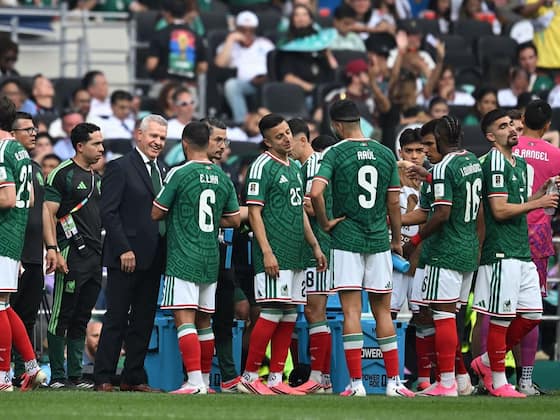
“This hydration break is powered by Powerade,” exclaimed Fox Sports commentator Ian Darke, as play was halted 24 minutes into the World Cup’s opening match to let players sip water. The temperature in Mexico City was around 23°C, a fairly pleasant summer day in Mexico. Yet, if recent weeks have taught us anything, it’s that this tournament is leaving no opportunity untapped when it comes to making money.
Fox Sports, unsurprisingly, used the three-minute interval to run a stream of high-paying commercials. Powerade, FIFA’s official sports drink, got its spotlight first, followed by ads for AT&T (telecommunications), Michelob Ultra (light beer), Lowe’s (home improvement), and FanDuel (sports betting). By the time the broadcast returned, players were already preparing to resume action. No one has yet explained why a water break needs to last three full minutes.
Mexico’s head coach Javier Aguirre was seen discussing tactics with his squad during the hydration break, a scene captured inside the stadium. The electric energy that had filled the stands — from the passionate Mexican anthem to the roar following their opening goal — fizzled out. Music replaced the chants, and spectators began to drift away from their seats, likely to get refreshments of their own, as “dance cam” footage played on the big screens.
While there will be matches during this World Cup where hydration breaks are essential, FIFA’s blanket mandate enforcing them across all 104 fixtures is unprecedented. The governing body claims these pauses are designed to “ensure the best possible conditions for players.” However, cynics argue that FIFA’s true motivation lies in the added advertising opportunities, boosting broadcaster profits from an already revenue-maximised tournament.
“I don’t like it,” said United States head coach Mauricio Pochettino when asked about the planned water breaks ahead of his team’s first game against Paraguay on Friday. “I only agree with it when the weather is extreme. When conditions are good, it’s just unnecessary.”
Former US women’s football star Carli Lloyd was even more direct, writing simply, “I hate it.”
Adding to the irony, this odd spectacle unfolded at the iconic Estadio Azteca — football’s sacred ground. This is the venue where Pelé lifted the 1970 World Cup after that famous assist to Carlos Alberto, and where Diego Maradona produced his immortal solo goal and the infamous “Hand of God.”
In this year’s opener, Mexico defeated South Africa at the same legendary venue. ITV Sport’s Ally McCoist, reporting from the touchline (ITV cannot show ads due to Ofcom’s regulations), was visibly emotional at being so close to such a historic site. Yet, in a telling move, the stadium has been temporarily renamed “Mexico City Stadium” to conform with FIFA’s naming rules. With FIFA’s relentless commercial drive, it wouldn’t have been surprising if it had been rechristened after one of its corporate partners — perhaps “The Coca-Cola Stadium,” “The Hyundai-Kia Arena,” or even “The Marriott Bonvoy Thunderdome.”
FIFA’s alignment with Fox Sports dates back years before this World Cup. When the Qatar World Cup was shifted from summer to winter, Fox threatened legal action. To avoid a messy and costly dispute, FIFA granted Fox the rights to the 2026 tournament at a discounted rate of $500 million in 2015. The network hit the jackpot when the tournament was later confirmed to take place across North America, expanded to 48 teams and 104 matches. The value of these rights is now estimated at $1.5 billion — meaning Fox paid just a third of their true worth.
FIFA’s decision to divide each match into quarters gives Fox even more to celebrate. With as many as 208 in-game advertising slots available, Michael Johnson, a US sports industry analyst for S&P Global, told Reuters that each ad slot “could potentially attract Super Bowl-level prices, in the range of seven to nine million dollars.” If hydration breaks remain for the 2030 World Cup — set in the warmer climates of Morocco, Spain and Portugal — the competition among broadcasters and streaming platforms will be even more profitable for FIFA.
The entire structure of the world’s oldest and most-watched sport has effectively been changed overnight, on its biggest stage. Coaches are now using these breaks as tactical timeouts, issuing instructions while players rehydrate. For American audiences, accustomed to stop-start sports like basketball and NFL, it may feel familiar — but football’s continuous flow, its defining charm, is being sacrificed in the process.
Is any of this truly necessary? FIFA president Gianni Infantino has already celebrated this World Cup’s record-breaking revenue, projected to surpass £10 billion for the first time. Must there always be a push for even more profit? These water breaks might quench players’ thirst — but for fans, they are draining the soul of the game. Once again, FIFA seems to serve only one master: money.