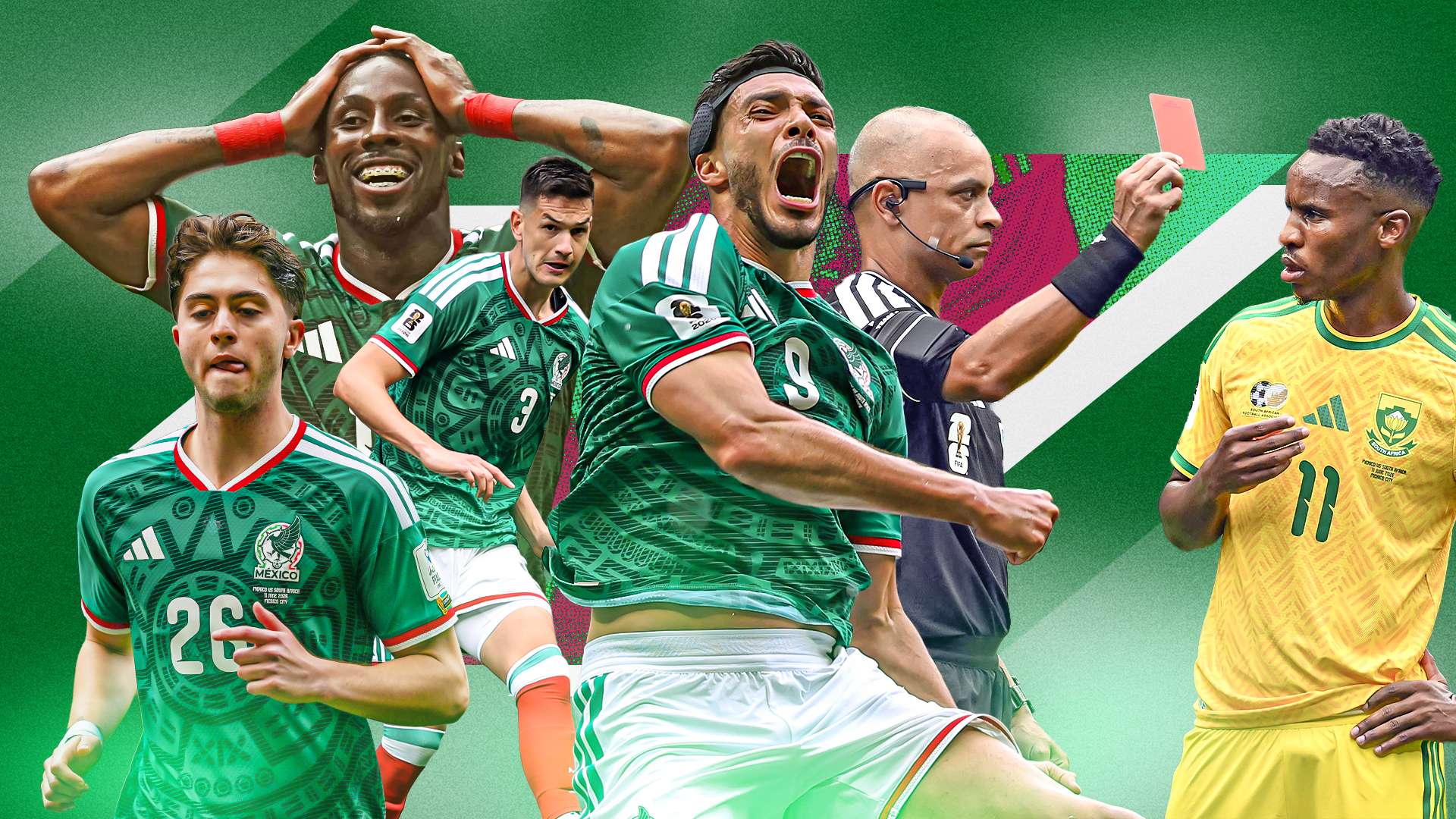
Mexico began their World Cup campaign in memorable fashion, securing a 2-0 victory over South Africa, though the late red card shown to Cesar Montes slightly dampened the celebration. Here’s a closer look at the standout performers and disappointments from El Tri’s opening match.
It might have been only the first of 104 matches, but Mexico ensured that the World Cup atmosphere felt alive from the very start.
At Estadio Azteca, the energy, noise, and colours of a host nation were on full display, captivating millions watching across the world. After seven previous attempts in World Cup openers without a single win—five losses and two draws, including one against South Africa in 2010—El Tri finally broke the streak.
Julian Quiñones opened the scoring in the ninth minute, and Raul Jimenez added a second with a well-timed header in the second half, sealing a 2-0 win over Bafana Bafana. The result extended Mexico’s unbeaten run in 2026 and gave Javier “Vasco” Aguirre’s squad the ideal start they were hoping for.
Next up for Mexico is South Korea in Guadalajara, although they’ll be missing Cesar Montes, who was sent off unnecessarily in stoppage time when the result was already assured.
Mexico City lived up to its billing as a true World Cup host. The fans roared, sang, and pushed their team through an unforgettable afternoon. Still, Mexico could have done more to capitalise on their dominance, especially against a South African team that ended the match with nine players.
Here’s a detailed look at the winners and losers from Mexico’s opening World Cup triumph over South Africa.
WINNER: The Azteca Crowd
This one picks itself.
Thousands of fans gathered outside Estadio Azteca from as early as 6 a.m., with others walking long distances just to witness what could be a once-in-a-lifetime experience. The celebration began early, and inside the stadium, time seemed to stand still.
Then came the national anthems.
Mexico’s anthem was sung with such passion that the stadium seemed to transform into something far beyond concrete and steel. Youngsters like Mateo Chavez, Armando La Hormiga Gonzalez, Obed Vargas, and Gilberto Mora were visibly moved as they sang proudly. Even the South African anthem was met with respect, echoing beautifully across the stands before kickoff.
Mexico has a 12th man, and it’s painted in green. It won’t tire after 90 minutes, nor will it stop pushing from the stands. El Tri must make the most of this intangible yet powerful advantage.
South Africa felt it, and South Korea and Czechia will soon feel it too. There’s no easy way to counter a Mexican crowd that turns a football match into a national fiesta.
LOSER: El Tri’s Drop in Intensity After the Early Goal
After scoring in the ninth minute, Mexico failed to press home their advantage and punish South Africa further.
Perhaps it was the pressure of the occasion or nerves from playing the opening match, but rather than raising the tempo and making it a long afternoon for Bafana Bafana, Mexico seemed content to play it safe.
That reflects Aguirre’s pragmatic approach—protect the lead, maintain defensive solidity, and control the pace of the game rather than chasing a spectacle.
Still, given the setting and the crowd, the moment called for more.
Brian Gutierrez and Quiñones both created dangerous opportunities that could have doubled the lead before halftime, but Mexico entered the break only 1-0 ahead. Against stronger teams, failing to convert such chances can create unnecessary pressure.
Mexico made history and controlled most of the match, but at home in a World Cup, dominance must translate into a ruthless mindset.
WINNER: Roberto Alvarado
Roberto “El Piojo” Alvarado, one of Aguirre’s most consistent starters, delivered a strong performance.
On Thursday, South Africa had no answer for him.
His pinpoint assist for Raul Jimenez’s goal highlighted his precision and composure in the final third. Alvarado kept things simple, focusing on sharp passing, quick combinations, and maintaining Mexico’s rhythm on the right wing.
His chemistry with Chivas teammate Brian Gutierrez gave El Tri a reliable attacking route. Whenever Mexico needed a smart pass or composure near the box, Alvarado was there.
He also showed defensive discipline, tracking back multiple times to help right-back Israel Reyes contain South Africa’s attacks from wide areas.
As long as he stays fit, Alvarado seems undroppable from Aguirre’s lineup. His performance in the opener—with sharp vision, timing, and hard work—silenced much of the criticism surrounding him before the tournament.
LOSER: South Africa’s Red Cards
Bafana Bafana made things worse for themselves.
Sphephelo Sithole and Themba Zwane’s dismissals left Hugo Broos’ side in trouble—not just in this match, but also for their next group fixture against Czechia.
Before the World Cup, Broos had emphasised the goal of winning at least one game to stay in contention for a best third-place finish. That task is now much harder. South Africa left the Azteca with no points, no goals, and two players suspended.
There were some positives, though. Chicago Fire FC defender Mbekezeli Mbokazi impressed with his calmness, left-footed passing, and leadership. He looked like one of the few capable of controlling the tempo and giving his team shape.
But the red cards overshadowed everything else.
Even though Mexico didn’t fully capitalise, Broos could take solace in the fact that the defeat was limited to 2-0. On another day, it could have been far worse.
WINNER: Julian Quiñones
After the final whistle, Julian Quiñones looked like he could have played another 90 minutes.
That summed up his immense contribution. While his goal will be the lasting image, his all-round display was even more impressive. He pressed relentlessly, attacked space, and gave El Tri the spark they needed on an emotionally charged day.
He nearly added a second, striking the post with a shot that might have sealed the result earlier.
What stood out was his understanding of Mexico’s home advantage—both physically and mentally. Having spent years in Liga MX and winning titles with Atlas and Club America, Quiñones understands how altitude and crowd pressure can wear down opponents. He knows when to press, when to force defenders into mistakes, and when to turn loose balls into danger.
Next week’s return to Guadalajara will be special for him. Still revered by Atlas fans after leading them to consecutive Liga MX championships, Quiñones will feel right at home—even if the match against South Korea is at Chivas’ Estadio Akron. The city knows how dangerous he can be when the spotlight shines brightest.
After scoring 33 goals in the Saudi Pro League, he now has his first World Cup goal. It likely won’t be his last.
LOSER: Cesar Montes
Cesar Montes has occasionally been guilty of rash tackles, but this one came at a particularly needless moment.
Mexico were leading 2-0, South Africa were down to nine men, and the game was effectively over. There was absolutely no reason for Montes to risk a foul that led to a red card.
Now Aguirre must plan for South Korea without one of his defensive leaders—a side that looks the most experienced and dangerous in the group.
Montes isn’t just another centre-back; he’s central to organising the defence and handling the physical challenges of a World Cup. His dismissal leaves El Tri facing an avoidable setback after what should have been a smooth evening.
In a match perfectly set up for Mexico—at home, backed by a passionate crowd, and against a depleted South African side—the unnecessary red card created new questions. Aguirre will now need to reshuffle his defensive setup before the second group match.
The fans carried the team through, and the result gives Mexico the strong foundation it wanted. But just like in 2018, their second World Cup opponent will be Son Heung-min’s South Korea.
This time, Mexico head into that clash with three points, confidence, and a suspension they could have avoided.