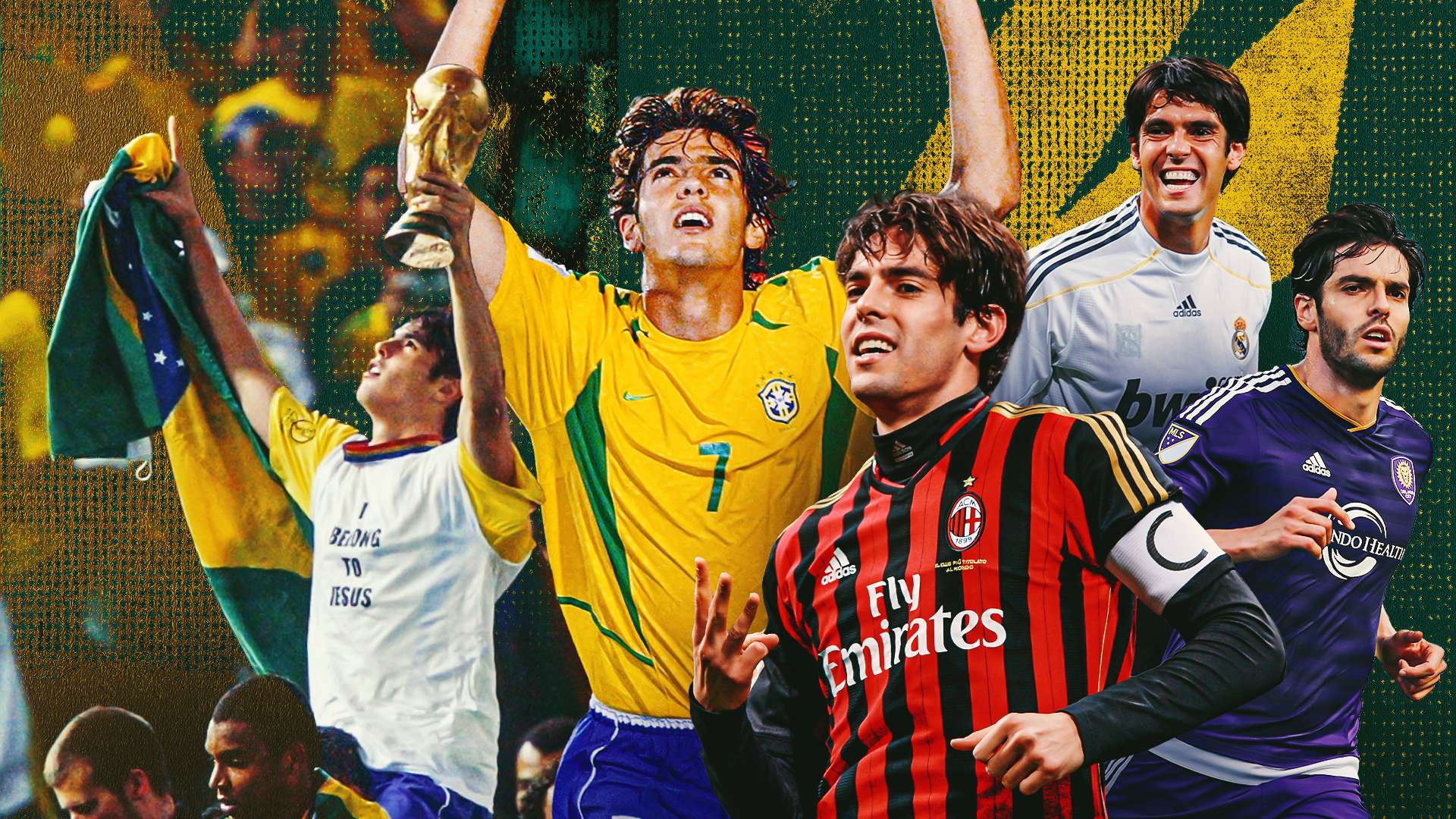
In an exclusive conversation, Brazilian football legend Kaka reflects on winning the World Cup at the age of 20, the immense pressure now carried by Vinicius Junior and Neymar, and why the Selecao’s dream of a sixth star remains alive.
At the 2002 World Cup, Kaka spent most of his time observing others. Then just 20 years old, fresh out of the São Paulo academy and a year away from his move to Italy that would define his career, he was a student among masters in South Korea and Japan. Nearly a quarter of a century later, he admits his mentors were extraordinary.
“It was Ronaldinho, Ronaldo Fenomeno, and Rivaldo. I watched them every day. I wanted to see how they trained, played, and behaved. They were my teachers,” Kaka recalled with a laugh.
That lineup was a dream trio: three Ballon d’Or winners, three of football’s greats, and champions of the 2002 World Cup. Kaka spent nearly 50 days under their guidance, absorbing everything he could. Though he played only 25 minutes in the tournament, he vividly remembers the moment Brazil lifted the trophy. His one-word description—“Incredible.”
Brazilian football has evolved greatly since then, and Kaka was there to witness its transformation. While he is celebrated as one of the modern era’s finest players, his Selecao career peaked early. Now, 24 years after that triumph, Kaka looks upon a different Brazil side—one still carrying the same weight of expectation he once felt.
“The pressure is… It’s incredible. It’s hard to explain. There’s nothing I can say that truly matches the pressure we feel. It’s something really special,” he admitted.
Everyone remembers Kaka’s club achievements—two UEFA Champions League titles with AC Milan, the 2007 Ballon d’Or, and a rare treble of honours as one of only ten players to win the World Cup, Champions League, and Ballon d’Or. Yet, for a Brazilian, footballing success is measured most by the World Cup. Kaka achieved that milestone at 20 but never reached the same heights again, bowing out after the 2010 edition at 28, with Brazil exiting in the quarterfinals both in 2006 and 2010.
“It’s strange because it’s something you cannot train. I can prepare myself emotionally, physically, technically, but I cannot train for being in a full stadium, playing against Argentina or France,” he said. “You never know how you’re going to handle it.”
In 2006, Kaka genuinely believed Brazil would win again, boasting an attacking lineup of Ronaldo, Ronaldinho, Adriano, and himself. “Yes, the expectation was to win again, in 2006 and 2010. But what’s important for me was understanding how hard it is to be in and win a World Cup. At 20, in 2002, I thought it was easy,” he explained.
However, Brazil’s imbalance saw them eliminated in the quarters. In 2010, Kaka received a controversial red card in the group stage, though he still managed three assists before Brazil again fell short. That was his final World Cup, after which he made only ten more international appearances as Brazil rebuilt with a younger generation. “Every year I realised how hard it is to play and win a World Cup. It’s huge to have that in my list of achievements,” he said.
As Brazil prepare for the 2026 edition, the pressure persists. Under Carlo Ancelotti, the Selecao are at a crossroads, having last lifted a major trophy in 2019 with the Copa America. In 2024, Ronaldinho even called them ‘unwatchable’. But Ancelotti, known for his tactical discipline and tournament experience, is expected to restore order. Kaka, who won the Ballon d’Or under him at AC Milan, backs his former mentor. “With Carlo, I had the best period of my career, when I performed really well,” he said.
Brazil’s squad faces injury concerns. Rodrygo is sidelined with a torn ACL, while Eder Militao will miss out due to a muscle injury. The biggest debate, though, surrounded Neymar’s inclusion. Though his prime years are behind him, Ancelotti included him in the 26-man squad—a decision Kaka fully supports. “For me, it’s really important that he’s in the squad. He can help on and off the field. He’s mature; it’s his fourth World Cup. He knows what it takes, how to play, how to behave. It’s great to have him there,” said Kaka.
Neymar’s exact role remains uncertain, with Ancelotti calling him “an important player” but not guaranteeing a starting position as the forward recovers from injury.
Much of the expectation now rests on Vinicius Junior. The Real Madrid winger had an exceptional 2024 season, scoring 21 goals and providing 10 assists in 50 appearances, narrowly missing the Ballon d’Or to Manchester City’s Rodri. However, he has faced criticism over his chemistry with Kylian Mbappe. Kaka defended him: “Vinicius played a really good season. At Real Madrid, if you’re not winning, it’s seen as disappointing. He scored many goals and performed well, but Madrid didn’t win anything. So everyone says it’s a flop.”
Real Madrid have responded by bringing back Jose Mourinho, another of Kaka’s former coaches. Mourinho’s first spell at Madrid between 2010 and 2013 ended in controversy, and Kaka admits it was a difficult time. “Three years with him in Madrid was a challenging but interesting period. I improved a lot. He gave me good advice. I tried my best to play more, but I wish him all the best,” he said. Kaka is intrigued to see Mourinho’s return. “This second stint, he has many Brazilians like Vinicius. It’ll be interesting to see Madrid with Mourinho next season.”
Now, Kaka enjoys the World Cup in a different way. Partnering with DoorDash in the U.S. market, he remains close to the tournament’s spirit. “Football has always been about unforgettable moments created by fans, teams, and players, especially during the FIFA World Cup. I know what it’s like as both a player and a fan—how consuming it is. Partnering with DoorDash means supporting fans with the best assist during the tournament,” he said.
He believes hosting the World Cup in North America will benefit the sport’s growth. “It’s really important for football’s development in the U.S. Hosting such a tournament is great for players, coaches, and different sports cultures,” Kaka noted. He also commented on changes within U.S. college football, praising the shift to a year-round calendar. “I saw the NCAA changes for the next two years. The full-year season is a big improvement for developing players,” he said.
Though he hasn’t played in the U.S. since 2017, Kaka still follows developments closely. “I love following the teams and countries I played in. It’s always on my radar to see what’s happening and how they’re developing football in the U.S.,” he said. Having ended his career at Orlando City SC, Kaka believes Major League Soccer will continue to grow. “MLS is still growing, and we see big names coming in. Now we have Messi there—it’s great to see the league developing,” he added.
For Kaka, the pressure of carrying Brazil’s hopes is long gone. Now, he can simply enjoy the spectacle. Though Brazil may not be favourites, he believes they still have a real chance. “I’m really hoping this is the right moment for Brazil to win the World Cup again,” he said. “We wish for Brazil to claim the sixth star, back in the U.S.”