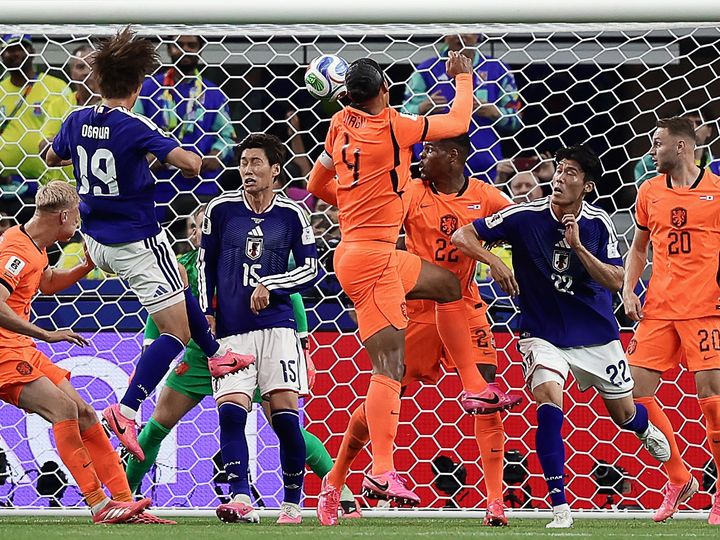
The opening Group F clash of the 2026 World Cup between the Netherlands and Japan at the Dallas Stadium in Dallas, United States, on Sunday (14 June 2026), ended in a 2-2 draw.
For Japan, the draw felt like a victory, but for the Netherlands, it seemed more like a defeat.
In terms of individual quality, the Netherlands clearly stood above Japan. However, their performance relied heavily on collective play, moving as a unit rather than through individual brilliance.
The cautious approach in the first half prevented the Dutch side from scoring. Japan, too, opted for a reactive strategy, maintaining a compact defensive shape.
This made it difficult for the Netherlands to create meaningful chances during the first 45 minutes. They managed only two attacks and one clear scoring opportunity — a shot from Donyell Malen, a header by Jan Paul van Hecke, and another attempt by Malen.
Cody Gakpo, expected to be the main threat, found little space due to Japan’s disciplined defending. The Japanese defenders consistently marked him with two players, forcing him into frequent back-passes.
Japan appeared to target Crysencio Summerville as the trigger point for pressing. Each time he received the ball, two Japanese players immediately closed him down with high intensity. With Gakpo struggling and both Summerville and Denzel Dumfries unable to perform optimally, the Netherlands could only penetrate Japan’s defense through central attacks.
It was understandable that both teams played cautiously since it was their first match of the tournament. Interestingly, both sides displayed impressive passing accuracy in the first half — the Netherlands completed 307 passes with 90% accuracy, while Japan managed 130 passes at 88% accuracy.
Entering the second half, the Netherlands adopted a more aggressive approach, pushing forward with positive passes and taking more risks to box Japan into their own half.
Just five minutes after the restart, Virgil van Dijk scored with a header from a Ryan Gravenberch cross. Only seven minutes later, Japan equalised through a powerful strike by Keito Nakamura, who outsmarted Denzel Dumfries and Bart Verbruggen.
Japan proved capable of attacking but remained overly cautious until they were behind. Once trailing, they finally took the initiative to move forward.
Summerville’s goal in the 64th minute restored the Dutch lead, but Daichi Kamada’s equaliser in the 88th minute ensured that both teams shared the spoils. The Netherlands went ahead twice, only to be pegged back each time by Japan.
This raised an important question: why couldn’t the Netherlands hold onto their advantage? In every measurable aspect, they were superior to Japan. They attacked, dominated, and scored — their strength clearly lay in offense.
However, after leading 2-1, Dutch coach Ronald Koeman instructed his team to play more defensively. This was evident from his substitutions starting in the 70th minute. Attack-minded players like Tijjani Reijnders and Summerville were replaced by more defensive options such as Teun Koopmeiners and Quinten Timber. The final switch — bringing on Nathan Ake for Gravenberch — left the Netherlands with five defenders.
There is nothing wrong with defending, but doing so from the 70th minute while only one goal ahead seemed questionable. Why not push for a second or third goal instead? The Netherlands’ strength lies in attacking; so why retreat so early?
Was this the result of a miscalculation by Koeman? It could be said so, as his overly cautious approach backfired. The consequence of defending too early was Kamada’s 88th-minute equaliser that cost the Netherlands two valuable points.
Many have argued that this reflects Ronald Koeman’s mentality — one inclined to defend narrow leads. In a post-match interview, he stated, “I think it was a good match, and a draw is not a bad result.”
This further strengthens the perception that Koeman’s mindset does not align with the traditional attacking philosophy of Dutch football. For a nation like the Netherlands, a draw against Japan is far from ideal, especially in a World Cup where every point and goal could determine qualification for the knockout stage.
Both teams still have two matches left to fight for a place in the last 16 of the 2026 World Cup. For the Netherlands, two points slipped away, and their two-goal advantage ultimately meant nothing. If Koeman continues with this cautious mentality, the Netherlands might not progress far in this tournament.
*The writer is a Philosophy student at the State Islamic University of Surakarta.