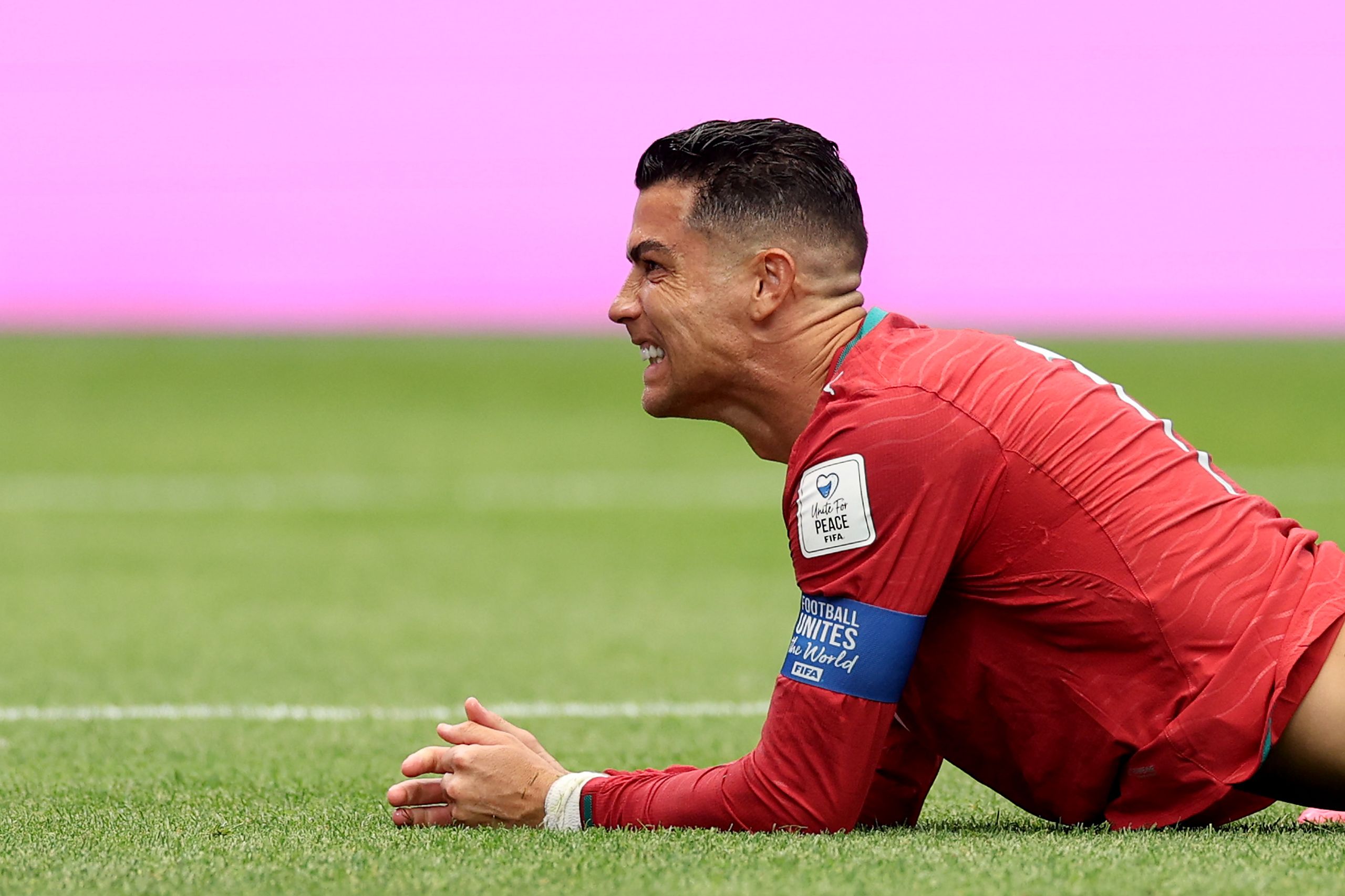
Portugal’s captain Cristiano Ronaldo appears to be the most obvious weak link in Roberto Martinez’s squad. Yet if he were to lift this tournament’s trophy, what would that say about the state of football today?
The year is 2026. Cristiano Ronaldo pushes Bruno Fernandes, Vitinha and Bernardo Silva away from a free-kick, taking his familiar position over the ball. His trademark stance, a deep breath, and that coiled posture – everything is ready. He takes a step left, charges forward, and strikes.
Inevitably, the ball soars high into the sky. Aside from Nike commercials, nearly every Ronaldo free-kick you’ve seen in recent years has ended the same way. It hardly matters which one we’re describing – you’ve seen enough clips of a 41-year-old Ronaldo trying to imitate his 21-year-old self: the stutter, the stepovers, the stance that’s grown stiffer with time. The memes of his free-kicks have lasted longer than the years he was a genuine set-piece master. For fans who adored the 2006 version of him, it’s bittersweet to watch.
Ageing is no disgrace; the world has changed dramatically in those two decades. Portugal have celebrated their first international triumph, and UEFA created a new competition that Portugal have since won twice. The country now enters tournaments not as dark horses like the Netherlands or Belgium once did, but as a bona fide football superpower, boasting more talent than Brazil on paper. That would have sounded ludicrous when Ronaldo made his debut.
Ronaldo himself has been busy. Over 900 career goals, five Ballons d’Or, and a European Championship to his name. Yet Lionel Messi has eight Ballons d’Or and a World Cup. So Ronaldo clings on, much like Mufasa on a cliff edge, desperate to match that feat.
The signs of this fixation were visible long ago – refusing to celebrate teammates’ goals, taking on an impromptu coaching role after being injured in the Euro 2016 final while Fernando Santos looked too nervous to tell his captain to sit down, and even trying to claim Bruno Fernandes’ goal at the 2022 World Cup before ball-tracking technology proved otherwise.
The 2026 Ronaldo seems almost like a body double – a man weighed down by his own ego, with Roberto Martinez seemingly tethering Portugal’s ambitions to it, unaware that it could drag the entire team down, as happened in Turin and Manchester. His supporters point to his title win in Saudi Arabia, Martinez’s unwavering endorsement, and most notably, his 13 goals since Euro 2024. Those numbers, undeniably, speak loudly.
Cristiano Ronaldo, at 41, is compared by his supporters to Miroslav Klose or Davor Suker in their prime. Goals win matches, and no one has embodied that truth more emphatically. “Until the wheels fall off” might signal retirement for others, but for Ronaldo, the wheels seem to keep spinning.
Goals have never really been the issue since he left Real Madrid. He scored over 100 goals in three seasons at Juventus and maintained a one-in-two strike rate at Manchester United. The problem lies in his all-round play – which statistics struggle to capture. This was evident in 2022 when he was dropped for Goncalo Ramos, who scored a hat-trick in Ronaldo’s absence. Four years older now, he looks further diminished. It was the same at Juventus, where the club’s dominance faded, and at Manchester United, where Ole Gunnar Solskjaer’s steady project collapsed after Ronaldo’s arrival.
For those who watch closely, Ronaldo has never been a true lone striker. He thrived as a winger, then an inside forward, and finally as part of a front two alongside Karim Benzema at Real Madrid. He doesn’t press, hold up play, win aerial duels, link up, or move like a traditional number nine. Kylian Mbappe faces similar criticism — at his best in a pair or wide role, he too struggles as a lone forward. The difference is that Mbappe is in his prime; Ronaldo’s was 10 to 15 years ago. His ambitions now seem smaller — to simply exist in the penalty box.
Watching Portugal’s final warm-up matches before heading to North America has been unsettling. Even Ronaldo’s most devoted fans might admit that he looks far from his best. Criticism of CR7 is never neutral, but it feels warranted.
What was once a rivalry between two footballing giants has become a philosophical debate. Messi, the selfless playmaker, now drops deeper to assist and orchestrate — as seen with his sublime reverse pass against Iceland in Argentina’s last pre-World Cup match. Ronaldo, meanwhile, represents the opposite ideal — the ultimate individualist, a man who through discipline and defiance overcame every obstacle and refused to accept decline. He is not a cog in a system but a brand, a hero who must save the day.
Portugal’s squad, however, is more cohesive than ever. Their midfield is exceptional — Joao Neves and Vitinha offer balance and control that few teams can match. Ahead of them, Bruno Fernandes has just completed a record-setting season with 20 league assists, later receiving a bonus one from the Premier League for good measure. Nuno Mendes is arguably the world’s best left-back, Diogo Costa is known for his penalty-saving prowess, while Ruben Dias and Joao Cancelo bring experience and winning mentality. Forward options like Pedro Neto, Goncalo Ramos, and Rafael Leao would be the envy of most nations. It’s a remarkably balanced team — except for one oversized ego.
That’s Roberto Martinez’s challenge, whether he recognises it or not. And perhaps, if this Portugal side were to win despite Ronaldo, it might not be good for the game. For years, Ronaldo symbolised the term “mentality” — his gestures, expressions, and aura were studied by those seeking to emulate his drive. His rise was inspiring; his refusal to step aside gracefully should be instructive too.
What would it mean if individualism triumphed on football’s biggest stage? Would it be right for Ronaldo to finally bask in ultimate glory? Or is there something troubling about the idea that perseverance alone — staying on long past your peak — defines greatness? Is dignity as important as victory? Does legacy depend as much on when to stop as on what you achieve?
It’s not personal, but it would feel like watching the villain win. There’s more romance in Ronaldo stepping back, channelling his hunger into inspiring others. Imagine him as a super-sub, coming on late to turn tight matches into 15-minute shootouts — even at 41, that could be his niche. But starting every game, taking set-pieces from Bruno Fernandes, and missing chance after chance only hurts Martinez’s side.
One day, we’ll show our children videos of Cristiano Ronaldo and tell them about his rivalry with Messi — two opposing ideologies. And depending on what we show, they may not believe that this man — prone to tantrums at 41 — once terrified defenders and was genuinely discussed as the greatest ever. There’s still time for Ronaldo to add another chapter to his story, though it may not be kind to him — or to football itself.