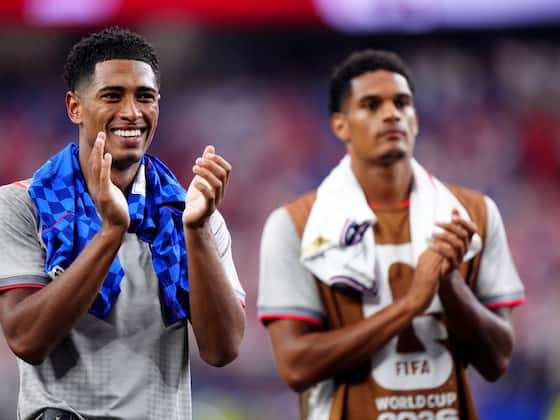
As Jude Bellingham walked off the field, the familiar tune of “Hey Jude” echoed through the loudspeakers at the sprawling Dallas Stadium. England supporters sang in unison as Bellingham made his way towards the tunnel, waving to fans, hugging teammates, and soaking up the applause with calm composure.
Although this was officially Harry Kane’s night — his two goals drawing him level with Gary Lineker’s record of 10 at World Cups — it arguably held deeper meaning for Bellingham. The young midfielder has faced both public criticism and private doubts from his manager, enduring a level of scrutiny that few of his England teammates have experienced. Earlier this season, a headline in the Daily Mail bluntly read, “Don’t bring Jude,” implying England might fare better without him in the World Cup squad.
“It feels great to put all that noise aside and just show my country and teammates how dedicated I am to helping us win,” Bellingham said after scoring England’s third goal in their 4-2 victory.
One of Thomas Tuchel’s most debated choices before this opening match — and throughout his 18-month tenure — was whether to start Bellingham or Morgan Rogers as his No 10. Bellingham had missed the September qualifiers due to shoulder surgery, a poorly timed setback. During that period, England produced their best performance under Tuchel, a 5-0 win in Serbia, in which Rogers shone brightly.
Despite Bellingham’s return to full fitness at Real Madrid, Tuchel left him out of the next training camp. There was also the notorious comment about Bellingham’s “repulsive” on-field behaviour — which Tuchel later attributed to a language slip and his mother’s influence — for which he apologised.
Tuchel believed England had forged a strong “brotherhood” during their September and October gatherings, recalling a moment in Serbia when unused players performed their own detailed warm-down. He wondered whether a personality as strong as Bellingham’s could blend seamlessly into such a group.
Even after Bellingham made the World Cup squad, his starting role against Croatia was not guaranteed. When asked before kick-off why Bellingham was chosen over Rogers, Tuchel replied, “It was really close. In the end, we went with the team that played and started so well against Costa Rica.” It was hardly an emphatic endorsement of Bellingham’s abilities.
Was he picked for his big-match temperament and knack for crucial goals? Of his six prior England goals, two were openers and three were late equalisers — including that memorable overhead kick against Slovakia at Euro 2024. But Tuchel dismissed that reasoning, calling it “a 50-50 call,” as though Bellingham had narrowly beaten Rogers in a dressing-room coin toss.
Tuchel had no shortage of other No 10 options. Eberechi Eze did not feature, while Phil Foden and Cole Palmer watched from home. Yet, what sense would it make to overlook Bellingham’s extraordinary skill set? Here is a player Real Madrid signed for €103 million at just 19, who lifted the Champions League at 20, and who, at 22, is featuring in his fourth major tournament. By comparison, Steven Gerrard reached his fourth at 30, Frank Lampard at 36.
Bellingham demonstrated why he is indispensable to England’s World Cup ambitions. Beyond his technical ability lies his aura — a commanding presence that inspires teammates and unsettles opponents even before the first whistle.
Any doubts surrounding his early mistake — losing possession in the buildup to Croatia’s opening goal — were quickly erased by a superb second-half display. For decades, England’s Achilles heel has been retaining possession against strong opposition in tournament heat and pressure. Gareth Southgate had begun to address that issue late in his tenure, but this 45-minute stretch surpassed anything seen before.
Bellingham orchestrated England’s control, collecting the ball deep and distributing it with precision, shielding it from opponents, spinning into open spaces, and driving forward with purpose. During England’s blistering 20-minute spell after the break, he looked both physically and technically superior to every other midfielder on the pitch.
Defensively, he was immense too. His three tackles — more than any player on either side — were not mere touches but full-blooded challenges that swept through opponents cleanly, drawing deep chants of “Juuuuuude” from the stands and approving applause from Tuchel on the touchline.
Bellingham’s crowning moment came with his goal — the culmination of a 23-pass sequence. Fixing his gaze on the goalkeeper, he surged into the box, brushed off his marker, and slotted a precise finish off the far post past Dominik Livakovic.
The performance encapsulated everything that makes Bellingham special: his ability to shield the ball using his physique, intelligence, and quick feet — whether receiving under pressure from England’s centre-backs or charging into the opposition area with defenders bouncing off him.
His career outside the Premier League spotlight may have limited his domestic appreciation, but his off-ball qualities are world-class — his positioning, pressing, and relentless pursuit of possession. Since his England debut, no player has won more duels or recovered the ball more frequently in the final third.
Bellingham is not an easily defined No 10. He tackles, passes, dribbles, scores, and combines strength with flair. His youth coach at Birmingham City once joked that he could play roles 4, 8, and 10 simultaneously — and therefore gave him the No 22 shirt to reflect all three.
Tuchel admitted that leaving Rogers out was tough, given his strong qualifying performances. “But you can always rely on Jude in these moments,” he explained. “He thrives under pressure — that’s when he’s at his best. So it was an easy call to trust him, especially after how he bought into the team spirit and brotherhood over the past couple of weeks.”
When Declan Rice went off with a minor knock in the second half, Bellingham dropped deeper alongside Anderson. The adjustment underscored Tuchel’s trust, particularly with England holding a narrow 3-2 lead and needing control in midfield.
Asked if he felt he had a point to prove, Bellingham smiled, “A little bit, yeah. I guess I’ve got a bit of a chip on my shoulder. You always play better like that. It helps me lock in early and find that intensity.”
He added, “It’s part of being a footballer. I don’t bear grudges against those who criticise me — sometimes I deserve it. But today, it was good to remind people what I’m really about.”