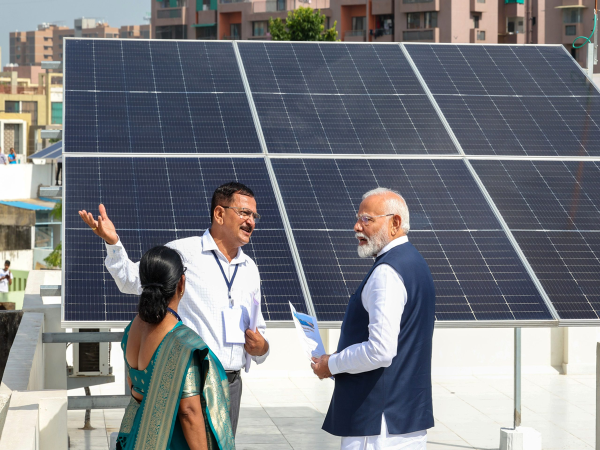
Rising electricity bills during the summer season become a major concern for every household. In such a scenario, having a zero electricity bill would be a tremendous relief. The Central Government's 'PM Surya Ghar Muft Bijli Yojana' (PM Surya Ghar Free Electricity Scheme) is being implemented with this very objective and is rapidly gaining popularity across the country. According to the latest data, over 35.14 lakh solar installations have been completed nationwide. This has directly benefited more than 42.86 lakh families. The government aims to reach 1 crore (10 million) families through this scheme.
Which states are seeing the highest uptake?
Healthy competition is being observed among various states in adopting this scheme.
Gujarat currently holds the top spot in the scheme. Over 7.05 lakh solar installations have been completed there, and more than 10.16 lakh households have joined the scheme.
The scheme is also progressing rapidly in Maharashtra, where over 9.86 lakh households are benefiting.
In Uttar Pradesh, more than 6.03 lakh solar panels have been installed so far, benefiting over 6.18 lakh families.
Meanwhile, in the national capital, Delhi, 13,689 households have benefited from the scheme through 9,110 installations.
What are the benefits under the PM Surya Ghar Yojana?
According to J.V.N. Subramanyam, Joint Secretary at the Union Ministry of New and Renewable Energy, the government provides a subsidy of up to ₹78,000 for a solar system with a 3 kW capacity.
The total cost of a 3 kW system is approximately ₹1.60 lakh.
The government provides financial assistance covering up to about 60% of this cost.
The subsidy amount is transferred directly to the beneficiary's bank account.
The entire process is usually completed within 45 days.
How to apply?
Joint Secretary J.V.N. Subramanyam stated that the government has made the entire process digital and user-friendly. To apply:
Applications can be submitted from the comfort of one's home via the PM Surya Ghar portal or WhatsApp.
Approximately 30,000 registered vendors are listed on the portal; users can select a vendor of their choice based on ratings.
Once a vendor is selected, solar panels are typically installed within 15 to 20 days.
Following installation, DISCOM officials inspect within about a week. Once the verification is complete, the subsidy amount is credited directly to the bank account.
The Joint Secretary further noted that the scheme, launched in February 2024, is rapidly gaining traction among the general public. The pace of adoption is evident from the fact that over 300,000 people were reached last month alone, and 100,000 new users are joining every 7–8 days. Several factors contribute to this momentum; for instance, feasibility clearance is no longer required for setups of up to 10 kW. The mandatory physical site visit has been eliminated, and the process has shifted to an 'auto-feasibility' model.
**Scheme Significant Amidst West Asia Crisis**
The Joint Secretary added that the scheme is not limited to merely reducing electricity bills but is also linked to the country's energy security. Rooftop solar panels enable induction cooking at home, thereby reducing reliance on LPG. Additionally, electric vehicles (EVs) can be charged using this power, cutting down on petrol and diesel expenses. In essence, the scheme is not only a means to save electricity but is also considered a major step towards a future of clean and affordable energy.
Disclaimer: This content has been sourced and edited from NDTV India. While we have made modifications for clarity and presentation, the original content belongs to its respective authors and website. We do not claim ownership of the content.