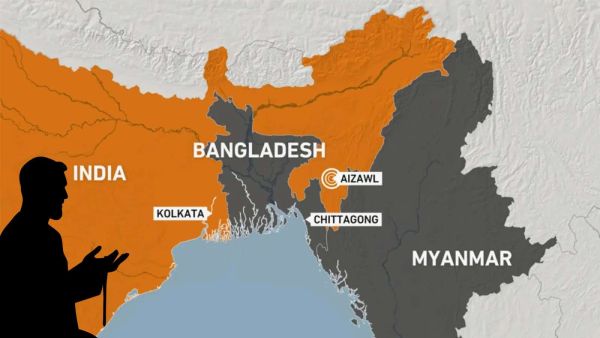
Hyderabad: A 76-year-old Rohingya Muslim fleeing violence and persecution in Myanmar was arrested while entering West Bengal. He was sentenced to two years in prison.
His family members in Hyderabad knocked on every possible door in the hope of securing his release. They approached the Telangana High Court, but found no relief. They moved the Supreme Court.
They soon realised that pursuing the case would require nearly Rs 1 lakh in legal expenses.

The Rohingya Muslim man, now 84, is still in jail, confined to a detention centre in Kolkata.
His story is not unique.
During the COVID-19 pandemic, 20 Rohingya Muslim refugees living in camps in Hyderabad were rounded up and shifted to a detention centre following orders issued by the office of the then director general of police. They spent nearly one-and-a-half years in detention.
Even today, many Rohingya Muslim refugees are placed under detention for an endless period for minor offences which are not even criminal in nature.
Senior advocate MA Shakeel, who has represented Rohingya refugees in such cases, told Siasat.com that the principle of non-refoulement prohibits countries from deporting, returning or extraditing individuals to territories where they face threats to their life or freedom, or risk torture, persecution and other serious human rights violations.
“If any Rohingya Muslim refugee serves the sentence and deserves to be released, he is still kept in jail for good, as Myanmar will not accept that refugee, just because Rohingyas are not issued passports in their home country, and wouldn’t accept their own citizens back,” Shakeel said.
The advocate believes that there is discrimination between refugees coming from different countries, depending on how those countries are aligned with the Government of India
There is a Tibetan Centre in Delhi where refugees from Tibet are housed, which the members of Parliament frequent quite often. Most Nepalis are daily wage labourers. They get voter IDs, through which they also apply for Aadhaar cards and other documents.
“Rohingyas and Bangladeshis are being kept in a separate box (category),” he observes.
Shakeel strongly believes that Article 21 (Right to life) and Article 14 (equality before law) clearly state that the State shouldn’t deny these rights to “any person,” and not just Indian citizens.
“There are refugees (non-Rohingyas) applying for voter IDs and getting Aadhaar cards using different names. But as the government believes, they don’t vote because they are scared that they will be caught. Without any identity card, there is always a threat to Rohingyas of being sent to detention camps,” he opines.
There are many ways through which Rohingya Muslim refugees are being exploited. In the absence of a government-run camp, they stay in makeshift sheds, spending between Rs 1,500 and Rs 2,500 in Hyderabad’s Balapur, under inhuman conditions.
Most of the Rohingyas are being exploited as cheap labour in abattoirs in Chengicherla, as rag-pickers, and in the construction industry. They are paid half the wages which are usually paid to any other worker.
A volunteer who had worked with the Rohingya Muslims in 2010-2011 tells Siasat.com on condition of anonymity that during that time, an effort was made by the Telangana civil supplies department to provide rice at Rs 10 per kg to the Rohingyas living inside the private camps. However, they couldn’t afford to purchase rice at that subsidised rate due to poverty.
According to the volunteer, there was a Supreme Court’s direction to provide basic needs to all refugees living in the country, the reason why that effort was made.
“But now the scenario has changed in the country,” the volunteer observes.