
The paper leaks, the cancellation and the rescheduling of the NEET-UG examination has thrown the lives of over 2.2 Mn medical college aspirants into disarray. It has also exposed a recurring, systemic crisis of integrity in the Indian education system.
In the wake of public outrage over the past month, the central government’s response was to target the digital messenger and restrict access to Telegram. This response has drawn the ire and the attention of nearly every home in the country.
Later today, millions of students will once again take the NEET exam and their fate will once again rest on the hope that this time there will be no leaks. If indeed that’s not the case, the ban on Telegram will start to look gravely misplaced.
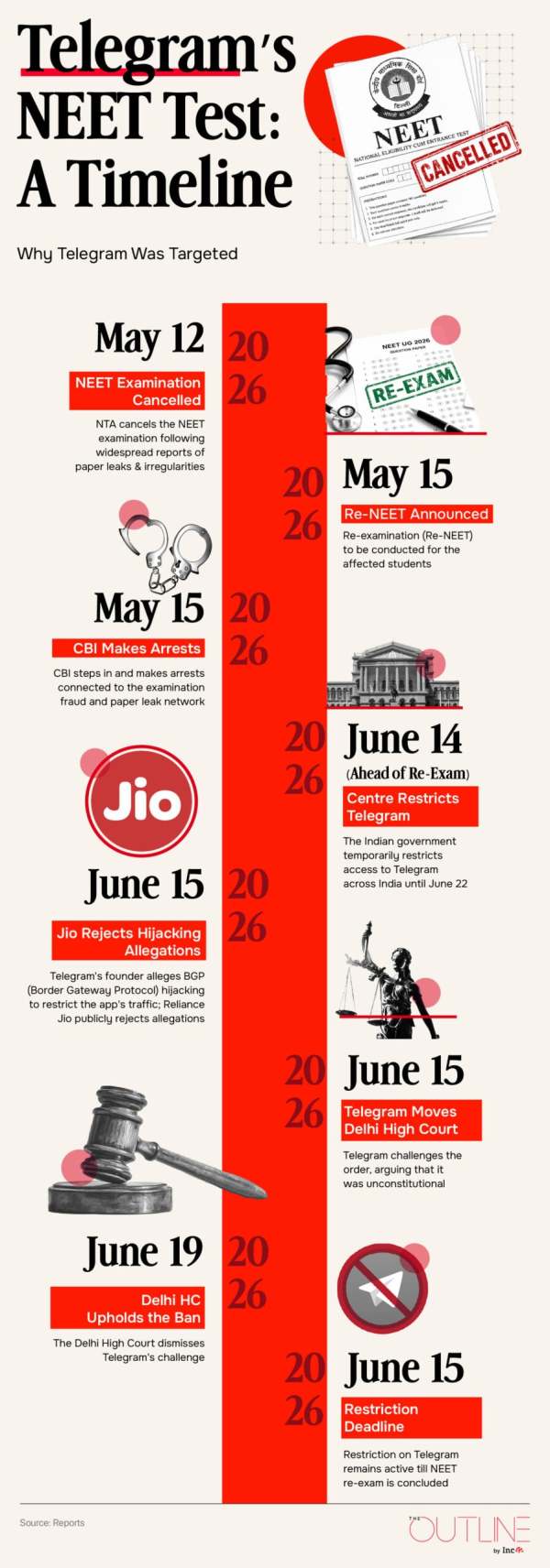
Acting under Section 69A of the Information Technology Act, the government temporarily put a ban on Telegram in India and has even likened it to the dark web.
As Telegram took the fight to the Delhi High Court, the court declined to interfere with the government’s blocking orders and Telegram is inaccessible in India till June 22 at the very least.
The court found that the requirements of natural justice were satisfied and that the power to block “information” is wide enough to permit the blocking of an entire platform.
Nevertheless, the drastic measure has severely divided the legal, cybersecurity, and policy communities. For some, the ban represents a necessary exercise of state leverage.
Lawyers we spoke to say the government has the authority to suspend apps if there is a reasonable basis to view the platform as a conduit for criminal activity that has failed to mitigate risks. The question being asked is whether this was justified.
But beyond this, the situation is an indictment of the Indian edtech ecosystem. Even as millions of students are affected, the Indian education ministry is still floundering to figure out a solution and edtech companies are busy running coaching classes. In the age of AI, the only clear response from the government has been to ban AI, rather than work with Indian startups and tech companies to figure out a solution at scale.
Before we get to that, let’s see what the ecosystem has to say about the ban on Telegram.
Why The Hammer On Telegram?Sohini Mandal, founder of Nilaya Legal, adds that this is the first time the government has imposed a platform-wide ban, arguing that because it is for a very short period, it meets the test of proportionality as the least restrictive mechanism available to prevent student extortion.
This perspective is rooted in the reality of uncooperative tech giants. As Rahul Rai, cofounder of law firm Axiom5, pointed out, the act of leaking is the core wrongful conduct, and Telegram is merely a means of dissemination.
“If the government has secured evidence of the paper being tossed around by a set of masked IDs and seeks their identities. What can the Indian government do when an app like Telegram just simply refuses to cooperate?” he wondered.
Others echo this, noting that temporary bans create friction, reduce immediate dissemination risks, and establish accountability expectations for intermediaries.
Responding to the court’s statements, the Internet Freedom Foundation (IFF) warned that treating the speech of a whole population as a single switch to be turned off sets a concerning precedent for the open internet, noting that a temporary duration does not automatically satisfy the standard of choosing the least restrictive means.
However, many experts argue that treating the symptom ignores the disease.
Maheshwer Peri, founder of Careers360, calls the move extremely short-term and myopic. “You need to plug the loophole, which is the leak, not the distribution,” he argues. “Tomorrow, if there’s something on YouTube, you’ll ban it. You actually have to go after people who are spreading false messages instead of targeting one platform.”
Others cautioned against mistaking disruption for resolution, warning that organised fraud networks are highly fluid and quick to adjust, while the root causes—insider compromise, weak controls, and poor verification—remain untouched.
Furthermore, the collateral damage is already immense. Several students have died by suicide in the aftermath of the cancellation and this has spurred the government to act faster against the leaks, but there’s no guarantee that the examination this afternoon will be free from these concerns.
Tech policy adviser Pranesh Prakash argues that many of these Telegram channels are actually seeking to scam students with fake leaks by backdating edited messages. He suggests the government should instead follow the money trails of these scammers, as UPI possesses multiple layers of KYC. “The necessity test doesn’t pass, the proportionality test doesn’t pass.”
Prakash asserted that millions of lawful exam aspirants are harmed by losing access to legitimate study resources. These users have been cut off due to the actions of a few subsets they have no connection to. In many cases, this includes teachers who legitimately conduct quizzes and catch-ups on Telegram.
In the wake of the ban, even these scrupulous users who are not hiding being fake accounts or bots have to find new means and this disruption could prove costly so close to the exam date.
Anirudh Rastogi, founder of Ikigai Law, warns of the dangerous precedent this ruling sets: “In the future, if a government wants to shut down an app before an election or during a protest, it will rely on this precedent. The ‘temporary’ framing makes it more concerning because that is precisely what makes it so easy to invoke.”
Edtech Leaves A Gaping VoidAmidst this chaotic cycle of NEET paper leaks and the temporary ban on Telegram, a glaring realisation emerges. Where is technology in the education sector?
Edtech in India has become a byword for coaching prep and cohort-based learning (skilling and certification) All three have parallels in that they are aiming to replicate the offline experience, but no true IP-led tech product has emerged that is solving the real problems in the Indian education system.
The blame is not only on founders, but also on the government and the education ministry, which has not done enough to boost tech adoption to solve problems at scale.
This mirrors India’s deficiencies in deeptech, though the factors at play at different. It’s not that Indian founders and startups do not have the technical proficiency to solve these problems, but that the ecosystem has not been built for such long-haul plays.
Investors in India are overwhelmingly driven by the pursuit of rapid, outsized returns, effectively pushing founders toward consumer-facing applications, SaaS models, or high-margin edtech test-prep platforms, whilst shying away from arduous, infrastructural B2G (business-to-government) problems.
It’s no wonder then that startups shy away from solving the hardest problems, or struggle to scale and sustain themselves without VC funds in the initial periods. Solving the problems related to NEET, CUET, JEE and other large scale tests involves painful and long engagement cycles with government departments and it has a higher degree of difficulty.
For all the billions of dollars poured into India’s booming educational technology sector over the past decade, the ecosystem has entirely failed to tackle the root causes of examination fraud.
A senior faculty member at PhysicsWallah noted off the record that platforms like Telegram have democratised learning, helping teachers reach students in Tier II and III cities who previously lacked access to immediate resources.
But the NEET leak highlights severe risks. “While temporary restrictions might be an understandable immediate precaution, they stressed that long-term solutions are needed, including stronger security measures, stricter action against cheating, and greater accountability at every level,” the senior PW exec added.
Teachers feel that platforms need to dedicate true effort toward creating IP-led technology that can survive the real world challenges over several generations. Building something of this magnitude demands years of painstaking, unglamorous engagement with lethargic government bodies, fragmented state-level authorities, and cautious policymakers.
Where Is The Real Edtech Innovation?But that doesn’t mean change cannot come. On the academic side, some ideas have been floated on how testing can be revamped through tech, even though these ideas have yet to be implemented on a nationwide scale.
A clear example of how structural redesign can be implemented is the Secure National Examination Conduction System (SNECS), proposed by Dr Santosh Ramrao Butle. SNECS outlines a paradigm where no question paper exists in a readable physical or digital format anywhere in the country until precisely 30 to 60 minutes before the exam begins.
Dr Butle is a professor in the School of Pharmacy at Swami Ramanand Teerth Marathwada University in Nanded, Maharashtra and has direct operational experience managing hybrid-mode examinations for approximately two to three lakh students across more than a hundred centres annually.
SNECS has been submitted as a formal policy proposal to the National Testing Agency and the Ministry of Education but so far the system has not been considered for national-level implementation.
Under SNECS, AI automatically selects questions from a massive, secure repository. The final paper is locked in high-grade encryption that requires simultaneous authorisation from multiple independent institutions to unlock, and is printed directly at the examination centres. Coupled with stringent biometric verification, systems like SNECS illustrate the true potential of applied technology.
The fact that solutions like SNECS or blockchain-secured frameworks remain largely conceptual is a damning indictment of India’s innovation priorities. And here the blame also falls on the Indian government which has shown lethargy when it comes to revamping key sectors such as education and agriculture. A lot of focus is on modernising school infrastructure, but when students are forced to protest on the streets or harm themselves, questions need to be asked.
The recurrence of paper leaks that affect millions of students is not a question of technological capacity, but of intent. Because the broader edtech ecosystem has failed to tackle this foundational problem, the state is forced to resort to stopgap, reactive measures like banning Telegram or going after online dissent.
If we are to future-proof the integrity of examinations in India, it is time for a drastic pivot. The continuous cycle of leaks, sporadic arrests, and public outrage will persist as long as human hands are allowed to handle examination papers.
It is time that India’s edtech ecosystem steps up to the plate. The problem is clear and present, and the willingness to change things at an all-time high. If this does not spur an edtech renaissance in India or a second coming after the bitter taste left behind by BYJU’s or the fate of dozens of other startups, then there can be little hope for edtech in India.
The post NEET, Telegram Ban And The Edtech Void appeared first on Inc42 Media.