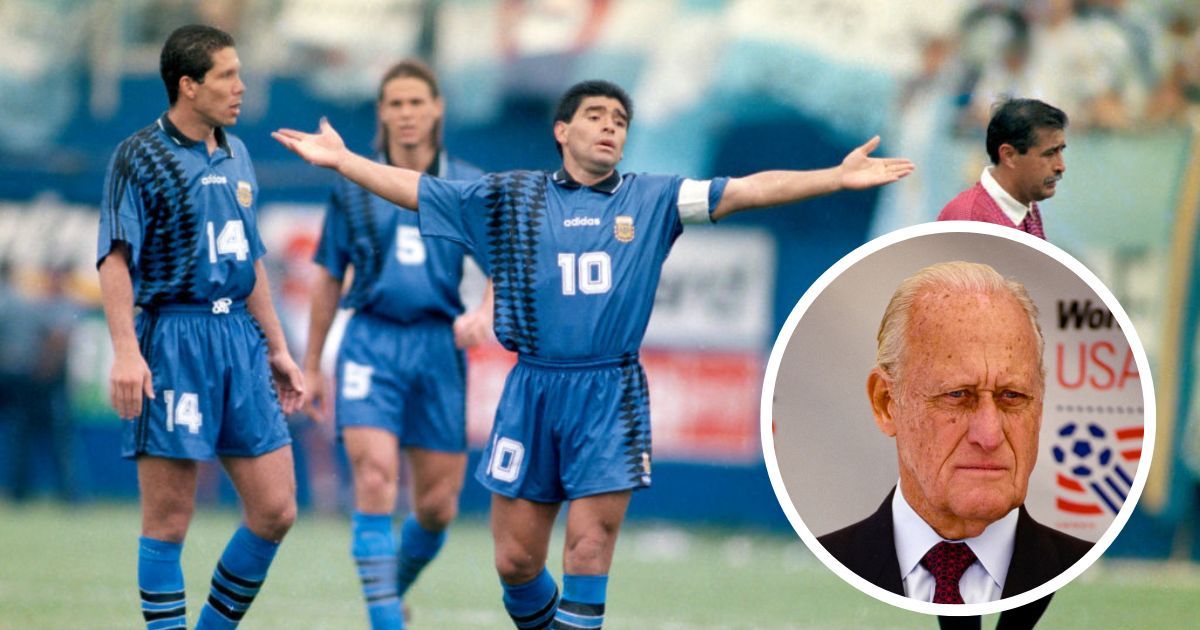
Hydration breaks may have drawn criticism during the 2026 World Cup, but the idea of dividing football matches into four segments has actually been around for much longer than most people realise.
The early to mid-1990s marked a particularly experimental period in football history. Trying to capture the lucrative American audience through the 1994 World Cup, FIFA faced a unique challenge. Major US television networks were uneasy about broadcasting a sport that featured 45-minute halves with no built-in commercial breaks.
FIFA, meanwhile, was still reeling from Italia '90 — a tournament often remembered as one of the dullest and most defensive in World Cup history, with an average of just 2.21 goals per game and a final marred by fouls and negativity.
In an effort to make football more appealing to American viewers and boost goal-scoring, FIFA explored several radical proposals. Among the most extreme was the idea of dividing matches into four 25-minute quarters.
In March 1990, FIFA President João Havelange stunned the football world by suggesting that the game abandon its traditional two 45-minute halves in favour of four shorter quarters. His motivation was clear — to make the sport more compatible with American broadcasters such as ABC and ESPN, who owned the rights for the 1994 tournament.
Television executives argued that without regular pauses for advertising, televising the event posed a major financial risk. The reaction from football traditionalists, however, was immediate and furious.
UEFA, strongly supported by the British Home Associations on the International Football Association Board (IFAB), took a firm stand in defence of the sport’s long-standing structure. They refused to sacrifice football’s continuous play for the sake of television commercials.
Remarkably, another idea floated at the time was to enlarge the goals. FIFA even discussed increasing the width between the posts by a few inches to make scoring easier — a suggestion that might have pleased Diana Ross after her famous missed penalty in the 1994 opening ceremony. This proposal, too, was firmly rejected by UEFA and IFAB.
With alterations to match duration and goal dimensions off the table, FIFA and IFAB looked for other ways to encourage attacking football ahead of the 1994 World Cup. Their solution came in the form of new rules that are considered standard today, such as the back-pass rule introduced in 1992 following a particularly tedious European Championship final in Sweden.
For the first time at USA '94, goalkeepers were banned from handling deliberate back-passes from teammates. This change effectively eliminated the time-wasting tactics that plagued Italia '90 and Euro '92, where defenders would repeatedly return the ball to their goalkeepers.
Another major change was the introduction of three points for a win. Although first proposed in 1981, it was implemented for the first time at a World Cup in 1994. The system aimed to discourage teams from settling for goalless draws, with the group stage awarding three points for victory instead of two.
USA '94 also brought several other firsts — referees were allowed to wear colours other than black (often yellow, pink, or white) to avoid kit clashes, and players had their names printed on their shirts for the first time in tournament history.
In the end, these compromises paid off. The 1994 World Cup in the United States became a resounding commercial success, setting attendance records that remain unbeaten and producing a much-improved average of 2.71 goals per match — all achieved without introducing commercial breaks into the game itself.