Psychology suggests adults who feel uneasy around clutter may be reacting to cognitive overload, not judging cleanliness
ETimes June 23, 2026 11:40 PM
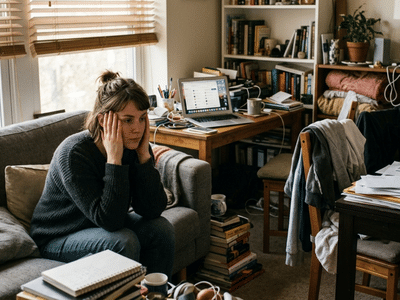 A pile of parcels in an untidy state sits on a side table. Clothes hung loosely on chairs. Counters are filled with things that have piled up over time.
These situations are just not noticed by some people. But others find it quite annoying. The room might not be dirty, and there is nothing really wrong about it, but somehow the place makes you mentally exhausted.
Psychologists believe that such reactions have more to do with cognitive load than with hygiene or perfectionism. Often, it is related to the way individuals perceive visual input and the amount of energy required to be put into a cluttered space.
Clutter, in several studies, has been described as being visual noise that competes for your attention and makes it difficult for you to feel relaxed and comfortable.
Clutter could influence a person’s perception of home
Although clutter is usually described in the context of household chores, scientists have investigated the psychological impact of this phenomenon.
In 2022, scientists published their paper about the impact of clutter, psychological home, and well-being in the journal Behavioral Sciences, available through. They based their research on the widely accepted definition of clutter provided in the Journal of Environmental Psychology, which states that “clutter is an overabundance of possessions that collectively create chaotic and disorderly living spaces”.
As a result, the study found that more clutter was correlated with a weaker sense of psychological home and lower subjective well-being. Psychological home can be seen as a comfortable, safe, and pleasant place to live.
Additionally, it is worth noting that age had a different effect on the impact of clutter on one's perception of their home, although the negative correlation was established for all age categories.
Why does clutter become stressful?
Some research indicates that clutter could affect more than the appearance of a room.
According to a-indexed study, according to an article published in the journal Health & Place, data gathered from older Americans indicated that people with high levels of clutter in their homes experienced more anxiety and depression symptoms. The authors considered clutter to be a characteristic of one’s living conditions rather than one’s personality or neatness.
It suggests that one’s surroundings could affect one's emotional state. If the space is difficult to organise or navigate through, any activities could become more challenging and stressful.
However, the authors of the article did not claim that clutter could cause anxiety and depression directly. Nevertheless, they managed to establish a connection between the two characteristics.

An overcrowded room increases the demands made on attention
One way in which clutter could be exhausting is by presenting more stimuli that need to be processed by the mind.
Scientists who investigated the phenomenon of household chaos looked into how clutter, crowding, noise, and other forms of overstimulation affect people's perception of their surroundings. Reportedly, greater chaos in the home was associated with increased stress and lower feelings of control.
According to scientists, environments rich in competing stimuli may add further demands on attention.
Everyone does not respond the same way to clutter
Anyone who has lived in an environment surrounded by family members, flatmates, or even a partner has surely observed that there is a significant difference in how tolerant people are of the level of clutter around them.
According to psychologists, individual variations in the capacity of attention and working memory may account for such disparities.
The findings revealed that people differ in their capacity to block out distractions and irrelevant data. People who are highly skilled at controlling their attention will not be easily distracted by competing stimuli, while others will find it difficult to focus despite distractions.
In a cluttered atmosphere, these differences can become even more prominent.
An experiment conducted in 2025 used virtual reality to explore how humans find objects in ever-increasingly complicated visual fields. The scientists discovered that the more cluttered a scene was, the longer it took for individuals to identify the target. The subjects focused on irrelevant objects and reviewed the data repeatedly. Older individuals performed significantly worse, whereas working memory was a determining factor in performance.
This evidence indicates that complicated visual fields may raise cognitive load in order to execute even relatively easy tasks.
How sensory processing may affect clutter tolerance
Scientists have been researching the effects of sensory processing on one’s perception of clutter. It is important to note that the mentioned research does not mean that all the people who are not fond of cluttered spaces are neurodivergent.
When all of the findings are taken into consideration, it becomes clear that the discomfort associated with clutter might go beyond a mere preference for a clean place.
The experts state that the responses towards clutter are related not only to cleanliness but also to attentional and sensory needs of humans. Clutter creates visual complexity, which results in a greater amount of stimuli to filter and a greater number of distractions during routine activities.
This does not mean that every messy space causes problems or that everyone feels uncomfortable in clutter. However, based on psychological theories, when certain adults become distressed in such places, it may be due to the sensory and cognitive burden rather than cleanliness only.
In other words, in such a case, clutter works similarly to background noise. The more distractible a person is, the noisier it becomes.