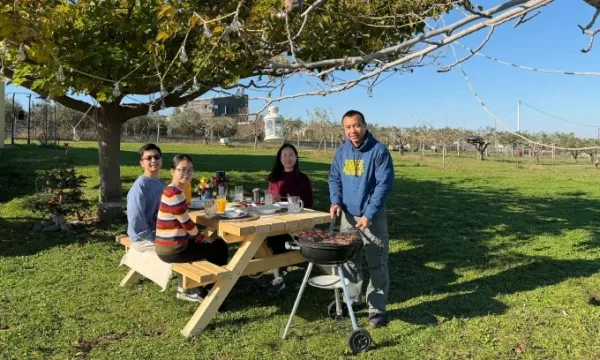
They moved to Thessaloniki in 2019 through the European country’s residency-by-investment program. A year later, they left the city and purchased a 5,700-square-meter property in the suburbs.
As their visa category did not allow them to take salaried jobs, the two decided to retire in their 50s and study Greek to qualify for citizenship. As the only Vietnamese family in the area, they sought to create familiar aspects of life back home to ease their homesickness.
|
Truc Quynh and her family in their garden on the outskirts of Thessaloniki, Greece. Photo courtesy of Quynh |
Quynh’s husband returned to Hanoi to buy fruit tree saplings and vegetable seeds to bring back to Greece, and installed an automatic irrigation system on the property.
They had initially assumed the climate there would be similar to northern Vietnam’s, but there was heavy winter snowfall that killed many of their Vietnamese fruit plants like Dien, a famous variety of pomelo from Hanoi, dragon fruit, lychee, longan, star apple, and herbs such as Vietnamese balm and rice paddy herb.
“Looking at the empty garden, I realized not every plant I liked would grow here,” Quynh says.
After that, the couple adopted a more systematic approach, improving the soil with homemade organic compost and switching to crops better suited to local conditions like beans, sticky corn, water spinach, and oriental melon.
The planting season begins in March. Quynh’s husband observed that the best time to sow water spinach, Malabar spinach, and mustard greens was when honeybees emerged from their hives after winter.
After five years of work, the garden now supplies most of the vegetables, fruits, and herbs consumed by their family of four, including the couple and their two children. Except rice, meat, and fish, all their food is homegrown. The land produces a wide variety of seasonal crops, including fig leaves traditionally served with fermented pig ear and roasted rice powder.
Of all the plants they tried, tea was the only one that failed completely, despite being grown in a greenhouse with heating throughout the winter. On the other hand, two 20-year-old cherry trees left by the previous owner regularly continue to bear fruit. One ripens early and the other late in the season, extending the family’s harvest period further than its neighbors’.
Wild birds frequently feed on the cherries. Since Greek law prohibits harming wildlife, the couple can only try to scare them away.
“There are so many different fruits in the garden that we’ve gradually become used to sharing some of them with the birds,” Quynh says.
Once the cherry season ends, the family harvests blackberries, raspberries, loquats, plums, pears, and peaches. They also collect olives from 50 mature trees already growing on the property, producing more than 100 liters of olive oil annually, enough for cooking and making salad dressing throughout the year.
 |
|
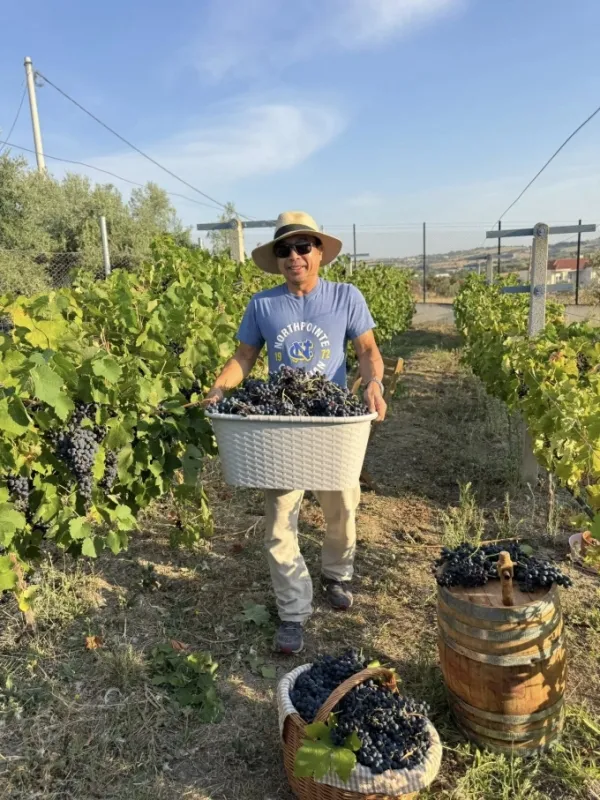
Truc Quynh’s husband harvests grapes from their garden in Thessaloniki, Greece. Photo courtesy of Quynh |
In addition to growing produce, Quynh also makes many traditional Vietnamese staples and seasonings. To ensure a year-round supply of fish sauce, she learned a recipe from a friend in Hanoi and began fermenting it herself.
Each batch uses four kilograms of fresh fish purchased at the port, washed with seawater and mixed with one kilogram of locally sourced coarse salt and a pineapple. The mixture ferments for two years before being filtered and left to mature in the sun for another six months. In the early years, filtering each batch by hand took the couple around two days. Later, Quynh’s husband, a mechanical engineer, designed his own pressing and filtration machines to reduce the workload and processing time.
Fish sauce is not the only traditional Vietnamese staple Quynh makes at home. She bought a noodle-making machine and uses locally grown Greek rice to produce fresh rice noodles. Every March, she buys small local red shrimp, salts, and ferments them in glass jars for about a year to make shrimp paste.
These homemade staples allow the couple to make dishes such as pho, banh gio, a steamed rice dumpling filled with minced pork and mushrooms, and bun dau, a popular Vietnamese dish of rice vermicelli and fried tofu typically served with fermented shrimp paste.
Their home sits in a windswept grassland area. In the outdoor cooking space, Quynh’s husband welded a custom iron stand so she could braise fish and cook rice in cast-iron pots over a wood-fired stove.
“The smell of wood smoke makes me feel as though my homeland is close by,” Quynh says.
Thanh Hai, a visitor from Hanoi, said she was impressed by how the family had maintained Vietnamese cooking traditions while adapting to local ingredients in Greece.
“They’ve managed to preserve a distinctly Vietnamese way of eating, with everything from fish sauce to olive oil made by hand,” Hai said.