The Ministry of Land, Infrastructure and Transport announced on Monday that it is expanding its International Remote Baggage Screening program to include Los Angeles International Airport and Seattle-Tacoma International Airport, Korea Times reported.
The initiative enables a more seamless, “luggage-free” transfer experience for passengers connecting to domestic U.S. flights, streamlining airport procedures and improving transit efficiency.
|
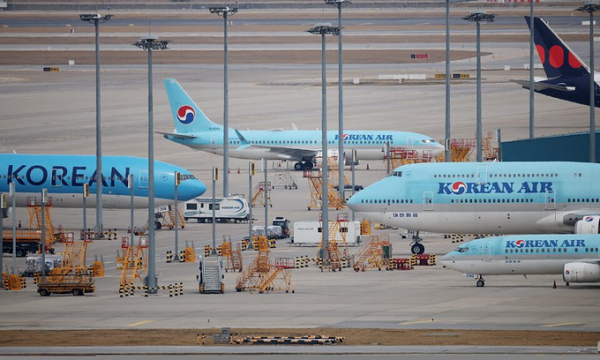
Korean Air aircraft are parked at the Incheon International Airport in Incheon, South Korea, March 31, 2026. Photo by Reuters |
Previously, passengers connecting through Los Angeles or Seattle were required to first clear U.S. immigration, retrieve checked baggage at the carousel, complete customs inspection, and then carry their luggage to a separate airline counter for re-check-in, ChosunBiz reported.
The procedure typically takes around 90 minutes and creates a major bottleneck for transit travelers.
A new remote baggage screening system aims to eliminate this step.
Under the program, high-resolution X-ray images of checked luggage are transmitted from Incheon Airport directly to U.S. Customs and Border Protection (CBP) while flights are en route. CBP officers review the scans in real time, and approved bags are automatically transferred to connecting flights, allowing passengers to proceed directly to their departure gates.
The service will initially be rolled out for passengers of Korean Air and Delta Air Lines who meet CBP eligibility requirements. It will apply to both passengers departing from South Korea and transit travelers connecting through Incheon from third countries.
Incheon International Airport was voted the world’s second best airport after Changi by the 2026 Skytrax awards. The airport handled 73.55 million international passengers last year, making it the third busiest airport globally just after Dubai International Airport in the UAE and London Heathrow Airport in the U.K., according to data from the Airports Council International.