The political landscape in Tamil Nadu is currently charged with tension as Chief Minister Vijay and DMK leader MK Stalin engage in a fierce verbal clash. What began as a debate within the assembly has now spilled over into public discourse and social media. This exchange, filled with accusations, sarcasm, gestures, and jibes, has evolved beyond a mere personal confrontation between two leaders, signaling a shift in Tamil Nadu's political dynamics.
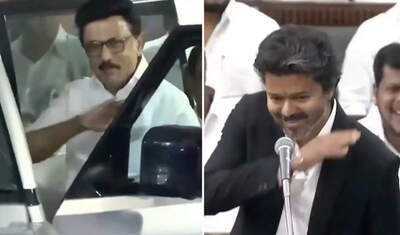
The controversy ignited during a discussion on the Governor's address in the assembly, where Chief Minister Vijay, in his characteristic cinematic style, narrated a brief story targeting the opposition, particularly the DMK. He made a pointed remark about the opposition leader Udhayanidhi Stalin, referencing their electoral defeat and implying that his father was absent from the scene. This jab was directed at MK Stalin, who was not present in the assembly.
Vijay's remarks were not merely political commentary; his theatrical delivery seemed to provoke the DMK. During his speech, he mimicked a hand gesture associated with Stalin, which had already become a political meme in recent months. This moment quickly gained traction on social media. In response, DMK legislators staged a walkout in protest, yet Vijay continued with his address.
MK Stalin wasted no time in retaliating. While addressing a gathering in Thiruvarur, he asserted that whether present in the assembly or not, he would always remain in the hearts of the people. He quipped that those wishing to see him could find him in the files at the secretariat, where welfare schemes like the Kalainar Rights Scheme are documented. Stalin emphasized that politics should not be treated as a stage for theatrics.
Stalin accused Vijay of undermining the dignity of the assembly, claiming that the Chief Minister's speech resembled a film presentation rather than addressing pressing public issues. He pointed out that Vijay failed to provide substantial answers regarding critical matters such as power outages, farmers' issues, law and order, and electoral promises. Stalin also alleged that Vijay insulted farmers by attributing their movements to opposition instigation.
The DMK leader raised concerns about the filming of assembly proceedings, suggesting that the Speaker allowed Vijay's speech to be recorded without interruption, as if it were a movie shoot rather than a legislative session. Stalin advised Vijay to step away from his actor persona and fulfill his responsibilities as Chief Minister.
This clash is not merely about personal insults; it reflects a deeper narrative of shifting power dynamics in Tamil Nadu politics. Vijay, who launched his party Tamilga Vetrikazhagam in 2024, has quickly established a significant presence in state politics. While his popularity is still largely tied to his film persona, his assertive demeanor in the assembly indicates his ambition to position himself as a viable political alternative.
For the DMK, this challenge is far from simple. The party, with a long political legacy from Karunanidhi and Stalin, is now contending with a rival who is seen as a formidable force in engaging the public. Vijay's approach resonates with youth and first-time voters, prompting the DMK to respond swiftly to his every remark.
Political analysts believe this conflict could shape the direction of upcoming elections, as Vijay's strategy is becoming increasingly clear. He is presenting himself as a leader who is distinct from traditional parties, aggressive, and direct in communication. Meanwhile, Stalin is leveraging his experience, administrative capabilities, and the DMK's commitment to social justice as his strengths.
Tamil Nadu's political scene has always been characterized by strong personalities and emotional political styles. The confrontation between Vijay and Stalin has ushered this tradition into a new era. It will be intriguing to see whether the public favors cinematic charisma or seasoned political leadership in the future. One thing is certain: this clash will keep the political temperature in the state elevated for a long time.