FanSided MLS
·25 June 2026
In February 2020, Lionel Messi travelled with Barcelona FC to face Napoli in the first leg of the UEFA Champions League Round of 16. The game ended in a 1-1 draw, though that is not the main focus here.
What truly matters is that this was Messi’s first visit to Naples — widely regarded as the “Holy Land” of the Iglesia Maradoniana, or the Church of Maradona. The church was founded in 1998 by three friends in Rosario, Argentina — Messi’s own hometown — with the mission of spreading their passion for football in honour of Argentine legend Diego Maradona, who they revered as a football “god.” When Messi visited Naples in 2020, the sect’s leader, Hernán Amez, described him as “the living hope” of their Church, adding that the only thing Messi still needed to match Maradona was “to bring the Argentine people to the streets for the joy of a triumph,” as Maradona had done after the historic 1986 World Cup victory.
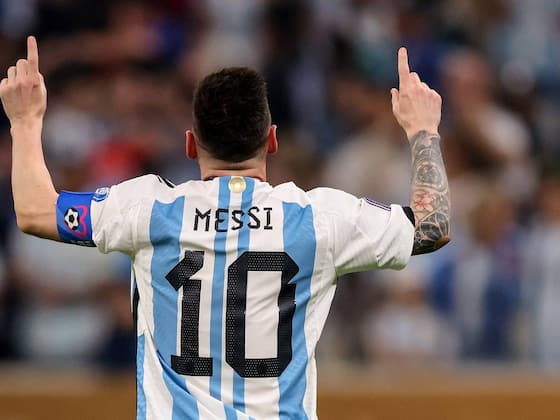
Now, six and a half years later, Messi has indeed led Argentina to their third World Cup title (2022) — following previous wins in 1978 and 1986 — secured two Copa América trophies (2021 and 2024), collected two more of his record eight Ballon d’Or awards (2021 and 2023), and broken the all-time World Cup goal-scoring record (as of June 22). His appeal transcends national boundaries, with cities and countries across the globe celebrating his legacy through murals and monuments — such as the recently unveiled 85-foot, 70-ton steel statue in Cutral Co, Argentina.
Will the Iglesia Maradoniana now elevate Messi to divine status? Or will his own followers create a new movement to honour their hero in a similar way? It would not be surprising if they did. Yet, it seems unlikely that Messi himself would encourage such reverence, even playfully. A practising Roman Catholic, he has consistently attributed his success to his faith.
“It’s very clear to me that I was born this way because God chose me,” Messi told Juan Pablo Varsky during an appearance on the Argentine podcast Clank in 2023.
“It was a gift He gave me. I tried to make the most of it and did everything I could to get the best out of it. The truth is, although I worked hard, I did nothing to become the player I already was as a child,” he added, as quoted in a June 2025 Premier Christian News article that drew heavily from the Clank interview.
Messi also told Varsky that he had prayed before playing in the 2022 World Cup final, which Argentina won 1-0 against France.
“Even more so at that moment… I didn’t ask my grandmother or Diego [Maradona], but I did ask God, as always,” Messi explained. “I thank Him every day of my life for this and for everything He has always given me. I can’t ask Him for anything more because, thanks to Him, I have everything.”
An image from the 2010 World Cup shows Argentina coach Diego Maradona speaking with Lionel Messi after a match. | Cameron Spencer/GettyImages
While Messi does not worship Maradona as a deity or saintly figure, he has always expressed deep admiration for his former idol and national team coach.
In 2010, during one of the finest seasons of his illustrious career, Messi declared that he would never reach Maradona’s level.
“Diego is Diego and for me he is the greatest player of all time. Even after a million years, I’m not going to come close to Maradona,” Messi told The Telegraph of London. “I have no intention of comparing myself with Maradona — I want to build my own legacy through what I have achieved.”
He has certainly done that and continues to do so, even as he turns 39 this Wednesday.
And that, truly, is a blessing for everyone who loves football — regardless of faith.