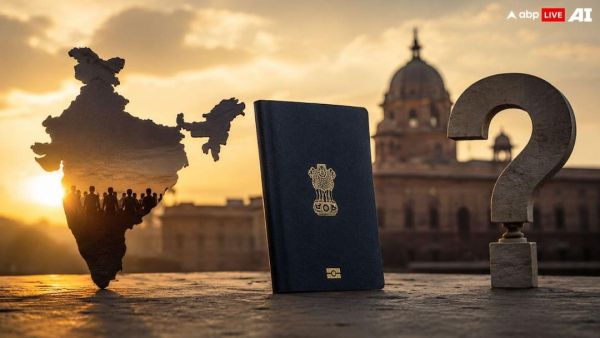
For decades, Indians have believed that a passport represents the highest official recognition of their nationality. It is issued by the Government of India, carries the national emblem, identifies the holder as "Indian", and is accepted worldwide as proof of nationality while travelling abroad.
Yet, recent statements by the Ministry of External Affairs (MEA), coupled with judicial observations on Aadhaar and earlier court rulings on passports, have exposed a far more complicated reality. The result is not merely a legal debate over documentation but a deeper question about identity itself.
If neither a passport nor Aadhaar conclusively establishes Indian citizenship, what does? More importantly, what should an ordinary citizen do when different arms of the State appear to attach different meanings to the country's most recognisable identity documents?
The confusion stems from an uncomfortable distinction between identity, nationality and citizenship.
The MEA recently clarified that a passport is primarily a travel document and not a standalone certificate of citizenship. Officials explained that while passports are issued after verification of documents submitted by applicants, the document itself does not independently establish citizenship in every legal context.
Separately, the Supreme Court ruled that Aadhaar cannot be treated as proof of citizenship or domicile. The court reiterated that Aadhaar is designed to establish identity, not nationality, although it may be used as an additional document for identity verification in specific circumstances.
Legally, these positions are not entirely new. Citizenship in India is governed by the Citizenship Act, 1955, under which a person may become a citizen through birth, descent, registration, naturalisation or incorporation of territory. Unlike many countries, India does not issue a universal citizenship certificate to every citizen. Instead, authorities often rely on a combination of documents depending on the legal context.
However, the practical implications are far less straightforward.
Most Indians possess an Aadhaar card. Many hold voter identity cards, driving licences, PAN cards and passports. Yet none of these, individually, is recognised as conclusive proof of citizenship.
That leaves citizens facing an uncomfortable paradox. The government issues these documents, requires them for countless public and private services, and treats them as proof of identity in everyday life. But when citizenship itself comes under scrutiny, each document carries limitations.
The ambiguity becomes even more striking when viewed through the lens of judicial precedent.
In 2013, the Bombay High Court held that an Indian passport is fundamentally a travel document and cannot be regarded as conclusive proof of citizenship. The reasoning relied partly on the Passports Act, 1967, which allows the Central Government, under specific circumstances, to issue passports even to non-citizens in the public interest. According to the court, questions of citizenship must ultimately be determined under the Citizenship Act rather than through possession of a passport alone.
Five years later, the Delhi High Court appeared to assign considerably greater evidentiary value to the same document.
In Prabhleen Kaur v. Union of India (2018), the court described an Indian passport as a significant document evidencing a citizen's nationality. It ruled that passport authorities could not arbitrarily question an applicant's nationality based on vague suspicions, particularly where previous passports and other official records already existed. The judgment also recognised that denial of passport services could affect fundamental rights.
Taken together, these decisions reveal a noticeable divergence in judicial interpretation. One court treats the passport as insufficient to conclusively establish citizenship; another emphasises its substantial evidentiary value while protecting citizens against arbitrary administrative action.
For legal experts, these distinctions may be manageable because each judgment arose in a different factual and statutory context. For the average Indian, however, the distinction is far less obvious.
If the country's most secure travel document cannot definitively establish citizenship, and the country's largest identity database cannot do so either, citizens are left wondering which document actually does.
The answer, according to existing law, is that there often is no single document. Citizenship is determined through multiple records assessed together depending on the circumstances. Birth certificates, citizenship certificates issued through registration or naturalisation, documents relating to parents' citizenship where relevant, electoral records, school certificates and other government documents may all become part of the assessment.
Legally, that framework may be coherent.
Administratively, however, it places a considerable burden on citizens to preserve decades of documentation, often across generations. It also creates uncertainty because the evidentiary value of any individual document may change depending on the authority examining it and the legal purpose for which it is produced.
The debate, therefore, extends beyond passports or Aadhaar.
It is ultimately about certainty.
Citizenship is the foundation upon which voting rights, constitutional protections and access to the State rest. When the documents issued by the State itself are treated differently across institutions and legal settings, questions naturally arise about what constitutes a reliable proof of belonging.
An Indian passport still carries immense practical significance. It enables international travel, reflects recognition by the Government of India and identifies its holder as an Indian national abroad. Aadhaar remains indispensable for establishing identity and accessing numerous public services. Neither document has become meaningless.
But recent developments underline a more sobering reality: neither was designed to answer every legal question about citizenship.
For millions of Indians, the challenge is not proving who they are in daily life. It is understanding what the State itself ultimately accepts as proof that they belong to it.