For the first time in India, preparations are being made to set up an entire city just for the data centre. This data center city proposed in Alor village, about 55 kilometers from Hyderabad, will be developed in about 1500 acres. Its objective is to create a place where data center companies can get electricity, water, high speed fiber network and modern infrastructure in a single complex. Today, due to the increasing demand for AI, cloud computing and digital services, large data centers are being built all over the world. In such a situation, this project is considered to give a new direction to India's digital infrastructure. Its special thing will be that there is a plan to use treated dirty water instead of fresh water for cooling. Let us know about the country's first data center city…
Data center city is not like a normal IT park. This is a special area where the entire infrastructure is prepared keeping in mind every need of the data center building companies. There will not only be buildings to house servers, but power substations, high speed fiber network, cooling system, backup power, security system, wide roads and necessary utility networks will also be developed together. With this, companies will not have to arrange for electricity, water or internet at different places and they will be able to start their data centers in less time.
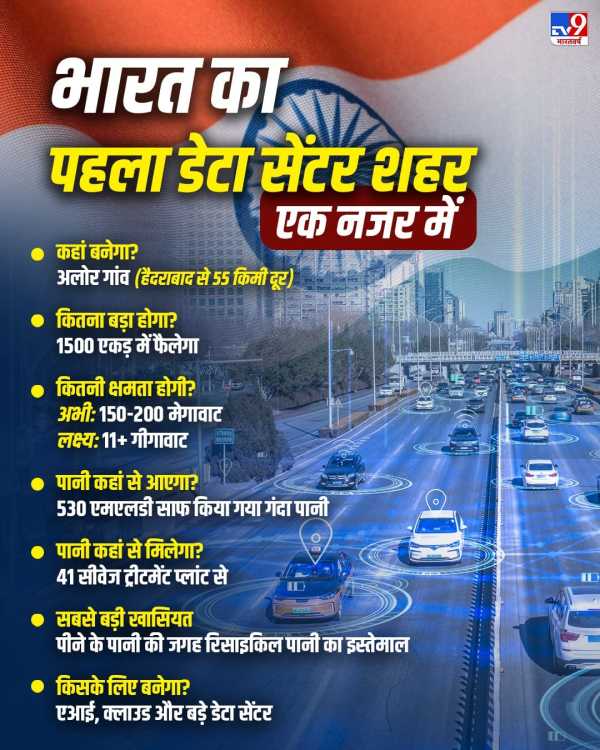
Data centers are not just buildings to house computers. Thousands of servers run continuously in these and to keep them cool, large cooling systems, power substations, transformers, water tanks, backup systems and network equipment are required. This is why such a large area is required. Keeping in view the future demand, a large-scale expansion has also been planned in the proposed data center city, so that new companies can also get space. With this thinking in mind, about 1500 acres of land has been identified.
Data centers run 24 hours a day without interruption. In such a situation, the biggest challenge is continuous electricity and cooling. Keeping this need in mind, this project is being considered to provide electricity to the companies through open access. Instead of fresh water, dirty water treated in the city's sewage treatment plant will be used for cooling. There is a plan to transport about 530 MLD of treated water coming out of 41 STPs of Hyderabad Metropolitan Water Supply and Sewerage Board to data centers and industrial areas through two separate pipelines. This will reduce the pressure on drinking water and water can be reused on a large scale.
Till a few years ago, data centers were mainly used to run websites and cloud services, but now the picture has changed. Due to technologies like generative AI, machine learning and large language models, the need for data processing has increased manifold. Whereas earlier a server rack used to consume 5 to 15 kilowatts of power, now GPU-based AI systems are demanding 30 to 120 kilowatts of power. To keep such a system cool, modern cooling technology is also required. This is why now emphasis is being laid on developing not just the data center but the entire data center ecosystem.
Hyderabad is already home to data centers for companies like Amazon, Microsoft, ControlS, CapitaLand, STT Global, NTT Data, Sify and Tillman Global Holdings. According to officials, currently data centers with 150 to 200 MW capacity are running. While about 5 gigawatt capacity projects are in the pipeline. Apart from this, MoUs have been signed for proposed data center projects with capacity of more than 11 GW in Telangana. This is the reason why this city is being designed keeping the future demand in mind.
Digital services are expanding rapidly in India. With the rise of online payments, cloud computing, OTT, e-commerce and AI services, the demand for data is continuously increasing. In such a situation, big data centers are becoming the backbone of the country's digital infrastructure. The objective of the proposed data center city is not just to provide space to install servers, but to create such a digital ecosystem where companies can get electricity, water, network and expansion facilities at one place. If this model is successful then other states can also develop similar data center cities in future.