During his time as leader of the opposition and in the run-up to the 2026 assembly elections, Suvendu Adhikari frequently used the term ‘sticker badal’ (change of sticker) to ridicule Mamata Banerjee’s welfare regime. Adhikari’s contention was that Banerjee merely repackaged central schemes like Pradhan Mantri Awas Yojana and Pradhan Mantri Gram Sadak Yojana as Banglar Bari or Pathashree. Adhikari wouldn’t tire of saying that the TMC was all about replacing the old sticker with a new one to claim ownership of the scheme.
Now that he has replaced Banerjee as chief minister, Adhikari is either renaming those very programmes or dismantling them. Where a new scheme (like Ayushman Bharat) is replacing an old one (Swasthya Sathi), the new administration’s message is that they are not just changing the stickers but fundamentally altering how the welfare programme is targeted and funded. Vying for attention are 90-odd social welfare schemes of the Mamata Banerjee government at an annual outlay of nearly Rs 1.8 lakh crore, or 45 per cent of budgetary expenditure.
The BJP government has retained that expenditure envelope while replacing the TMC’s Bengali nomenclature — Lakshmir (pronounced Lokkhir in Bengali) Bhandar, Swasthya Sathi, Banglar Yuva) with Hindi/Hindu-coded names (like Annapurna) or PM-branded Central schemes. The outlays have been retained but attributions and name associations redirected.
This makeover of welfare schemes became clear in the maiden budget of new state finance minister Swapan Dasgupta presented on 22 June. The budget pivoted significantly toward aligning with Central policies, aggressive job creation and real estate and industrial deregulation. The major policy shift involves the ‘double engine’ integration, which officials estimate has unlocked nearly Rs 40,000 crore in previously withheld or paused Central funds.
Derek O’Brien accuses BJP of imposing vegetarianism through school meal policyFor example, the highly popular Lakshmir Bhandar women’s cash transfer scheme has transitioned to Annapurna Yojana with the benefit going up from Rs 1,000 to Rs 3,000 per month. But the beneficiary base has shrunk. A strict biometric/voter data verification exercise has removed nearly 30 lakh names, branding them ‘fake’ or ‘ineligible’.
There are eligibility hurdles as well, which have changed the no-strings-attached, universal nature of Lakshmir Bhandar. Development economist Abhiroop Sarkar says, “Direct benefit transfer schemes around the world work on the principle of universal coverage. The idea is to include everyone, even ineligible beneficiaries, to ensure that nobody, not a single eligible beneficiary is left out.”
Sarkar cautions that tight and complicated eligibility criteria will keep a large number of genuine beneficiaries out of the welfare net. The exclusion of 30 lakh women validates Sarkar’s apprehension. Simple arithmetic shows that with an outlay of Rs 36,000 crore, the Annapurna Yojana can provide the promised Rs 3,000 to one crore women — a sharp drop from the 2.4 crore beneficiaries under Lakshmir Bhandar.
****
Similarly, the transition from a fully state-funded Swasthya Sathi to the central Ayushman Bharat will shift nearly 1.43 crore low income families to the 60:40 Centre-state fund-sharing arrangement. More importantly, this will mean a shift from an insurance-based health system (Swasthya Sathi) to an assurance-based model. While each model has its own benefits and lacunae, managing the transition is going to be critical.
Among other welfare measures, West Bengal has now adopted the central PMAY-G (Pradhan Mantri Awas Yojana–Gramin) with an allocation of Rs 13,000 crore to construct 2.5 million rural homes. Rural jobs are being heavily backed by the rollout of the VB-GRAMG with an allocation of Rs 14,000 crore, a massive change since Central MGNREGA funds were suspended in 2021.
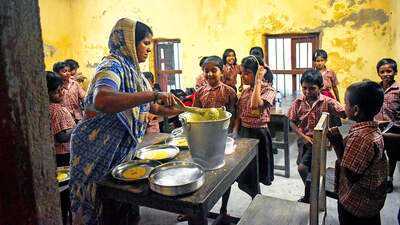
West Bengal budget: welfare promises win praise; questions mount over funding, fairness, deliveryThe most contentious change involves the mid-day meal for school children not just because of the enormity of the shift but also the inherent socio-political symbolism. The Budget details a pilot project in partnership with the International Society for Krishna Consciousness (ISKCON) to prepare, supply and manage mid-day meals in government-run schools in Kolkata municipal areas.
Historically, the state prioritised decentralised, localised setups, with meals prepared directly inside school kitchens by local women’s self-help groups (SHGs) and individual cook-cum-helpers rather than oversized, centralised kitchens. “Managing a mid-day meal in rural Bengal will be a huge logistical challenge. Only big players will be able to do this. The mid-day meal is a government obligation. NGOs like ISKCON should concentrate on their own work,” Sarkar points out.
ISKCON’s strict vegetarianism too has sparked controversy by replacing eggs with soyabean and rajma. State school education minister Dipak Barman supports vegetarian meals, and has said, “Egg is not the only source of protein for schoolchildren. Many people worldwide are vegetarians and they do not suffer any protein deficiency.”
While BJP neo-converts welcome the initiative, Bengalis see this as a cultural invasion by Hindi-speaking north Indians and a ploy to change the dietary habits of a population where 99 per cent are non-vegetarian. “Imposing a vegetarian diet on primary schoolchildren can change their food habits. Problems can also crop up when what they eat in school is different from what they eat at home,” says a government school teacher in Kolkata on condition of anonymity.
According to CPI-M state committee member Shatarup Ghosh, the introduction of vegetarian food in primary schools is part of the BJP’s Hindutva project. Speaking to National Herald, he says: “Wherever they are elected, the BJP tries to impose a particular kind of culture, a particular way of worship and cuisine. The issue is not about changing the menu. The BJP is trying to change the food habits of Bengal’s children.”
Sourabh Sen is a Kolkata-based independent writer and commentator on politics, human rights and foreign affairs. More of his writing here