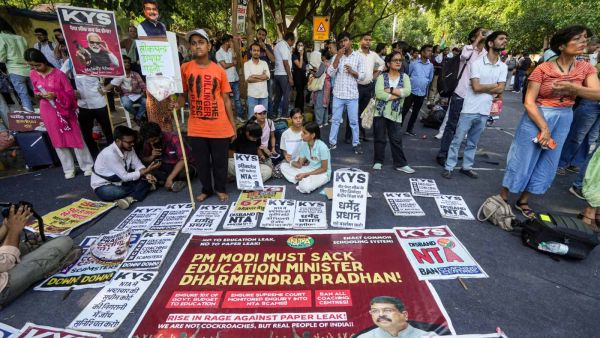
The recent indefinite protest organised by the Cockroach Janata Party (and various Left-wing student organisations) at Delhi’s Jantar Mantar is currently at the centre of national politics. Thousands of young people have taken to the streets demanding the resignation of Education Minister Dharmendra Pradhan over the NEET paper leak, the failure of the National Testing Agency (NTA) and related issues. This movement is being presented in the media and social media as a “historic student uprising.”
But behind this entire protest, there is a deeper, invisible and deeply disturbing political pattern at work, which, without understanding it, the current crisis in Indian student politics cannot be understood. If you visit the ground at Jantar Mantar, you will see an interesting and paradoxical scene. Under the scorching sun, standing in queues, spreading out mats, pasting posters and arranging food and water (logistics) for protesters who have come from far away, you will find a large number of Muslim youth. These young people are throwing their energy into this student movement with full intensity and dedication, treating it as their own.
But when your gaze moves to the main stage and the loudspeakers’ microphones, a stark silence prevails. Muslim faces are almost absent on the stage. Dominating the stage are selected mainstream left‑liberal student leaders, elite academic faces and new digital influencers. This contradiction points to an old and deep ailment in Indian politics: the Muslim community being used only as “labour,” not as “leadership.”

The concept of political labour is crucial in political theory and philosophical discourse. French philosopher and contemporary Marxist thinker Antonio Gramsci’s most famous theory is “cultural hegemony.” Gramsci argues that the ruling class does not rule solely through force; it creates ideologies and beliefs that the oppressed and marginalised classes, over time, begin to consider those rules natural.
For instance, the Left/CJP has created a hegemony in which Muslim youth are willing to provide “political labour” for every issue they raise, but lack the courage to demand a platform or raise their voices for their rights.
Louis Althusser proposed the theory of the ideological state apparatus. He explains how the education system and political parties control the minds of ordinary people so that they do not carry out a real rebellion against the system, but instead do what the party leaders want.
Pierre Bourdieu gave the theory of “social capital” and “cultural capital.” According to Bourdieu, in any movement or society, those who have “cultural capital” – such as speaking good English, studying at elite colleges and having media connections – are the one who capture the stage and visibility. For example, the Muslim youth at Jantar Mantar possess hard work and “labour,” but they lack the “cultural capital” possessed by elite leftist leaders from JNU/Delhi University, so they do not get the mic or the stage
Michel Foucault theory centres around “power/knowledge” and discourse. Foucault says that whoever is powerful decides which issues should be discussed and which should remain silent – that is, who controls the discourse. In the current situation, the CJP and Left leaders are controlling the discourse. They are deciding that NEET will be discussed, while talking about cases like Umar Khalid will be considered “illegal” or “diverting.”
In the context of secular movements in India, this can be called secular labour. Leftist and new liberal-populist organisations (such as CJP) rely on this very “secular labour” of Muslim youth. Muslim youth are perfectly acceptable to movement organisers as crowds, as numerically mobilising volunteers. But as soon as it comes to giving them space on the stage, making them key speakers or turning them into the face of the movement, a deliberate “strategic silence” is adopted.
This is not inclusion, but a new form of tokenism, where minorities are considered fit only for backstage management, while efforts are made to keep the frontstage “neutral” or “mainstream.”
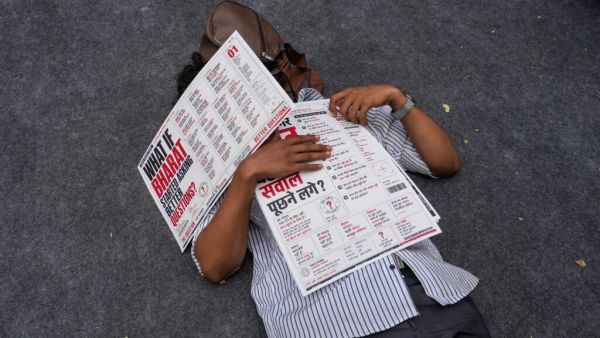
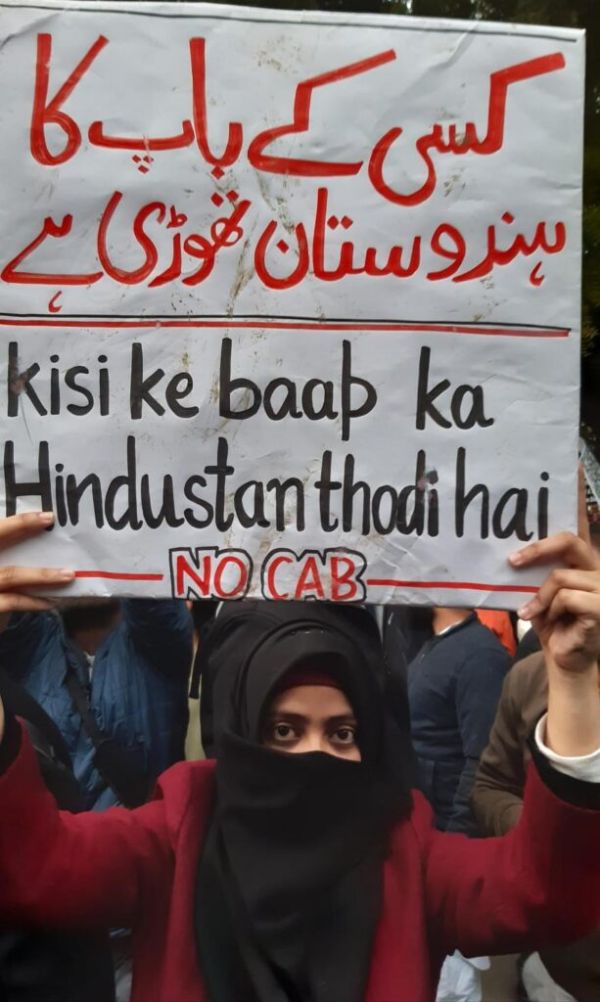
To understand this narrow perspective of the CJP and current Left movements, we have to revisit the memories of the historic anti-Citizenship Amendment Act (CAA)-National Register of Citizens (NRC) movement of 2019-20. That movement marked a turning point in Indian history, where the Muslim community, especially Muslim students and women, were at the frontline themselves. But the greatest beauty of that movement was its ideological inclusivity.
The anti-CAA-NRC movement was not limited to the technical citizenship law. From Shaheen Bagh to Jamia Millia Islamia University and Aligarh Muslim University, the movement also continuously discussed Dalit and Adivasi rights, especially how lakhs of people from these marginalised communities were also left out in Assam’s NRC and how this law would be used against them too.
Farmers’ and workers’ issues were also raised against corporate policies and changes in labour laws. Economic inequality, student fee hikes and the privatisation of government institutions were also discussed. Most importantly, Muslim student activists and women never considered non-Muslim activists “outsiders.” On the contrary, they not only invited progressive non-Muslim figures to their platforms and gave them space, but also leadership and the mike.
Yogendra Yadav, Medha Patkar, Chandrashekhar Azad “Ravan,” Harsh Mander, Kanhaiya Kumar (then-a Left leader) and countless left student leaders were given respect and time on the stage of Jamia and Shaheen Bagh that they perhaps did not even receive in their own organisations. Muslim youth never said, “Since this movement primarily focuses on Muslim identity and citizenship, giving the mike to non-Muslims will weaken our issue.” They made pluralism the soul of the movement.
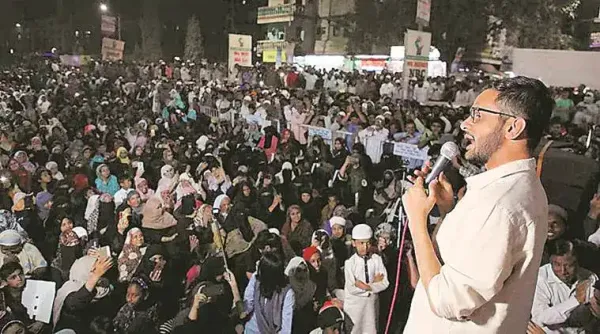
The top leaders of the CJP or Left-wing student organisations at Jantar Mantar today should be asked the direct question of why the Union government is using the Delhi riots as a pretext to jail student leaders like Umar Khalid and Sharjeel Imam, who have been imprisoned behind bars in Tihar Jail for the past six years. The young man who has read Bhagat Singh more than anyone else is not a terrorist or a traitor. He is educated and a graduate of one of the best institutions in the country. If Umar or Sharjeel were not mentioned at all, it would be assumed that this is not the issue of protest right now.
But Umar has been the centre of discussion from day one. My question to the leftists and the CJP is why they are not discussing the release of Delhi riots prisoners. Their response is usually a very measured and convenient argument. “Our movement is completely non-political and student-centric. Our sole goal is the resignation of the Education Minister and reforms in the NEET examination system. If we talk about UAPA, political prisoners, or the human rights of Muslim activists from this platform, the original movement will deviate from its path, disintegrate, and the government will get an opportunity to defame it.”
Political theorists Ernesto Laclau and Chantal Mouffe’s theory of “hegemony and socialist strategy” completely exposes the emptiness of this argument. According to Laclau, no mass movement can become a genuine (real) “populist upsurge” or an anti-establishment force unless connecting the diverse demands of various oppressed and exploited classes, forming an equivalence chain. If a student movement is limited to the leakage of an exam papers and distances itself from the country’s broader repressive policies (such as imprisonment for years without trial), it ceases to be a revolutionary movement but merely a demand for administrative reform.
When Muslim student activists incorporated the issues of Dalits, Adivasis and progressive leftists into their movement in 2020, they did not use the excuse of “issue dilution” or “issue drift.” They understood that the fight against oppression cannot be compartments. So why does the CJP and the Left fear that simply mentioning Umar Khalid and Sharjeel Imam will “deviate from the issue”? This contradiction raises a serious question mark on their ideological integrity.
To understand the real psychology behind this silence, we have to look at the research of the famous political scientist Christophe Jaffrelot. He has deeply analysed the pressure of majoritarian nationalism in contemporary Indian politics. According to Jaffrelot, India’s mainstream, so-called secular and progressive forces are now suffering from deep self-doubt and right-wing anxiety. They are so afraid of being labelled as minority appeasement.
Umar Khalid, a highly prominent and popular student leader at JNU who consistently advocated for leftist and democratic values, has been in jail for several years without conviction or trial. The silence of the Left and the CJP on his human rights and his release stems from this anxiety.
The strategists of these organisations feel that if they mention Umar Khalid’s name, or raise pictures of Muslim prisoners from the stage, right-wing media and the ruling side will label their entire movement as “communal” or “anti-national.” To escape this fear, they choose a very cunning and cowardly path: they use the crowd of Muslim youth to increase the numbers at their rallies, but they make their crisis and their leaders completely untouchable from the stage.This is giving birth to a new “political untouchability” in Indian politics.
It sends a message that everyone wants the support of the Muslim community, but when the machinery of state repression is directed against that community, no progressive organisation wants to become part of that risk.
If a new political party or student front (such as the Cockroach Janata Party or the Left Alliance) calls itself the “new voice of youth,” it must first clarify its definition of “youth.” Does that definition include the Muslim youth who, risking their education, career and time, are laying out carpets on the streets of Jantar Mantar? Or is their fate merely to be “used”? Until these new progressive organisations show the courage to stand with student leaders who have emerged from within their own ranks, such as Umar Khalid, their claim that they have come to “change the system” will remain completely hollow and hypocritical.
History bears witness that any movement which leaves its weakest, most persecuted and most marginalised comrades alone in the name of strategy can never challenge the established brutal order. Such a movement eventually begins to play by the terms of that oppressive system and becomes a silent part of it.
For Muslim youth as well, this is a moment of deep self-reflection. They must ask themselves how long they will continue to carry on their backs the political platforms of others, while the moment questions of their own existence, citizenship and rights arise, silence descends upon those grand stages.
Solidarity is always on the terms of equality and respect, not on the terms of backstage labour.
(The author of this article, Azam Khan, is working as an independent researcher focusing on violence against Muslims, Dalits and other minorities in India after Independence)