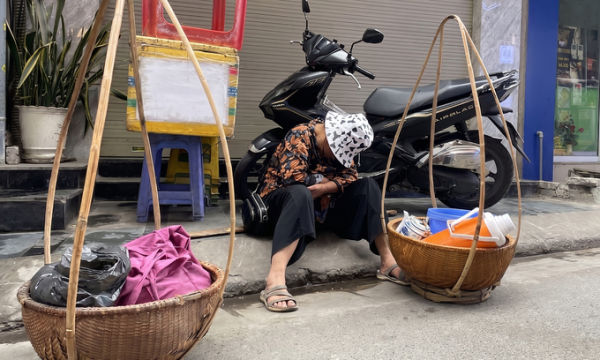
On a hot afternoon in June, Hoa, 70, sets down her basket of cakes on a sidewalk along Hanoi’s To Lich river and looks across the street, points there and says, “That used to be my home.”
Her husband died 50 years ago, and she raised their two children alone. After her sons grew up, married, and started their own families, she transferred all of her assets to them. She divided her 70-square-meter plot of land between the two, and each built a house there. She had hoped the arrangement would allow her to live out her later years in peace.
But the Covid-19 pandemic changed everything: Her sons’ businesses suffered heavy losses, forcing them to sell their houses to repay debts. The family’s finances collapsed, and its members ended up living separately. Not wanting to burden her children while they struggled with debt, Hoa rented a small room and began earning a living as a street vendor.
Every morning, she sets up her stall across the street from what was once her home. In the afternoon, she moves to a nearby school gate. On good days, she earns around VND200,000 (US$8). Recently, rising rents forced her to give up the room, and she moved in with relatives.
“I am saving for the future so my children will not have to worry about me,” she says.
|
An elderly person dozing off next to a street vending load on a Hanoi street, March 2026. Photo by Phan Duong |
In Nghe An Province, 90-year-old Toan does not know which of his children’s homes he will be living in next month. Since suffering a stroke in 2019, he has had limited mobility and can no longer care for himself. His only asset is a small house. He has no pension or personal savings and gets by on a monthly elderly allowance of VND500,000 ($19) and some income from rice fields that are rented out.
In June, his nine children agreed to take turns caring for him, with each child assuming responsibility for one month at a time for the rest of his life.
According to his eldest son, he had been caring for their father since 2019 under a family agreement that allowed him to live in the house in exchange for maintaining the family’s ancestral altar and not selling the property. But disagreements later emerged among the siblings over property, and the monthly rotation was introduced as a temporary solution.
After their father’s passing, the house will be divided among the heirs. For a 90-year-old man with limited mobility, moving from one home to another every month involves far more than simply packing his belongings, and his children understand this.
“This is a last-resort solution,” the eldest son admits.
The gap behind filial piety
Hoa and Toan are both facing a reality in which care during old age is not guaranteed simply by having children.
Vietnamese families have traditionally lived in multi-generational households. Parents controlled land and property and occupied a central role in family life, and adult children lived with them along with their own families. The idea that children would look after their parents in old age served as an informal form of social security.
But things are changing. Vietnam is among the countries with the fastest-aging populations in the world. It now has nearly 15 million elderly people, a figure projected to reach 18 million by 2030 and 21.5 million by 2035 by the General Statistics Office. Some 700,000 join the ranks of seniors every year.
Professor Giang Thanh Long of the National Economics University said Vietnam’s social protection system is not yet adequate to cope with this demographic shift.
“Coverage has expanded in breadth, meaning more people are receiving benefits. However, coverage in depth, the level of benefits provided, remains inadequate and does not guarantee a decent standard of living.”
The traditional three-generation household, once the foundation of the belief that children would support their parents in old age, is gradually becoming less common.
A 2021 report by the United Nations Population Fund found that about 4.5 million elderly people in Vietnam live alone or in households where an entire generation is absent, such as grandparents living only with grandchildren.
A 2022 Vietnam Aging Survey found that nearly 60% of elderly people’s income comes either from their own work or financial support from their children, while pensions and social assistance account for only 15%.
More than 10 million elderly Vietnamese remain outside the formal social protection system and rely largely on limited savings, employment, or family support. More than 60% continue working, mostly in agriculture or other informal and unstable jobs.
 |
|
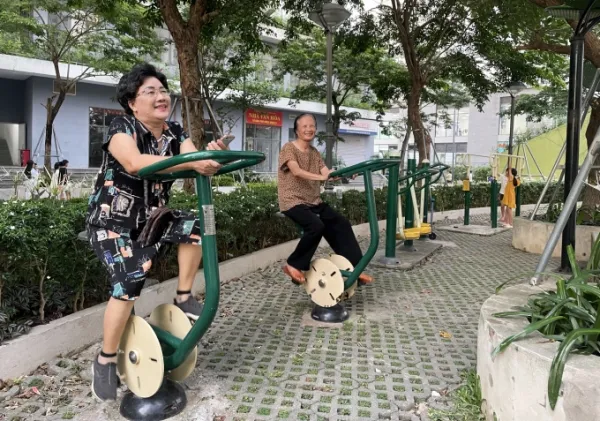
Elderly people exercising in Dong Ngac ward, Hanoi, June 2026. Photo by Phan Duong |
The weakening of traditional family support structures in Vietnam mirrors trends seen elsewhere in Asia.
Dr. Kumarashvari Subramaniam of British University Vietnam says in aging societies such as Japan, South Korea, and China, expectations that adult children will provide financial support to their parents have gradually declined.
“Urban migration, declining birth rates, and rising living costs are making complete dependence on children increasingly unrealistic.”
Preparing for independent old age
In Chuong My District, Hanoi, 86-year-old Tuyet Hong chose to prepare financially for old age long before retirement. She uses her monthly pension of VND3.5 million, together with personal savings and proceeds from the sale of her house, to pay VND7 million a month for nursing home care.
“From a young age, I decided to take care of my old age myself,” she says.
Subramaniam argues that financial independence in old age does not weaken family bonds and can even strengthen them. Studies show that older people who are financially independent tend to be more optimistic, self-confident, and psychologically resilient.
Takanori Hisaoka, CEO of Kiramekikai Social Welfare Group in Japan, says urbanization, shrinking household sizes, and labor migration have weakened adult children’s ability to care for aging parents. Japan has already gone through this transition, and Vietnam is beginning to experience it as well.
While Vietnam still lacks community-based eldercare services, experts suggest that senior care remains a valuable Vietnamese tradition and should be preserved.To reduce the hardships faced by older adults, support from relatives should be supplemented by multi-functional community care systems, including day-care services for seniors and home-visit programs.
Under such a model, families remain at the center of eldercare, but responsibility is shared with healthcare and social-support networks. This allows adult children to fulfill their caregiving duties while maintaining their livelihoods.
 |
|
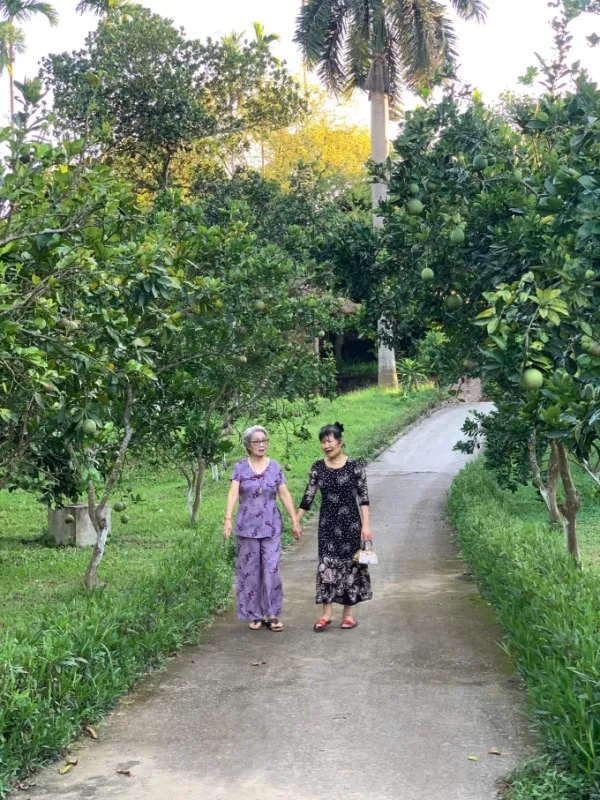
Hong, 86 years old, (left) taking a walk with her friend at a nursing home in Chuong My, Hanoi, June 2026. Photo by Dien Hong |
Clinical psychologist Dr. La Linh Nga says when children are raised with love and respect rather than a sense of obligation, gratitude is more likely to develop naturally, allowing both generations to support each other willingly.
Despite the hardships she faces, Hoa rarely complains. She regards both hardship and happiness as part of fate. Many of her customers sympathize with her and occasionally try to give her extra money, but she always insists on returning the change.
“Accepting even a single penny from someone else means owing them a debt,” she says as she carefully smooths out the VND15,000 she received from a customer buying a cake.
*Some names have been changed.