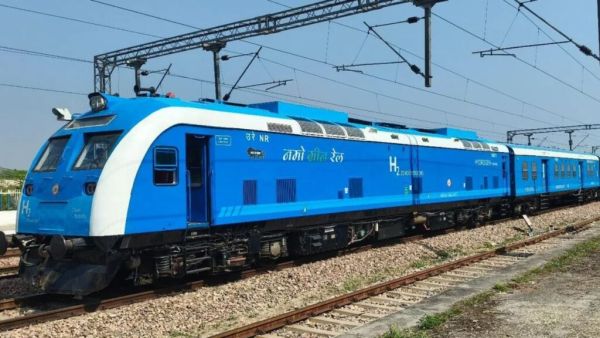
New Delhi: India’s first hydrogen-powered train has successfully completed a trial run between Delhi and Jind, marking a major step forward in Indian Railways’ plan to introduce cleaner and greener passenger transport.
The latest trial was conducted after an earlier test run between Sonipat and Jind. According to officials, the Delhi-Jind trial focused on key safety and performance parameters, including emergency braking distance and oscillation behaviour.
During the test, the hydrogen train touched a top speed of 120 kmph on the Jind-Sonipat section. Railway officials monitored the train’s movement and technical performance as part of the final phase of trials.
The successful run is being seen as an important milestone before the train is cleared for passenger operations. However, commercial service will begin only after all regulatory, technical and safety formalities are completed.
The hydrogen train has been fitted with several advanced safety features. These include hydrogen leak detectors, flame detection systems and continuous monitoring equipment.
These systems are designed to detect any technical issue at an early stage and help ensure safe operations. Officials said such features are crucial because hydrogen-based mobility requires strict monitoring of fuel storage, dispensing and usage systems.
The project is part of Indian Railways’ larger plan to reduce dependence on fossil fuels and cut carbon emissions. Unlike conventional diesel trains, hydrogen trains use fuel cells to generate power, producing water vapor as the main emission.
In May, the Railway Ministry had approved the operation of India’s first hydrogen-powered 10-coach DEMU train between Jind and Sonipat under the Northern Railway zone. The train has been approved for passenger operations at a maximum speed of 75 kmph, subject to completion of all compliance requirements.
The hydrogen train has a total power output of 1,200 kilowatts. It will operate on Distributed Power Rolling Stock technology, under which power is spread across the train instead of being concentrated in a single locomotive.
The approval followed technical clearance from the Research Designs and Standards Organization and safety testing by the Commissioner of Railway Safety.
Officials clarified that the ministry’s approval does not mean the train will begin passenger service immediately. Northern Railway will have to submit compliance reports to conditions laid down by RDSO, CCRS and other statutory bodies.
The Petroleum and Explosives Safety Organization has already granted a license for filling and storage of compressed hydrogen gas at Jind in Haryana. However, the Railway Ministry has directed strict compliance with all safety conditions.
The ministry has also flagged the need for regular cleaning and maintenance of sensors installed at the hydrogen production, storage and dispensing facility, as dust accumulation may affect their functioning.
Once all safety and operational checks are completed, the hydrogen train is expected to become a landmark project in India’s clean mobility journey.