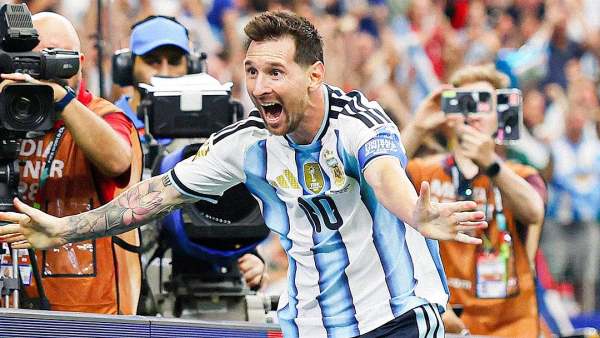
After first closing in on, then matching, and ultimately surpassing the record for the most goals ever scored in World Cup history, Argentina’s iconic No. 10 continues to add fresh achievements to his glittering career.
On Saturday (27 June), Lionel Messi began the match against Jordan on the bench.
However, he was brought on in the second half (61st minute) and found the net with a stunning free-kick, taking his World Cup goal tally to 19.
With that strike, Messi has now set a new benchmark for the longest consecutive scoring streak in World Cup matches — seven games in a row.
Previously, he was level with Just Fontaine of France and Jairzinho of Brazil.
Fontaine had scored in each of the six matches he played at the 1958 World Cup, finishing as the tournament’s top scorer with 13 goals — a record that still stands today.
Meanwhile, Jairzinho, known as the “World Cup Hurricane,” achieved the same feat by scoring in all six matches as Brazil lifted their third world title in 1970.
Messi’s own streak began at the Qatar World Cup, where he scored in the Round of 16 (against Australia), quarter-final (Netherlands), semi-final (Croatia), and final (France).
Before the start of this 2026 edition, Messi had matched Pelé’s total of 21 goal involvements in World Cup history.
The Brazilian legend registered 12 goals and nine assists across 14 matches between the 1958 and 1970 tournaments.
The Albiceleste captain, on the other hand, had recorded 13 goals and eight assists in 26 matches since his World Cup debut in 2006.
Heading into the clash with Jordan, Messi already had 18 goals, after scoring three times against Algeria and twice against Austria — and he has now added another to that figure.
Messi’s latest appearance was his 29th in World Cup history — the most by any player ever.
He also holds the record for the most World Cup match victories, with 19 wins to his name.
Additionally, he shares with Cristiano Ronaldo the record for the most World Cups played on the pitch — six tournaments in total.
Mexican goalkeeper Guillermo Ochoa has also been called up for six editions but did not play in 2006 and 2010, serving as backup to Oswaldo Sánchez and Óscar Pérez, respectively.
Messi is the only player ever to score in every stage of a World Cup since the tournament format introduced the Round of 16.
He accomplished that feat at the Qatar World Cup, scoring in each knockout round (as mentioned earlier) and also during the group stage matches against Saudi Arabia and Mexico.
The only time he failed to score was in the win over Poland, Argentina’s third Group C match.
Fontaine and Jairzinho had also scored in every stage of their respective tournaments in 1958 and 1970, but those editions began directly from the quarter-finals.
Messi ends the group stage of the 2026 World Cup as the tournament’s leading scorer.
This means he will enter the knockout phase defending that position and pursuing one of the few accolades missing from his résumé — the Golden Boot.
He came close in Qatar, netting seven times, but Kylian Mbappé edged him out by one goal.
Only two Argentine players have ever won the World Cup Golden Boot: Guillermo Stábile in 1930 with eight goals, and Mario Kempes in 1978 with six goals during their championship run.
Messi has scored in every World Cup he has played except for 2010. His tournament goal breakdown stands as follows: 2006 (one goal), 2014 (four), 2018 (one), 2022 (seven), and 2026 (six so far).
📸 David Ramos - 2026 Getty Images