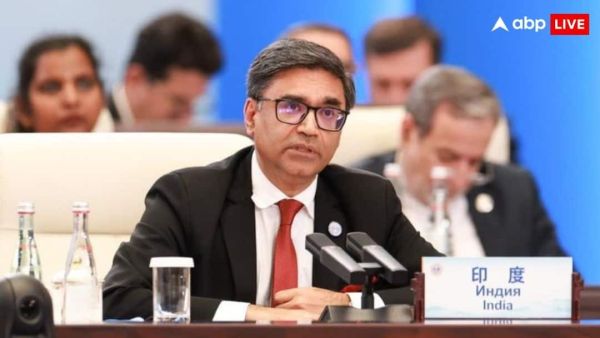
India has firmly rejected reports suggesting any diplomatic thaw with Pakistan, making it clear that unofficial back-channel engagements carry no official recognition or significance for New Delhi.
The clarification came after several media reported that former senior military officers, diplomats and political figures from India and Pakistan met in Colombo this week for an unofficial Track II dialogue held alongside a regional security conference. The discussions were hosted on the sidelines of the International Institute for Strategic Studies (IISS) conference, attended by delegates from India, Pakistan, Sri Lanka, the Maldives, the UK and other countries.
Talking with ANI, Misri said, "I have seen the reports. I am aware of them. Dozens of these kinds of events take place in dozens of places around the world on a whole variety of subjects. There's nothing new, nothing special about these events. As far as we are concerned, these are private events organised by private parties. There is nothing official about them as far as we are concerned. I cannot speak for the government of Pakistan, but as far as the Government of India is concerned, there is no official participation, no official support or involvement, in these visits," he told ANI.
#WATCH | Victoria, Seychelles: On being asked about Track 2 India-Pakistan dialogue in Colombo, Foreign Secretary Vikram Misri says, "I have seen the reports. I am aware of them. Dozens of these kinds of events take place in dozens of places around the world on a whole variety of… pic.twitter.com/Z54aCxbTUr
— ANI (@ANI) June 29, 2026
He further stated, " Anybody from India who is participating in these events, whether it is retired diplomats, retired military officials, members of civil society, when they participate in such events, they speak for themselves and they represent their own point of view. They do not in any way, they cannot in any way represent the view of the government of India. We really take no cognizance of these events. They really don't hold much value, as far as we are concerned."
Track-2 diplomacy typically involves informal dialogue among retired diplomats, former military officers, academics, think tank experts, journalists and civil society representatives, who engage in discussions in their personal capacities to explore confidence-building measures and conflict management.
The India-Pakistan interaction was held over two days in separate sessions at a hotel in Colombo. The Indian delegation comprised former Army chief General MM Naravane, India Foundation president and former BJP national general secretary Ram Madhav, and former diplomat Ruchi Ghanashyam. Pakistan was represented by Foreign Ministry Director General (South Asia and SAARC) Sajjad Haider Khan, former ambassador to the US Sherry Rehman, and retired Major General Isfandiyar Ali Khan Pataudi.
NDTV reported that the discussions centred on cross-border terrorism, the Indus waters issue, improving communication during periods of heightened tensions, and exploring mechanisms to reduce the risk of future military escalation. However, the talks did not yield any significant breakthrough.
The Colombo meeting was part of a series of informal Track-2 engagements held after the military confrontation between India and Pakistan in May 2025, which followed India's Operation Sindoor targeting terror infrastructure in Pakistan in response to the Pahalgam terror attack.
US Assistant Secretary of State for South and Central Asian Affairs S. Paul Kapur, who was in Sri Lanka for the conference, attended a dinner hosted for participants. Members of both the Indian and Pakistani delegations were also present at the event.
Relations between the two neighbours have remained strained since Pakistan downgraded diplomatic ties after India revoked the special status of Jammu and Kashmir by abrogating Article 370 on 5 August 2019.
The relationship deteriorated further following the Pahalgam terror attack. There are currently no meaningful diplomatic engagements or direct trade links between the two countries, with India's position continuing to be shaped by concerns over Pakistan's support for cross-border terrorism.
While the diplomatic freeze has restricted India's overflight access through Pakistani airspace, Pakistan faces more significant strategic consequences.
Following the Pahalgam attack, India placed the decades-old Indus Waters Treaty in abeyance. Reinforcing New Delhi's position, Prime Minister Narendra Modi declared that "blood and water cannot flow together".
The suspension of the treaty carries far-reaching implications for Pakistan, whose agriculture and hydropower sectors depend heavily on the waters of the Indus river system.