The qualifying session in Austria, already filled with excitement, took a dramatic twist in its final moments when Max Verstappen spun out at the penultimate corner during his last flying lap.
The Dutch driver slid across the gravel trap before colliding with the tyre wall. This incident not only ended Verstappen's hopes of claiming pole but also seemed to have dashed the chances of Mercedes drivers George Russell and Kimi Antonelli, who were just behind him and completing their final attempts – now seemingly ruined by the crash ahead.
For a brief moment, it appeared that Ferrari’s Charles Leclerc and Lewis Hamilton might lock out the front row. But then Russell’s name surged to the top of the timing screens. Antonelli, on the other hand, aborted his lap and could not improve on his previous best, leaving him stranded in fourth position.
It initially seemed impossible that Russell could have driven through a crash zone and still legally set a lap fast enough for pole. However, he had indeed done so, and after a quick review by the FIA, it was confirmed that his lap was valid and his pole time would stand.
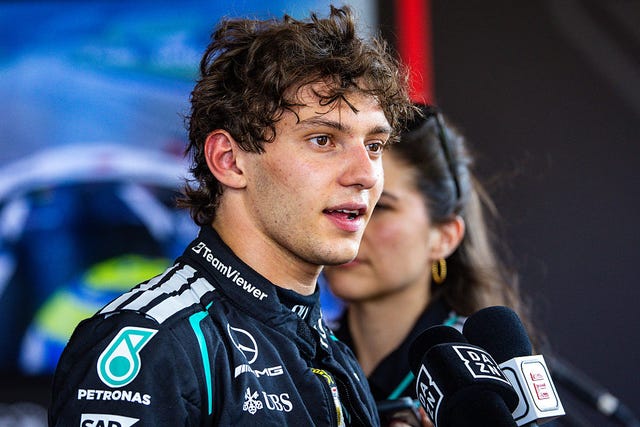
Meanwhile, Antonelli admitted that he had made an error in judgment, a tough blow considering he had been leading the timesheets for most of the weekend.
So, what exactly happened? Under Formula 1 regulations, there is a clear difference between a single waved yellow flag – whether physical or displayed on the light panel – and a double waved yellow, which signals a more severe incident.
In the case of a single yellow flag, drivers must show that they have acknowledged it by reducing speed, something that can be verified through telemetry data. During qualifying, drivers are allowed to continue and complete their laps as long as they have demonstrably lifted off the throttle.
However, if a double yellow is displayed, any lap completed through that section is automatically invalidated, prompting drivers to abort immediately.
In a free practice session, Verstappen’s crash would have prompted an instant red flag. But in qualifying, the race director aims to maintain the flow of action if it’s safe enough to do so, allowing drivers to finish their flying laps.
It’s also worth remembering that a driver sitting on provisional pole could intentionally trigger a yellow or red flag to prevent others from improving their times. Although that was not the case here, it explains why race control tries to avoid unnecessary stoppages.
In this instance, race control determined that Verstappen’s car had come to rest far from the racing line in a section with ample run-off. Since no marshals had yet crossed the barrier, a single yellow flag was initially deemed sufficient for the first 15–20 seconds – the period during which both Mercedes drivers passed the scene. It was only later upgraded to a double yellow.
The remarkable part of the story is that Russell managed to lift slightly, losing some time, yet still posted a lap quick enough to beat the Ferraris and take pole – demonstrating the impressive pace of the Mercedes in qualifying trim.
Russell explained his thought process: “It’s a corner where you can see quite a lot. I did a big lift and planned to assess the situation as I approached the corner, in case the car was still there. Since it was a single yellow, I felt confident there was no danger. As soon as I turned in, I saw the green light ahead and thought the car must have continued because I couldn’t see it at all. It was so far off track that I never noticed it. Only when I saw the replay did I realize it had hit the wall. I’m glad common sense prevailed.”
He further elaborated on the importance of the light panel: “The rules are pretty clear – a single yellow means there’s an incident, but a double yellow means you must be ready to stop because there’s clear danger. The double yellow flashes diagonally, while the single yellow is solid.”
This was a moment of quick, intelligent decision-making from the GPDA director. In contrast, his teammate Antonelli, faced with the same situation, believed it was a double yellow and chose to abort his lap.
Antonelli explained to Road & Track, “I saw double yellow. It was probably my mistake, but I aborted the lap, and that was that. I heard ‘yellow, yellow’ on the radio, but I was looking at the marshals and maybe I saw wrong – I thought I saw two flags instead of one, so I aborted.”
He added, “It was difficult to see because the sun was in my eyes. I looked at the marshal since I wasn’t sure if the panel showed a single or double yellow. It was hard to distinguish, and I thought I saw two flags, so I completely backed out.”
Unsurprisingly, Antonelli later said he felt the situation warranted a double yellow given the speed of the corner.
“For sure, it was a car in the wall at a fast corner, so I don’t understand why it wasn’t double yellow immediately. At such a high-speed corner, if someone goes off at the same time, it could end badly. It was confusing, but that’s how it was. It’s something that should be reviewed, especially for high-speed corners. A single yellow might be fine for slower sections, but at fast corners it should be double yellow straight away.”
Verstappen himself echoed similar concerns, saying it was “quite crazy” that his crash had not triggered a double yellow.
After analysing the data, McLaren team principal Andrea Stella confirmed that Russell had indeed lifted, satisfying the FIA’s requirements.
He also praised the Mercedes driver for executing the lap so effectively. “From the GPS overlays I’ve seen, Russell did a great job managing his lift. You can see his speed drop before braking, losing just enough time through corner nine while still being fast enough for pole. Drivers are incredibly skilled at standard driving, but sometimes they also excel at managing tricky situations under yellow flags, and Russell’s execution was an example that the stewards rightly accepted.”