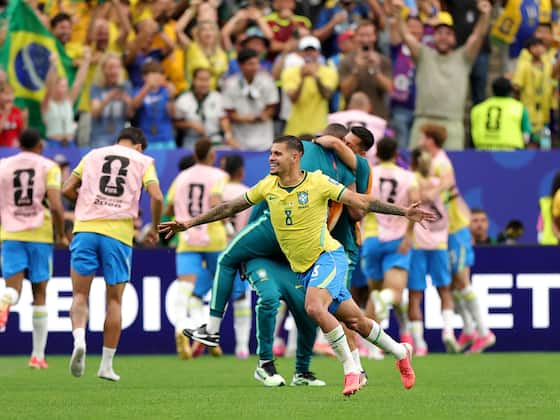
Brazil stormed back into form against Japan with a record-breaking performance.
Their 2-1 victory marked their first comeback win in a World Cup knockout match after half-time since 1978. Gabriel Martinelli’s decisive strike was also the latest winning goal in normal time of a knockout stage fixture since 1966.
Was the win justified? The answer is yes – though not without some reservations.
In the opening half, Japan’s relentless pressing and direct approach unsettled Brazil’s midfield, particularly Casemiro, who received a yellow card and collided with two teammates within the first 45 minutes.
A misplaced pass from makeshift right-back Danilo allowed Japan to capitalise. Casemiro lacked the acceleration to recover, enabling Sano to break through and fire home from just outside the box to put Japan ahead.
At half-time, Carlo Ancelotti faced a tough call – should the Italian tactician substitute Casemiro to spare him further trouble in the centre of the pitch?
Instead, Lucas Paquetá was replaced by Endrick, who seemed to have picked up a knock before the break. The decision raised eyebrows among fans inside the stadium, as Casemiro remained on the pitch despite being one misstep away from receiving a second yellow card.
The second half, however, told a completely different story. Japan, having taken the lead, chose to drop back and protect their 1-0 advantage. After scoring in the 29th minute, they created only 0.05xG for the remainder of the match. The Blue Samurai retreated deeper, inviting Brazil to flood their penalty area – a tactical approach Hajime Moriyasu may rue for a long time.
Then, in a swift turnaround, Casemiro went from scapegoat to saviour.
His close-range header brought Brazil level just moments after a similar attempt had been blocked. He was later named player of the match – a reminder of how unpredictable football can be.
Japan’s defensive stance allowed Brazil to grow in confidence. In stoppage time, Bruno Guimarães delivered a perfectly weighted pass to Martinelli, who finished with poise to seal the comeback.
Martinelli’s touch and precision were world-class, but Bruno’s assist was the defining flourish on what was arguably one of the finest individual performances of this World Cup so far.
Guimarães was everywhere – intercepting passes, pressing high, and driving play forward. His energy lifted the entire team. With four assists to his name, he currently leads that category as Brazil await their next opponents, either Ivory Coast or Norway, in the round of 16.
Yet Brazil’s lapses remain a concern. Casemiro, despite scoring and controlling possession in the second half, was exposed and overrun before the break. Against Europe’s top sides, the 34-year-old could face serious difficulties.
Ancelotti, having already seen these issues against Morocco and Japan, will be acutely aware of Casemiro’s limitations. His backup, Fabinho, offers experience but lacks the quickness over short distances that Brazil might need.
The Italian coach may need to reconsider his formation going forward. If Casemiro stays in the starting XI, an extra midfielder may be necessary to balance the setup.
Matheus Cunha dropped deeper in the second half, freeing Endrick to lead the attack. While his game time was limited, his movement alongside Rayan and Vinícius Júnior injected speed into Brazil’s play – just as Ancelotti had demanded before the Japan clash.
Despite their imperfections, Brazil have advanced to the round of 16. Lessons have been learned. Japan served as a warning. But if Ancelotti fails to adapt for the next challenge, Brazil’s World Cup journey could quickly unravel.
For now, Brazil survive by the narrowest of margins. Still, this team has the ability to produce brilliance when it matters most. As inconsistent as they may be, both Norway and Ivory Coast will be wary of their capacity to conjure goals from nowhere – and that unpredictability could be the edge Ancelotti relies on this summer.