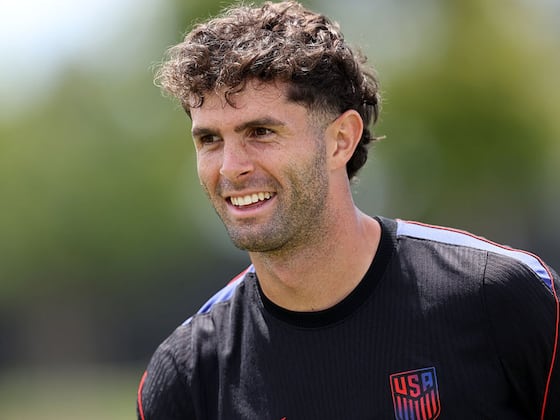
Hershey, Pennsylvania, may be best known as the “Sweetest Place on Earth” for its deep-rooted chocolate heritage, but it also holds another claim to fame — it is the hometown of Christian Pulisic, the most accomplished figure in the U.S. Men’s National Team, as the squad gears up to co-host the upcoming World Cup with ambitious expectations.
Recently, Pulisic looked back on his beginnings in Hershey while promoting a special-edition Pulisic’s Milk Chocolate Bar created by the Hershey Company and featuring his signature. “Hershey to me is everything — it’s where my family is from, it’s where I grew up,” he said. “It’s where I learned how to play. It’s just home.”
Located in south-central Pennsylvania, the town is surrounded by scenic farmland and rolling hills, with streetlights designed like Hershey’s Kisses lining Chocolate Avenue. Founded in 1903 by Milton S. Hershey, the American industrialist and philanthropist, the town was planned with homes for factory workers, a hotel, and a theme park that the young Pulisic often visited with his family.
More than 120 years later, the Hershey Company remains the economic lifeblood of “Chocolatetown, USA.” Yet the legacy of its founder now shares space with a new local hero — the footballer affectionately nicknamed “Captain America.”
As the World Cup unfolds, Pulisic’s hometown has rallied behind him with pride, cheering on the U.S. team as it plays some of its most exciting football in recent memory.
“It’s pretty amazing that he came from Hershey and played for my club,” said Cecelia Stefanelli, a rising freshman at Hershey High School. On a recent afternoon, she kicked a ball past her father on the same fields where Pulisic once trained.
The U.S. will aim for its first World Cup knockout-stage victory in 24 years when it faces Bosnia-Herzegovina on Wednesday evening in Santa Clara, California. Pulisic is expected to return to full fitness after missing the second group-stage match due to a calf injury and playing only 33 minutes as a substitute in the final group game against Turkey.
“I’d love if USA won the World Cup; it’d make me happy,” said Stefanelli, who plays as a centre-back for the Pennsylvania Classics football club. Pulisic has often credited PA Classics and its coaches for shaping his early development. He spent eight years there and, in 2021, returned to inaugurate new facilities that he had helped fund and design — now known as the Pulisic Stomping Grounds.
The club sits in Lancaster County, surrounded by chicken and dairy farms where the smell of fermenting feed hangs in the air. On a recent training day, players Liam Gustafson and Moussa Oumarou warmed up by juggling a football in front of a large collage tracing Pulisic’s journey from childhood training sessions to his current World Cup stardom.
“It’s really special to see someone from around here, where we live, playing in the World Cup,” said Gustafson, a 17-year-old forward aiming for a professional career. “It’s really inspiring to see someone who showed us that it’s possible.”
Pulisic’s path to football began early, following in the footsteps of his parents. He was born in Hershey on September 18, 1998, to Kelley and Mark Pulisic, both former college footballers at George Mason University. His father later played professional indoor football with the Harrisburg Heat. The family spent a year in England while Pulisic’s mother participated in a Fulbright teacher exchange, and a seven-year-old Christian joined Brackley Town’s youth setup during that time.
“Mark and Kelley could write a playbook on how to raise a humble, smart, kind superstar, while keeping the family so grounded,” said Tara Seymour, a family friend and former health and physical education teacher at Hershey Middle School. She met them during a football camp and became close friends with Pulisic’s mother.
“She quietly told me once, ‘We have never seen anything like this.’ This is a kid who could juggle the ball hundreds of times in elementary school,” Seymour recalled. She said Pulisic would spend hours practising in his backyard, trying to replicate the moves of professional players he admired on television.
“He had an intensity that couldn’t be taught,” she added. “I think he had the opportunity to go professional or move to Europe earlier, but his parents held back to make sure he was emotionally and mentally ready.”
When the family returned to Hershey, 10-year-old Pulisic joined PA Classics. According to Doug Harris, the club’s president and co-founder, Pulisic’s skill level allowed him to compete with older age groups, even though he was often the smallest player on the pitch.
“If you ask kids around the world who want to reach Christian Pulisic’s level, millions would raise their hands,” Harris said. “They’re all talented, but there’s something special about what Christian has achieved — and I give a lot of credit to Mark and Kelley Pulisic for that.”
The U.S. team’s only previous World Cup knockout-stage win came on June 17, 2002, when they beat Mexico 2-0 in South Korea. Pulisic has said the team’s approach won’t change heading into this round, maintaining a positive spirit despite the pressure. “It’s just special to be here,” he said. “You just don’t want it to end.”
Before the match against Bosnia-Herzegovina, PA Classics coaches Brittney and Nick Jakobson brought their children, Declan and Camden, to play on the same grounds where Pulisic once trained. They believe this U.S. team has a genuine chance at glory, but their influence extends beyond silverware.
“Their goal is to inspire a generation, and it’s really exciting to see that happening — to hear people talking about the games, buying jerseys, and showing support,” said Brittney Jakobson.
“Pulisic, of course, is a great figure to look up to,” added Nick Jakobson. “But he always emphasises that it’s not just about him or this World Cup. It’s about the next 8, 12, 16 years. It’s about building something lasting for the future.”