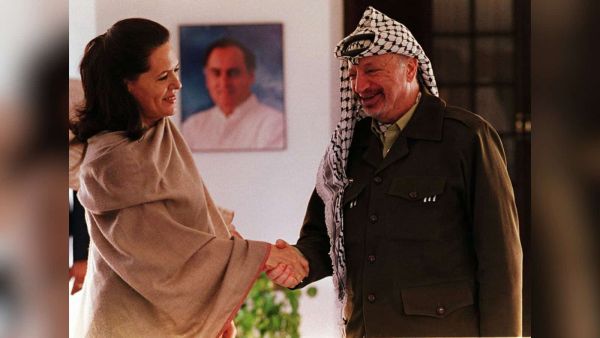
With Palestine emerging as the Narendra Modi government’s Achilles’ heel, Congress leader Sonia Gandhi is mounting moral pressure to take a more humanitarian stand, with Gaza being turned from an open-air prison into an open-air graveyard. Describing Israeli actions as “genocide,” Sonia Gandhi pointed out that the Modi government’s silence, especially on Gaza, is not just morally reprehensible but also inexplicable from a national interest perspective.
Gandhi surmised that India’s current foreign policy had alienated the country from its traditional partners in Palestine, Iran and the wider West Asia. It also paved the way for the emergence of Pakistan as a mediator in the region. She described Prime Minister Narendra Modi’s visit to Tel Aviv barely two days before the Israeli attack on Iran – eliminating its top political leadership, including Iran’s Supreme Leader Ayatollah Ali Khamenei, on February 28 – as a decision that will go down in history as a bewildering strategic decision.
Implicit in Gandhi invoking the traditional Indian support to Palestinian statehood is the series of steps taken by Indira Gandhi ever since the foundational philosophy on the besieged enclave was enunciated by Mahatma Gandhi way back in 1938. India, under Indira Gandhi, became the first non-Arab country to recognise the Palestine Liberation Organisation (PLO) in 1974 as the sole legitimate representative of the Palestinian people. In 1975, Indira Gandhi formally recognised the PLO and allowed the organisation to establish an office in New Delhi.

When Indira Gandhi was out of power in 1977, the Janata Party government’s Foreign Minister Atal Bihari Vajpayee signalled a subtle shift in Indian foreign policy. Vajpayee organised a secret visit of Israeli Foreign Minister Moshe Dayan to India. Dayan travelled incognito and under a false name, fearing the Janata Party government would collapse if the meetings were to become public.
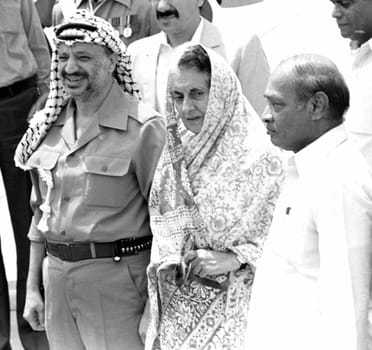
Soon after her return to power as Prime Minister in 1980, Indira Gandhi established full diplomatic relations with Palestine, upgrading the Palestine Mission into the Palestine Embassy. In 1983, Indira Gandhi conferred Head of State status on PLO chief Yasser Arafat, ahead of his visit to New Delhi, where he attended the meeting of the Non-Aligned Movement (NAM) Summit.
Rajiv Gandhi chose Indira Gandhi’s birth anniversary on November 19, 1988, to officially recognise the independent State of Palestine, following the Palestinian Declaration of Independence.
Now, as a result of the Modi government’s silence on the Palestinian issue, Sonia Gandhi pointed out that India has alienated traditional allies in West Asia. Most importantly, Sonia Gandhi insisted India has a moral obligation to stand up for human dignity and human rights, rather than putting personal political relationships first.
Mahatma Gandhi had laid down India’s foundational Palestine policy. Writing in Harijan on November 26, 1938, Gandhiji said, “Palestine belongs to the Arabs in the same sense that England belongs to the English or France to the French.” Gandhiji wondered if Jews had no home but Palestine, would they relish the idea of being forced to leave the other parts of the world in which they are settled?
Gandhiji made bold to declare that the Biblical promised land of Palestine is more a metaphor than a geographical tract. It is in Jewish hearts. But if they must look to Palestine as a geographical tract as their national home, it is wrong to enter it under the shadow of the British gun.
Since Jews were invoking the Holy Bible, Gandhiji said, “A religious act cannot be performed with the aid of the bayonet or the bomb. They can settle in Palestine only by the goodwill of the Arabs. They should seek to convert the Arab heart.” Gandhiji found that the Jewish homeland in Palestine contradicted the broader Jewish struggle for equal rights. Jews born in countries like France or England were rightfully citizens of those nations, he pointed out.
A confirmed Zionist, Albert Einstein mounted subtle pressure on free India’s first Prime Minister, Pandit Jawaharlal Nehru, to change the Indian policy on Palestine. In a letter to Nehru in June 1947, Einstein sought to sway Nehru towards endorsing the idea of an Israeli state.
Nehru responded in July 1947 with “deepest sympathy” for the Jewish suffering during the Holocaust, but ultimately rejected the Zionist cause. Primarily, Nehru believed Palestine was fundamentally an Arab country. He saw the Zionist movement relying heavily on British protection, effectively making it a tool of British imperialism.
He wondered, “After all these remarkable achievements, why have the Jews in Palestine failed to gain the goodwill of the Arabs? Why do they seek to compel the Arabs to submit against their will to certain demands? The approach taken has not led to a settlement but rather to the perpetuation of the conflict. I have no doubt that the fault is not confined to one party but that all have erred…”
For this reason, during voting on the United Nations partition plan, India voted against it in 1947. India herself had undergone the trauma following Partition. Nehru believed that imposed partitions were imperial legacies that would cause endless, festering conflict. The core issue in Palestine was a nationalist struggle, not a religious or racial conflict. Both Muslim and Christian Arabs were unified in this resistance.
In a press statement on June 13, 1936, Jawaharlal Nehru felt his reading of war and post-war history showed a gross betrayal of Arabs by British imperialism. The many promises that were made to them by Colonel Lawrence and others, on behalf of the British government, which resulted in the Arabs helping the British and allied powers during the war, were consistently ignored after the war was over.
All the Arabs, in Syria, Iraq, Trans-Jordan and Palestine, smarted under this betrayal, but the position of the Arabs in Palestine was undoubtedly the worst of all.
Israel was formed on May 14, 1948. Pandit Jawaharlal Nehru recognised Israel on September 17, 1950, as it was a historic reality, but held back full diplomatic relations, as Palestinian concerns were not addressed. PV Narasimha Rao established full diplomatic relations with Israel on January 29, 1992. The reason was that, in Norway, secret talks were underway for the Oslo Accords of 1993, for recognition of two-nation States.
What is more, prior to signing the file, Narasimha Rao took Palestinian leader Yasser Arafat into confidence over a breakfast meeting on the Indian decision on diplomatic relations with Israel. Welcoming Rao’s move, Arafat said India could really help the Palestine cause if it had good relations with Israel.
Later, Arafat was present at the press conference where Rao announced the decision on full diplomatic relations with Israel.
By his personal example, Narasimha Rao proved that there is no need to sacrifice relations with Palestine in order to uphold relations with Israel — a folly now being committed by the Modi government.