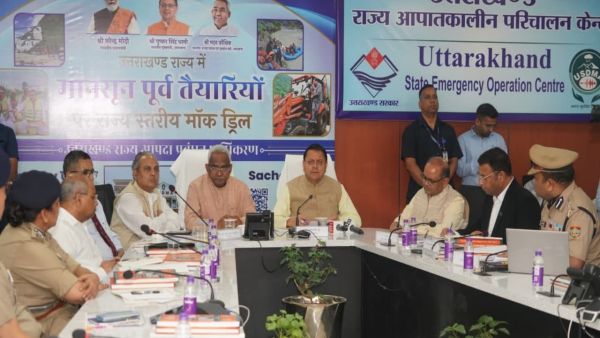
Uttarakhand Chief Minister Pushkar Singh Dhami on Thursday reviewed the State-level Pre-Monsoon Mock Drill at IT Park in Dehradun and issued directions to strengthen disaster preparedness across the hill state ahead of the monsoon season.

Addressing senior officials during the review, the Chief Minister stressed that in a disaster-prone Himalayan state like Uttarakhand, disaster management goes beyond routine administration and stands as one of the government's top priorities. He underlined that effective preparedness, quick and decisive response, strong inter-departmental coordination, and optimal use of modern technology are essential to deal with potential monsoon-related emergencies.
Describing the state-level mock drill as an important exercise to further reinforce the disaster management system, Dhami said it should not be treated as a routine drill but as a comprehensive mechanism to evaluate coordination among departments, communication systems, availability of resources, and operational readiness of rescue and relief agencies. He directed officials to focus equally on relief and rescue operations as well as risk reduction, preparedness, and technology-driven disaster management.
The Chief Minister highlighted that the state is actively integrating advanced technologies such as AI-based early warning systems, digital monitoring platforms, drone surveillance, GIS mapping, satellite-based monitoring, and data-driven risk assessment tools into its disaster management framework. He said these systems are aimed at identifying potential threats in advance and minimising loss of life and property. He further informed that Rapid Response Teams have been strengthened to ensure swift action during emergencies, while the Early Warning System is being continuously upgraded to ensure timely alerts reach even remote and vulnerable areas of the state.
Emphasising environmental conservation, the Chief Minister said the government is also undertaking initiatives such as water source conservation, glacier studies, plantation drives, environmental protection programmes, and public awareness campaigns to safeguard the fragile Himalayan ecosystem, adding that environmental protection remains a key pillar in reducing disaster risks.
The Chief Minister observed that Uttarakhand's disaster response mechanism has shown scientific planning, effective use of modern technology, prompt decision-making, and strong teamwork. He instructed officials to carefully analyse the lessons learned and shortcomings identified during the mock drill and directed all 13 districts to submit detailed review reports to the Uttarakhand State Disaster Management Authority within 72 hours. He also called for large-scale public awareness campaigns to educate citizens about disaster safety protocols, emergency helpline numbers, and essential precautionary measures.
Reiterating the government's long-term vision, Dhami said the objective is not only to provide relief after disasters but also to minimise disaster risks, safeguard lives and property, and establish Uttarakhand as a leading model in technology-driven and community-based disaster management in the country. He urged all stakeholders to work in coordination through preparedness, modern technology, effective communication, and public participation to achieve this goal.
On the occasion, the Chief Minister also released the Uttarakhand State Disaster Management Plan (SDMP) and District Disaster Management Plans (DDMPs) for all 13 districts of the state. He said the SDMP clearly defines the roles, responsibilities, and coordination framework of various departments for disaster risk reduction, preparedness, early warning, relief, rescue, rehabilitation, and reconstruction at the state level.
The DDMPs, he added, provide district-specific action plans based on local conditions, hazard profiles, available resources, and emergency response mechanisms, enabling district administrations to respond in a more structured and coordinated manner. Prepared under the Disaster Management Act, 2005, these plans will act as key guiding documents to improve coordination, integrate modern technologies, strengthen early warning systems, promote community-based disaster management, and ensure faster and better-planned response during emergencies.
The Chief Minister also visited an exhibition showcasing modern rescue and relief equipment displayed by the State Disaster Response Force, National Disaster Response Force, and the Fire Services Department. He was briefed on the functioning, utility, and deployment of the equipment during disaster situations.
A key attraction at the exhibition was advanced CBRNE (Chemical, Biological, Radiological, Nuclear and Explosives) response equipment displayed by the NDRF. Other specialised equipment showcased included deep diving sets, night vision cameras, thermal imaging devices, hydraulic cutters, underwater communication systems, underwater drones, sonar systems, and several other state-of-the-art rescue and relief technologies used in disaster response operations across difficult terrains. (ANI)
(Except for the headline, this story has not been edited by Asianet Newsable English staff and is published from a syndicated feed.)