The Food Safety and Standards Authority of India (FSSAI) has taken a major action against the food and beverage industry, which has created a stir in the market. FSSAI has issued notices to a total of 14 companies in the last few days. These include 8 companies which were making misleading claims in the names and advertisements of their food products, while there were 6 big brands which were misleading customers in the name of energy drinks. This action is an indication that the regulator is no longer in a mood to make any compromise on food safety and transparency in advertisements. Only after this action, discussion on popular energy drinks has started in India. Let us tell you what is the business of energy drinks in India and the global market and also know what are the rules of FSSAI which food companies are required to follow.
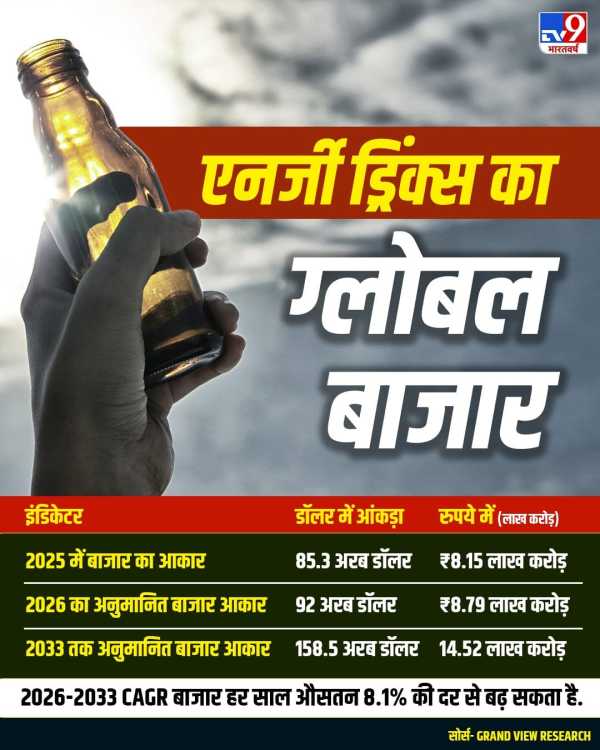
The energy drink market in India has grown rapidly in the last decade. In today's fast-paced life, where people want more productivity in less time, energy drinks are seen as a 'quick fix'. From multinational companies to local brands, everyone is racing to take advantage of this increasing demand. However, this business stands not only in the name of energy, but on the basis of attractive packaging and aggressive marketing. The business of energy drinks is very big worldwide and is growing rapidly. According to Grand View Research, the value of this industry is currently around 85 to 92 billion dollars i.e. approximately Rs 8.1 to 8.8 lakh crore. It is estimated that by 2033 it will increase to 158 billion dollars, i.e. more than Rs 15.1 lakh crore.
If we talk about the energy drinks market in India, then there is a report by Mordor Intelligence on this, according to which, the country's energy drinks market is currently worth around 0.75 to 1.5 billion dollars i.e. around Rs 7,164 crore to Rs 14,328 crore. In Indian rupees this business is around Rs 0.07 to 0.14 lakh crore. The main reasons for this growth are the increasing youth population in cities, increasing awareness about fitness and health and the rapidly increasing gig and mobile workforce in big cities.
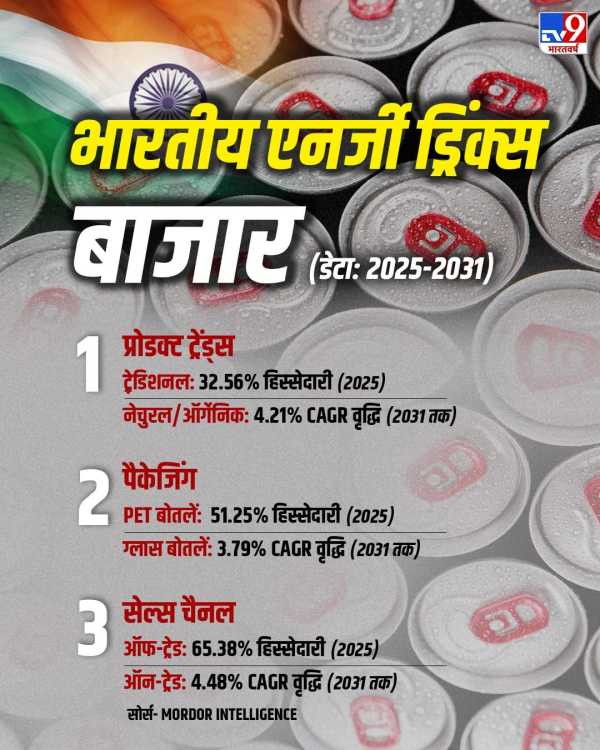
Product Segment-Traditional energy drinks will lead with 32.56% market share in the year 2025, while the business of natural and organic drinks is expected to grow at the rate of 4.21% CAGR till 2031.
Packaging Trend-PET bottles will hold 51.25% of the total market in the year 2025, while glass bottles have emerged as the fastest growing packaging format with a growth rate of 3.79% CAGR.
Sales Channel- Off-trade channels (stores/online) are expected to capture 65.38% of the market in 2025, while on-trade channels (hotels/bars/cafes) are set to grow rapidly at a CAGR of 4.48% by 2031.
The action taken by FSSAI now. In this, it has come to light that he did not follow some of the rules laid down by him. Along with this, let us also know the rules of FSSAI. FSSAI has made strict provisions under the 'Food Safety and Standards Act, 2006'.
Misleading advertisements and claims- No company can make such claims about its products which are not scientifically proven. For example, if a bread describes itself as 'zero flour', it should not contain even a trace of flour.
Medical and functional claims- Any food product has to obtain approval from the Food Safety and Standards Authority of India (FSSAI) before making claims like 'healing disease', 'boosting the brain' or 'providing instant energy'. In the case of energy drinks, claims like 'increasing focus' or 'increasing energy levels' are considered a direct violation of the rules without scientific evidence.
Labeling and naming- The name of any brand cannot be such that it may cause misunderstanding to the customers. For example, if a product has 'healthy' written in its name, it must actually meet health standards.
Vegan Certification- If a company calls its product 'vegan', then it is necessary to obtain a special license from FSSAI.
The food regulator is very strict about the rules. The result of this is that in the last 20 days, action has been taken against 14 big and renowned companies. While sending notices to 6 energy drinks companies, the food regulator said that the functional and therapeutic claims of many products do not appear to be true. It also said that claims like “refreshing body and mind”, “increasing focus”, “increasing energy level”, “helping in general weakness” are not valid for food products and are against the rules.
Earlier on June 14, 2026, the companies to which FSSAI sent notices included brands like Emami Healthy & Tasty, The Health Factory, Truvi, Healthy Master, Healthy Choice, Plan B and Newherbs. They are accused that their brand name and claims can mislead customers. For example, there were allegations of gluten being found in bread sold as 'zero flour' or of selling snacks with 'healthy' tag which did not meet the health standards.