The Government of India has achieved the target of mixing 20 percent ethanol (E20 Fuel) in petrol. But many types of questions have arisen regarding this on social media. People say that this will damage the engine of the vehicle. Or the mileage of the vehicle will reduce. Many people are also asking what other options we have besides normal petrol (91 octane), premium petrol (95 octane like XP95) and high-octane petrol and which petrol will be right for your vehicle. We are going to answer all these questions here.
Answer: No. However, the government has clarified that if E20 fuel is used for a long time in vehicles manufactured before 2023 (which are not BS6 Phase-2 or E20 compliant), then due to the chemical properties of ethanol, there may be a slight impact on the rubber pipes, plastic parts and fuel injectors of the vehicle. All vehicles manufactured after 2023 are completely safe for this.
Vikram Gulati, country head of Toyota Kirloskar Motor, says that performance does not deteriorate with E20, but acceleration and torque can be better because ethanol has a higher octane number. He also told that all the vehicles sold after 2023 are E20 compliant, while the vehicles before 2023 can also run on E20 without any major problem.
Answer: Yes, this is technically true. The energy density of ethanol is less than that of pure petrol. Due to this, there may be a slight reduction of 5% to 8% in the mileage of vehicles. However, the government is working to keep the price of ethanol mixed petrol under some control so that consumers are not burdened. According to Vikram Gulati, Country Head of Toyota Kirloskar Motor, the energy efficiency of ethanol in E20 is less than petrol. Therefore, mileage may decrease by about 4-5%.
Answer: This is a completely misleading claim (Afwaah) spread on social media. The government has made it clear that ethanol is definitely made from sugarcane or grains, but after distillation and refining, there is no trace of sugar left in it. There is no scientific basis for ants coming into it due to the pungent smell of petrol.
Answer: Not at all. Automobile companies and insurance companies have clarified that using government authorized fuel does not have any negative legal impact on the vehicle warranty or insurance claim.
Answer: A natural question of the public is that when ethanol is cheap and it is reducing the mileage, then why is the price of E20 petrol the same as that of normal petrol? People demand that the price of fuel should be reduced. Although the government has reduced the central excise duty on E22-E30 (blends with high ethanol content) to zero, the prices of E20 petrol currently sold at the pumps will remain the same. But fuel with high ethanol blend (like E85) is cheaper than normal petrol by about Rs 20 per liter.
Answer: No, most premium petrol also contains ethanol. Under the mandatory rules of the Government of India, up to 20% ethanol (E20) is being mixed in most of the premium petrol along with ordinary petrol sold in the country. If you go to a petrol pump and fill premium petrol like XP95 (Indian Oil), Power 95 (HPCL), or Speed (BPCL), these also contain about 20% ethanol. The only difference between ordinary petrol and this premium petrol is the octane number and cleaning additives. Premium petrol prevents carbon accumulation inside the engine and gives better pickup to the vehicle, but it also contains ethanol. In India, only 100-octane super premium petrol (like Indian Oil's XP100 or HPCL's Power 100) are completely ethanol-free (E0).
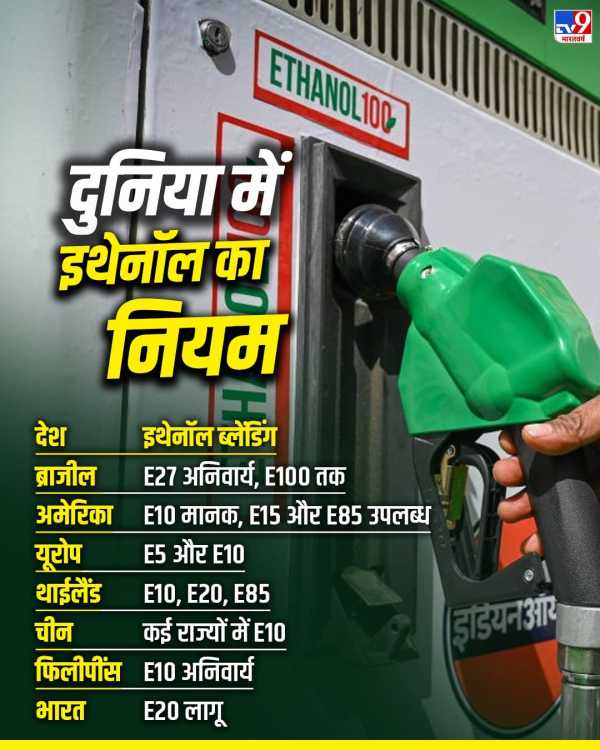
Answer: Brazil leads the world in terms of ethanol blending. Here it is mandatory to mix at least 27% ethanol (E27) in normal petrol. More than 80% of the vehicles are flex fuel, which can also run on 100% ethanol (E100). America is the world's largest ethanol producer. E10 is the standard petrol here, while E15 and E85 are also available for flex fuel vehicles. Talking about the European Union, E5 and E10 petrol is used in most of the countries here. Besides, it is also mandatory to keep petrol available with less or no ethanol for old vehicles. Talking about Asian countries, E10, E20 and E85 are available in Thailand. E10 blend is mandatory in many states of China and the Philippines.
Answer: According to government data, this policy has brought major benefits to the country:
Answer: In response to these questions of the people, the government (Petroleum Ministry) says that the issue of engine damage due to E20 is not based on scientific facts. The Petroleum Minister has admitted that there may be a slight (very small) reduction in mileage, but it improves the performance and acceleration of the vehicle.
Answer: After the successful implementation of E20, the next step of the government is to rapidly launch Flex-Fuel vehicles in the market. In the future, such vehicles will come which will be able to run on 85% to 100% ethanol (E100), which will almost eliminate the country's dependence on petrol.