
If the biggest threat of war in future is drones, missiles and high-tech weapons, then India has also started preparations to deal with them. The Defense Ministry has approved defense procurement worth Rs 52 thousand crore, through which the three armies will get many new indigenous weapons and state-of-the-art systems. 'Akash Tarang' will neutralize enemy drones in the air itself, while 'Psudo Satellite' will keep a 24-hour watch on the borders. Let us understand in simple language how this decision will change the strength of the Indian Army.
The wars in Russia and Ukraine as well as the conflicts in the Middle East have shown that drones have become the biggest weapon of war today. These low cost drones can cause huge damage to the enemy. Even on the western border of India, incidents of arms smuggling, sending narcotics and espionage through drones have been continuously coming to light. In view of this threat, the Defense Ministry has approved the Akash Tarang Anti UAV Electronic Warfare System for the Indian Army.
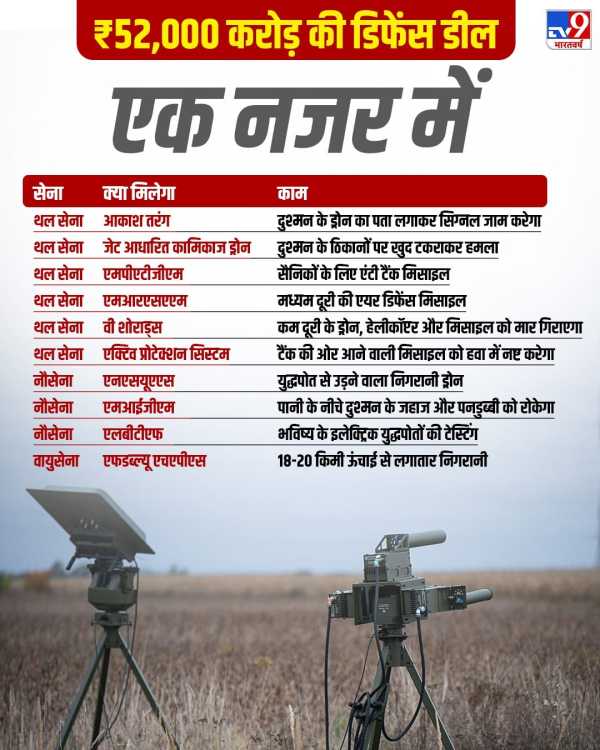
Akash Tarang will detect the enemy drone from a long distance and jam its communication and navigation signals. Due to this the drone will lose its way and will be neutralized in the air without any missile or firing. This system will act as a protective shield for the Indian soldiers and posts deployed on the border. Along with this, the army will also get jet based Kamikaze drone system. It will not just monitor like a normal drone, but will hit the enemy base like a missile and destroy it. Since it has jet technology, its speed will also be higher. This will give the army the ability to carry out more accurate and lethal attacks at lower cost.
Indian Army will get Man Portable Anti Tank Guided Missile System to deal with enemy tanks and armored vehicles. This is a completely indigenous missile, which soldiers can easily carry with them. If needed, it can accurately target and destroy the enemy tank. This will significantly increase the firepower of the soldiers deployed on the front. Medium Range Surface to Air Missile System and V Shorads Air Defense System have also been approved for protection from air attacks. MRSAM will intercept air threats coming from a distance, while V Shorads will be able to rapidly destroy aircraft, helicopters, drones and missiles coming at short ranges.
This system is equipped with multi spectral sensing technology. This means that even if the enemy tries to confuse it electronically, it can still identify its target and attack. Active Protection System has also been approved for the protection of Indian tanks on the battlefield. This technology detects the missile or shell coming towards the tank in advance and destroys it in the air. With this the tanks will be safer and will be able to remain in battle for a longer time.
Indian Navy will also get many new technologies in this defense package. Naval Shipborne Unmanned Aerial System will be purchased to strengthen surveillance in the Indian Ocean region. These modern drones will fly directly from the warship and keep a round-the-clock surveillance over a large area of the sea. With this, the Navy will be able to get advance information about enemy activities. Navy will also get Multi Influence Ground Mine. This is a modern tunnel laid under water. When an enemy ship or submarine approaches it, it will detect its magnetic, sound or pressure signal and explode. This will help in stopping the movement of enemy ships in the Indian maritime border.
Keeping in mind the future warships, a land based testing facility will also be created for testing the electric propulsion system. With this, India will be able to develop modern warships with completely electric technology.
Indian Air Force will get modern technology like Fixed Wing Based High Altitude Pseudo Satellite i.e. FW HAPS. This will not be a conventional satellite but an unmanned aircraft, which can fly continuously for several weeks or months at an altitude of about 18 to 20 kilometers high above the clouds.
This system will help the Air Force in continuous intelligence, surveillance, reconnaissance, telecommunication and remote sensing. This is a cheaper option than traditional satellites and will be able to do real-time monitoring of every enemy activity on the borders.
This approval received from the Defense Ministry is currently an acceptance of necessity. After this, the process of tender and field trials will start for the purchase of all these weapons and systems. This defense package of Rs 52 thousand crore is not just a plan to buy new weapons, but also a strategy to prepare the Indian forces for future wars. From Akash Tarang to pseudo satellites, all the technologies show that India is now moving rapidly towards modern, digital and indigenous defense systems. This will increase the strength of the army, reduce dependence on foreign weapons and the country's borders will be more secure than before.