Can you really build a house on sand? Well, you can, but it is futile. And that is exactly what has happened with Dream11.
The erstwhile RMG giant ventured into fintech after the Promotion and Regulation of Online Gaming Act, 2025, was passed in August 2025. The downfall of real-money gaming was on the anvil, and the industry players were busy finding their respective lifeboats. While some chose casual gaming and microdrama, Dream Sports chose to offer mutual funds, digital gold, fixed deposits, and loans. It later forayed into stockbroking with DreamStreet.
What surprised everyone was that the fantasy sports startup, running on life support, somehow thought of locking horns with giants like Zerodha and Groww. And, of course, the announcement came as a surprise.
On paper, the logic seemed compelling. After all, Dream11 had one of India’s largest internet user bases, particularly outside tier I cities. If RMG were headed for its judgement day, millions of users who already trusted the platform with money, payments and daily engagement could, in theory, become first-time investors. But something really did not add up.
Dream Sports is calling time on Dream Money. Its bold pivot into wealthtech is over. But the question is: was it ever destined to succeed? Let’s find out in this edition of The Outline…
Building The Future Or Buying Time?Dream Sports will pull the plug on its wealthtech play on July 30. Existing customers have been assured that their investments remain safe because they are held with partner institutions.
Users can redeem digital gold until July 15 before holdings are migrated to Augmont. Mutual funds can be redeemed until July 30 through the platform and thereafter will be held directly with respective asset management companies. Partner banks will continue to hold FDs. Loan servicing has already stopped. New customer registrations, fresh investments and new loan applications have all been suspended, while SIPs will automatically be cancelled starting July 7.
As Dream Money begins winding down, it is worth asking why it mattered in the first place. And what were the biggest challenges for a company diversifying from another sector?
Dream Sports’ fintech foray was supposed to be the company’s most ambitious diversification move. While Dream Money was to become the customer’s personal wealth manager, DreamStreet was seen as an investment platform that would compete with incumbents Zerodha, Groww and Dhan by simplifying financial decision-making with AI.
“Dream11’s user base overlaps significantly with the demographic that fintech companies have spent years trying to acquire. Users are digitally comfortable, already make online payments, and are increasingly located in tier II & III cities where financial penetration remains relatively low. On paper, cross-selling financial products made so much sense,” a senior executive at a wealthtech platform said.
Plus, the company also needed to diversify. By early 2025, senior leadership had become increasingly concerned about Dream11’s overwhelming dependence on fantasy cricket. Fantasy sports generated the overwhelming majority of revenue. It also concentrated virtually all regulatory, taxation and legal risk into one business.
As GST scrutiny intensified and uncertainty around retrospective taxation mounted, internal conversations shifted toward identifying entirely new revenue streams.
“Viewed through that lens, wealth management appears logical. Financial services operate on a fundamentally different currency than gaming. They operate on trust. Consumers don’t simply download an investment app because it has millions of users. That requires a different level of credibility,” the executive added.
Dream Sports had built expertise around prediction engines, engagement loops, gamification and personalisation. Those capabilities undoubtedly transfer into creating compelling consumer experiences. But asking consumers to view a fantasy gaming company as their long-term wealth manager required an enormous leap.
In hindsight, another interpretation looks increasingly plausible. The wealthtech push may have served multiple purposes simultaneously. While management saw a genuine opportunity in the segment, it also bought them time, kept product teams busy and provided employees with a growth narrative. It reassured investors that the company wasn’t sitting idle while legal battles unfolded.
Most importantly, it created optionality. If regulatory conditions improved, Dream11 could continue expanding fantasy sports while gradually building adjacent businesses. If they didn’t, at least alternative businesses would already exist.
But The Dream isn’t Over YetSaying that Dream Sports is in trouble would be inaccurate. The company remains financially strong, and it is only moving away from businesses that are not working to focus on areas where it has the best chance of winning.
Summing up the current state of Dream Sports, a senior industry executive said, “The reason Dream11 still stands today while most of its competitors have faded is its ability to run lean.”
Unlike several gaming startups that aggressively expanded during the boom years, Dream Sports largely avoided excessive cash burn, which allowed it to survive an industry-wide collapse without existential financing concerns.
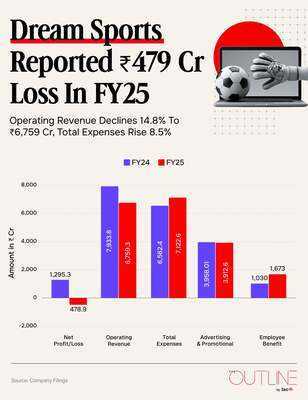
However, for FY25, Dream Sports reported a net loss of ₹478.9 Cr compared to a profit of ₹1,295.3 Cr a year ago. Much of that loss stemmed from an exceptional expense of ₹503.7 Cr related to taxes paid during its reverse flip back to India, where its US parent merged into Sporta Technologies.
Operating revenue declined nearly 15% YoY to ₹6,759 Cr from almost ₹7,934 Cr previously. Including other income of ₹615 Cr, total income stood at ₹7,374 Cr. But it is important to note that the RMG ban came into effect in FY26, and we don’t know the exact measure of financial impact yet.
Moreover, Dream Sports quietly shut FanCode’s sports merchandise business. That vertical had struggled with persistent commercial viability issues. As of now, Dream Sports appears increasingly willing to abandon businesses that fail to demonstrate clear strategic or financial potential. It also shut down its AI-powered sports performance analytics app Dream Play last month.
Its portfolio is still substantial — FanCode continues to operate as a sports streaming platform; DreamCricket represents its push into AAA gaming, and then it has its investment platform DreamStreet.
But none of them has been able to match the scale of fantasy sports. “The shutdown of Dream Money says as much about the limits of corporate reinvention as it does about wealthtech. For years, Indian startups have operated under the assumption that large consumer internet companies can endlessly leverage distribution into adjacent sectors,” a fintech investor said.
Looking ahead, the company’s strategy may become considerably narrower. Rather than chasing unrelated adjacencies, it is likely to double down on businesses where its competitive advantages remain strongest — sports content, gaming infrastructure, fan engagement and sports technology. So, even though Dream Money may be shutting down, Dream Sports’ story is far from over. Where does it turn to next?
[Edited by Shishir Parasher]
The post Dream 11’s Wealthtech Fantasy Is Over appeared first on Inc42 Media.